
Key Highlights
- Greek art focused on idealized forms, while Roman art leaned toward realistic portrayals of people and events.
- The traditions of ancient Greek art heavily influenced Roman artists, who often copied Greek masterpieces.
- A major difference is seen in sculpture, where Greek sculpture celebrated perfect bodies and Roman sculpture captured individual flaws.
- Cultural values shaped artistic goals in ancient Greece and Rome, from mythological idealism to political propaganda.
- Greek artists often created art to honor gods, whereas Roman artists focused on glorifying the state and its emperors.
When we walk through the hallowed halls of the Louvre or the Met, it is almost impossible not to be struck by the sheer presence of Classical antiquity. For centuries, the sculptures and structures of ancient Greece and Rome have stood as the gold standard for beauty, power, and technical skill. While they are often lumped together under the umbrella of “Classical Art,” the truth is that they represent two very different ways of seeing the world. One was obsessed with the “perfect” human, while the other was obsessed with the “real” human. This guide will walk you through the fascinating tug-of-war between Greek idealism and Roman pragmatism.
Why Do We Compare Them?
Greek and Roman art are the two pillars upon which Western aesthetics were built. By understanding their differences, we gain a clearer view of how art shifted from a tool for divine worship to a medium for political power.
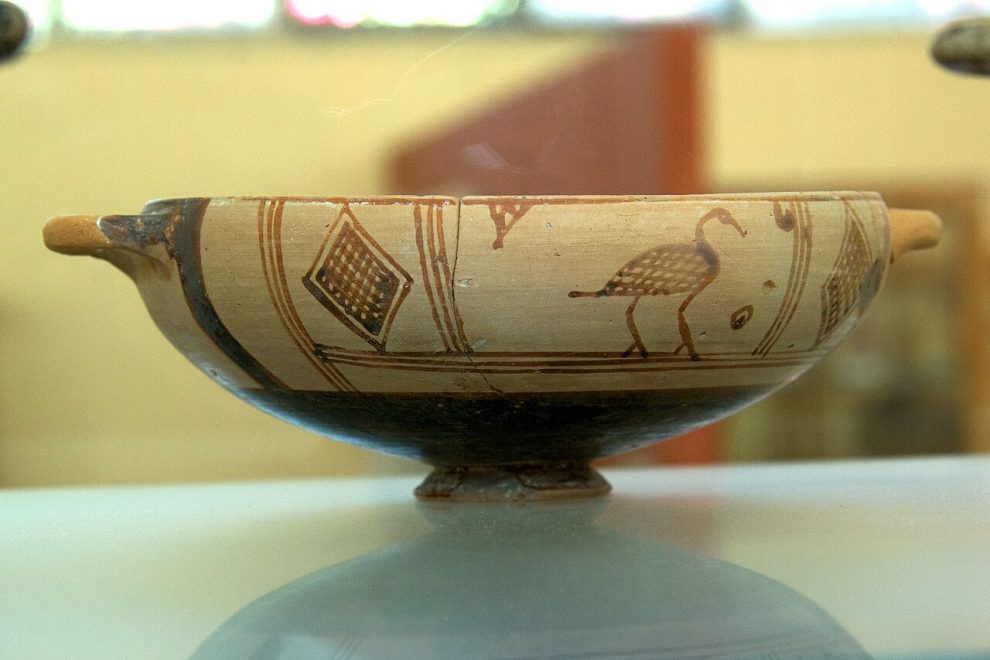
Photo by Zde, via Wikimedia Commons (CC BY-SA 4.0).
Origins of Greek and Roman Art Traditions
The artistic identities of Greece and Rome didn’t appear in a vacuum; they were the result of centuries of trial, error, and cultural exchange.
Historical Timeline of Greek Art Development
Greek art is usually divided into four main courses: the Geometric, Archaic, Classical, and Hellenistic periods. It began with stiff, Egyptian-style statues and evolved into the fluid, emotionally charged masterpieces of the later years. By the time of the “Golden Age” in the 5th century BCE, the Greeks had unlocked the secret to making stone look like breathing skin.
Historical Timeline of Roman Art Evolution
Rome started as a smaller player, heavily influenced by its Etruscan neighbors in Italy. However, as the Roman Republic expanded and eventually conquered Greece, they became enamored with Greek aesthetics. They didn’t just admire Greek art; they imported it by the shipload. Over time, they blended this Greek “look” with their own native interest in genealogy and history to create something uniquely Roman.
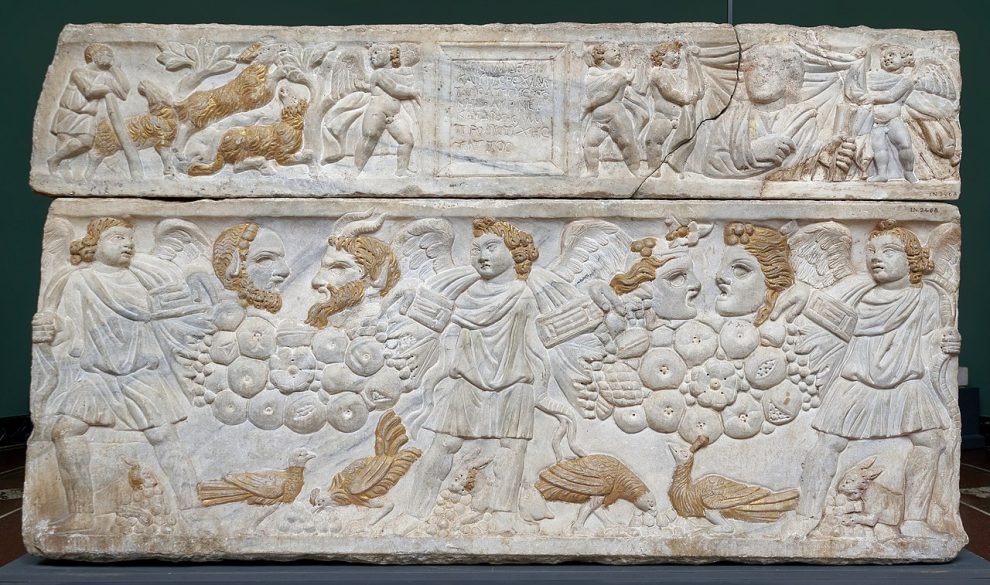
Photo by Jakub Hałun, via Wikimedia Commons (CC BY-SA 4.0).
Cultural Influences Behind Greek vs Roman Art
To understand the art, you have to understand what these people valued at their core.
Greek Mythology and Idealism in Art
For the Greeks, art was a quest for the “Ideal.” Influenced by mathematicians like Pythagoras, they believed that beauty was a reflection of mathematical proportions. Their gods were depicted as the peak of human fitness, youthful, athletic, and devoid of flaws. In their eyes, if a statue was perfect, it was closer to the divine.
Roman Realism and Political Propaganda
Rome was a civilization of lawyers, soldiers, and politicians. They valued authority and legacy. While the Greeks wanted to show what a human should look like, the Romans wanted to show what a leader actually looked like. This led to “verism”, a style that celebrated wrinkles, receding hair, and scars as badges of honor and experience.
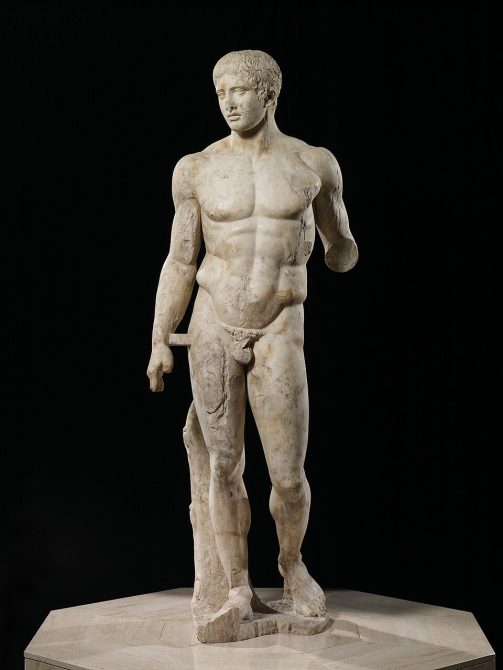
Minneapolis Institute of Art, via Wikimedia Commons (Public Domain).
Key Differences in Greek vs Roman Sculpture
This is where the differences become most visible to the naked eye.
Greek Idealized Human Form
If you look at a Greek statue, like the Doryphoros (Spear Bearer), you’ll notice a sense of calm and balance. The muscles are perfectly defined, and the face is serene. This is the “Canon of Proportions”, a set of rules ensuring that every limb is in perfect harmony with the rest.
Roman Realistic Portraiture
Contrast that with a Roman bust of a Senator. You see the crows-feet around the eyes and the stern set of the jaw. Roman art was often genealogical; these busts were used in funeral processions to prove the nobility and long history of a family. They wanted the character of the individual to shine through, not a generic version of beauty.
Use of Marble vs Bronze in Sculpture
The Greeks preferred bronze for their most important works because it allowed for more daring, open poses. Unfortunately, most Greek bronzes were melted down for weapons centuries ago. The Romans, on the other hand, loved marble. Most of the “Greek” statues we see in museums today are actually Roman marble copies of lost Greek bronze originals.
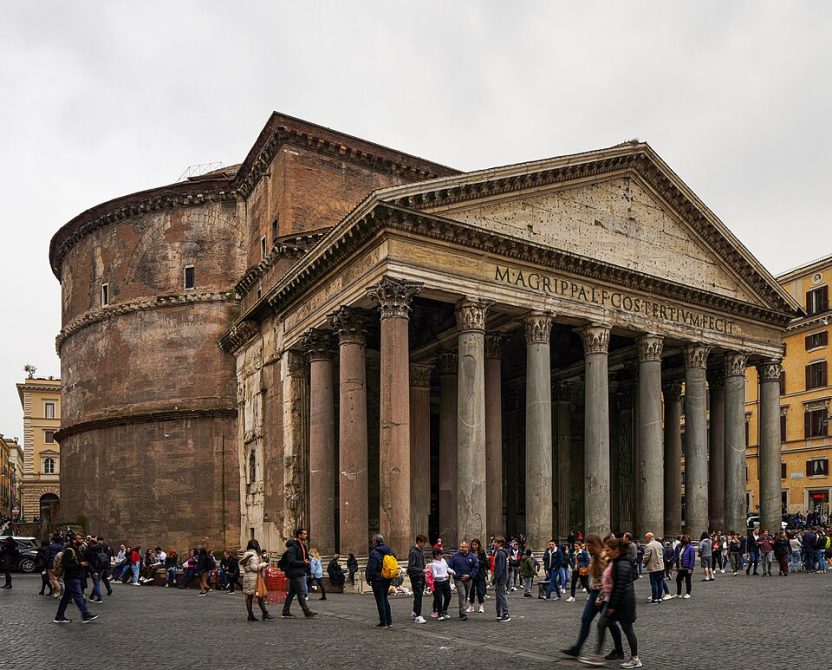
Photo by NikonZ7II, via Wikimedia Commons (CC BY-SA 4.0).
Architectural Styles in Greek and Roman Art
Both built impressive temples, but their goals were worlds apart.
Greek Architectural Orders
Greek architecture is defined by the “Order” of its columns. The Doric is sturdy and plain, the Ionic has elegant scrolls (volutes), and the Corinthian is lush with acanthus leaves. Their temples, like the Parthenon, were designed to be viewed from the outside, as monumental sculptures themselves.
Roman Engineering Innovations
The Romans were the world’s first great engineers. While the Greeks relied on “post-and-lintel” (vertical posts holding up a horizontal beam), the Romans mastered the arch, the vault, and the dome. Most importantly, they invented concrete. This allowed them to build massive indoor spaces, like the Pantheon, that didn’t need a forest of columns to hold up the roof.
Temple vs Monumental Building Functions
Greek temples were the “homes” of the gods, usually reserved for priests. Roman architecture, however, was civic. They built bathhouses, amphitheaters, and basilicas meant to hold thousands of citizens. For Rome, architecture was a way to manage, and impress, the public.
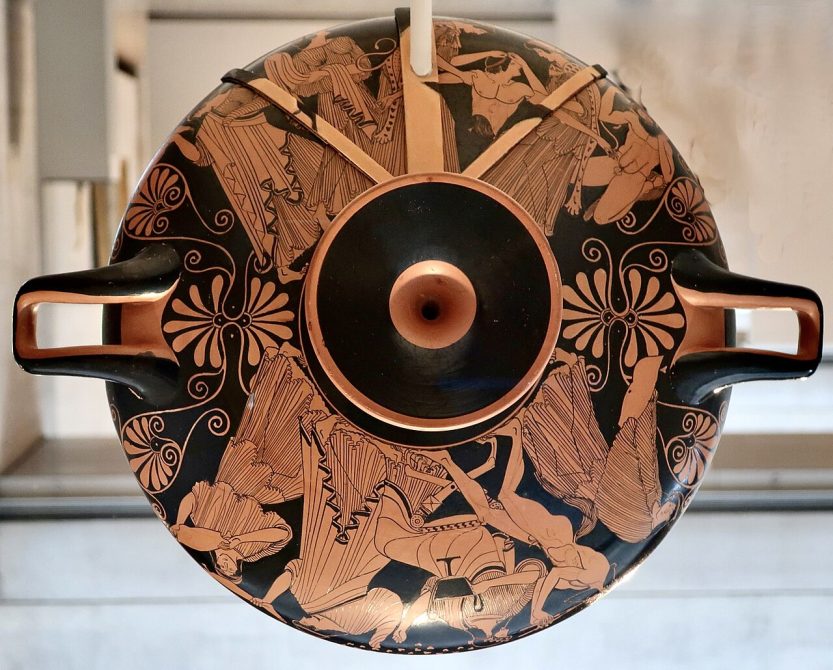
Photo by Wmpearl, via Wikimedia Commons (CC0 1.0).
Painting and Decorative Arts in Greece and Rome
While much of the ancient world’s painting has been lost to time, what remains is breathtaking.
Greek Vase Painting Styles
Since Greek wall paintings are almost all gone, we look to their pottery. The Black-figure and Red-figure styles tell incredible stories of heroes and gods. These vases weren’t just for decoration; they were high-end commodities traded all over the Mediterranean.
Roman Frescoes and Wall Paintings
Thanks to the eruption of Mount Vesuvius, the homes of Pompeii and Herculaneum were frozen in time. Roman frescoes show a sophisticated use of perspective and “trompe l’oeil” (trick of the eye) to make small rooms feel like they had windows looking out onto lush gardens or grand architecture.
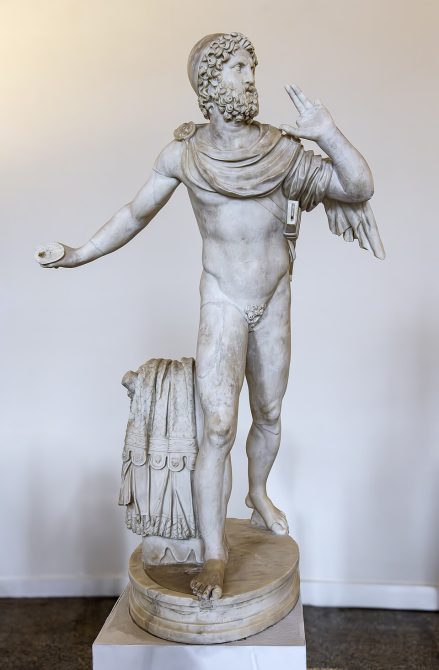
Photo by Didier Descouens, via Wikimedia Commons (CC BY-SA 4.0).
Techniques and Craftsmanship in Classical Art
How did they make stone look so real?
Greek Canon of Proportions
Polykleitos, a famous Greek sculptor, literally wrote the book on this. He believed that the secret to beauty was a ratio, specifically, that every part of the body should be a multiple of the pinky finger or the palm. This mathematical precision is what gives Greek art its timeless, “just right” feeling.
Roman Adaptation and Copying of Greek Works
The Romans were the ultimate curators. They admired Greek style so much that they set up workshops to mass-produce copies of Greek statues. However, they often “Romanized” them by placing a Roman general’s head on a body modeled after a Greek god.
Photo by Mark Landon, via Wikimedia Commons (CC BY 4.0).
Shared Similarities Between Greek and Roman Art
Despite their differences, they are two sides of the same coin.
Human-Centered Artistic Focus
Both cultures put the human being at the center of the universe. Unlike the stylized art of Egypt or Mesopotamia, Greco-Roman artists focused on how the body moves, how skin folds over muscle, and how facial expressions convey emotion.
Influence on Western Art History
Without these two traditions, there would be no Renaissance. Artists like Michelangelo and Da Vinci spent their lives trying to rediscover the techniques the Greeks and Romans had mastered 1,500 years earlier.

Photo by Jebulon, via Wikimedia Commons (CC0 1.0).
How Greek vs Roman Art Influenced Modern Culture
Their legacy isn’t stuck in a museum; it’s all around us.
Neoclassical Revival in Europe and America
Look at the U.S. Capitol or the British Museum. The white marble, the grand columns, and the sense of symmetry are all direct nods to the Classical world. In the 18th and 19th centuries, architects used these styles to project a sense of democracy (Greek) and imperial stability (Roman).
Classical Motifs in Contemporary Design
Even today, the “heroic” imagery of athletes, the symmetry in high-end jewelry, and the clean lines of modern furniture often trace their DNA back to the workshops of Athens and Rome.
Conclusion
Understanding the difference between Greek and Roman art is like learning a new language. You begin to see that a statue isn’t just a piece of carved stone; it’s a statement of values. The Greeks gave us the dream of perfection, while the Romans gave us the reality of power. Together, they formed a visual language that we are still speaking today.
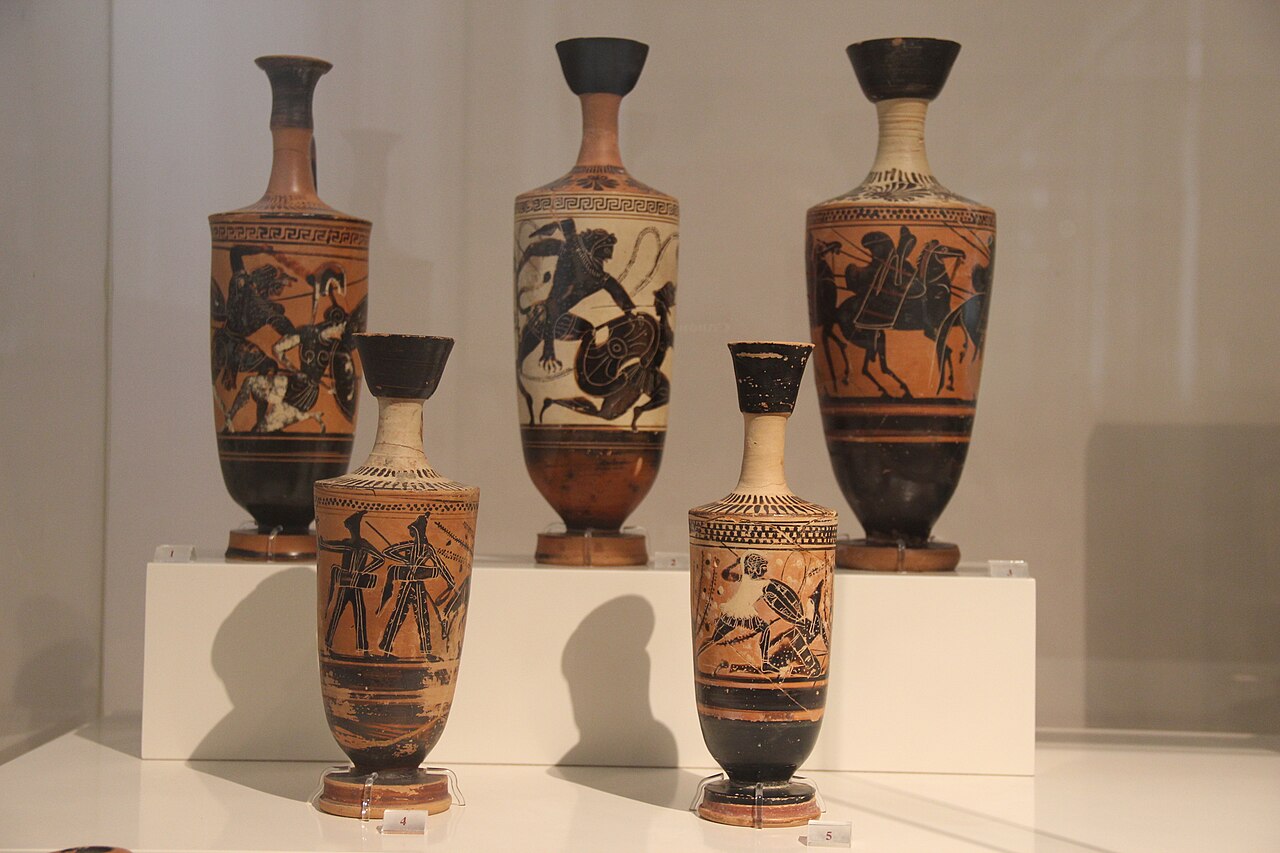
Featured image: Ancient Greek pottery lekythoi, National Archaeological Museum of Athens — photo by <a href=”https://www.flickr.com/people/101561334@N08″ target=”_blank” rel=”noopener”>Gary Todd</a>, <a href=”https://commons.wikimedia.org/wiki/File:Ancient_Greek_Pottery_Lekythoi_(28183971720).jpg” target=”_blank” rel=”noopener”>via Wikimedia Commons</a> (<a href=”https://creativecommons.org/publicdomain/zero/1.0/” target=”_blank” rel=”noopener”>CC0 1.0</a>).