
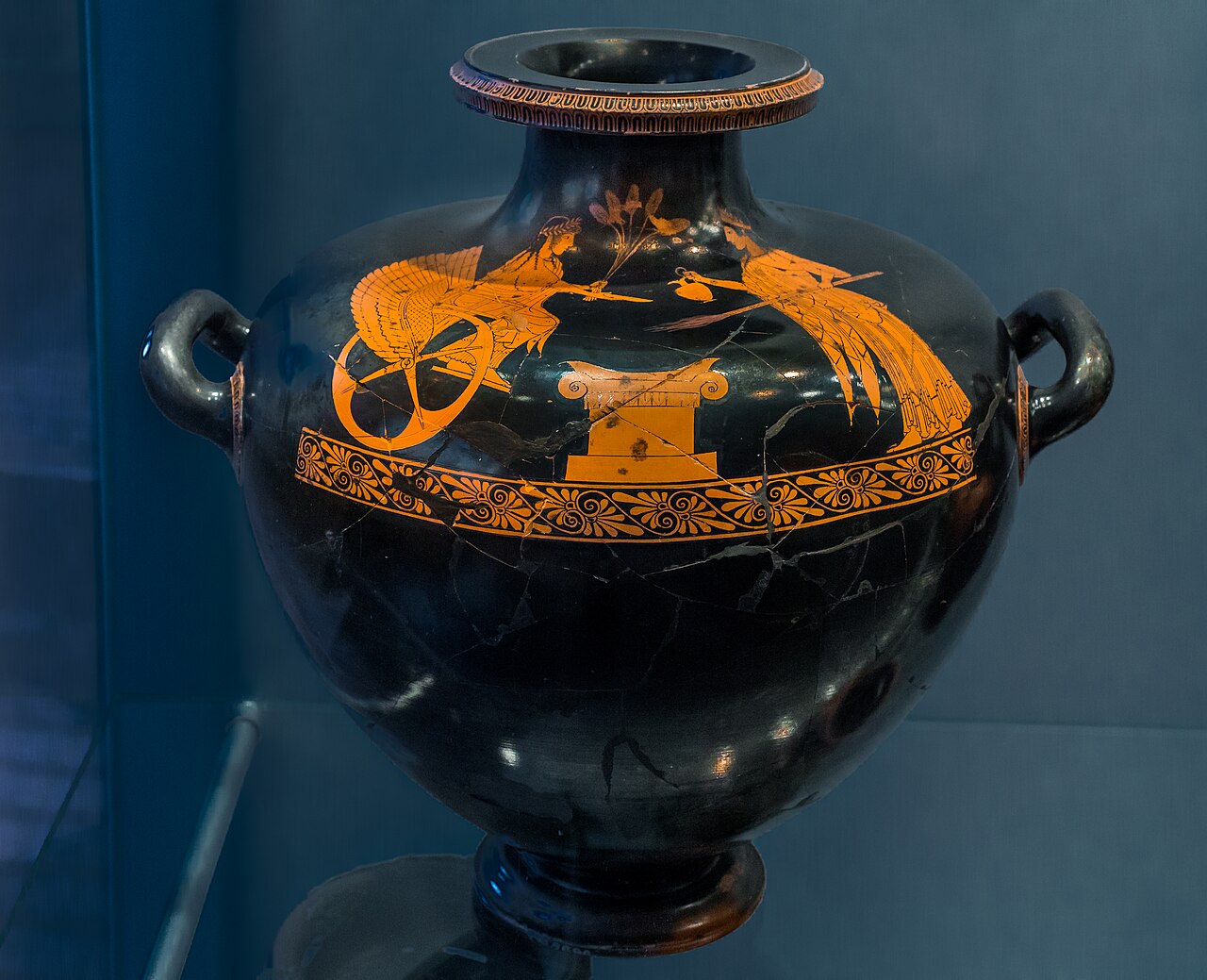
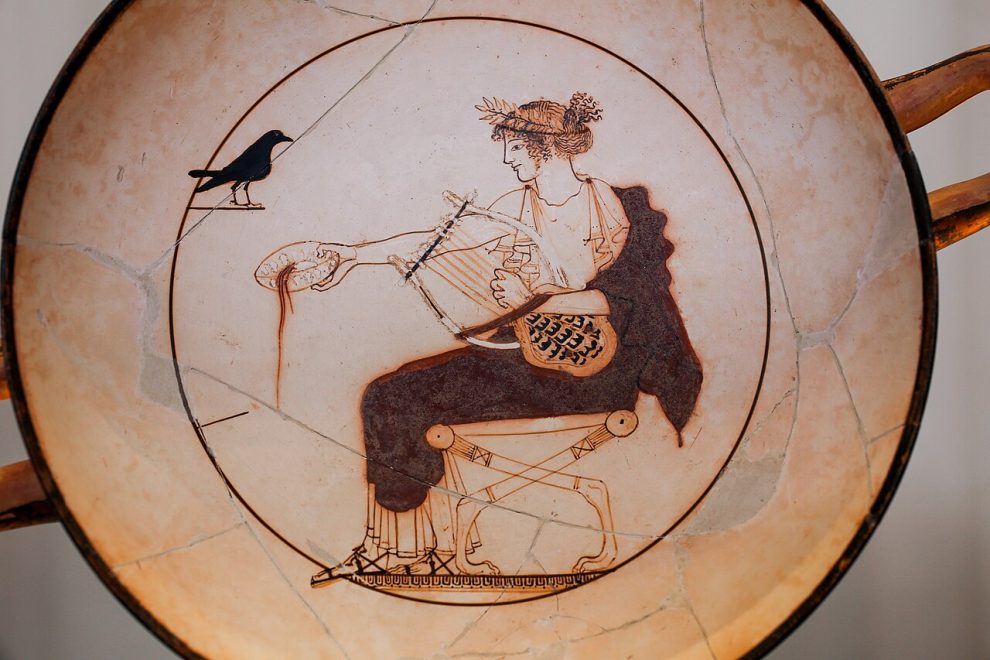
Attic white-ground kylix (Type B), attributed to the manner of the Berlin Painter: Apollo seated with a lyre, pouring a libation with a raven nearby (Delphi Archaeological Museum, inv. 8410). Photo by ArchaiOptix, via Wikimedia Commons, CC BY-SA 4.0 (no changes).

Key Highlights
- Discover the anonymous master of vase painting from Ancient Greece known as the Berlin Painter.
- His unique red-figure technique set him apart in Attic vase painting.
- The Berlin Painter’s work often features elegant, isolated figures on a striking black background.
- You can find his famous works in major museum collections, including a key piece in Berlin.
- His style greatly influenced later artists in Athenian vase painting.
- Scholars continue to study his impressive collection of surviving pieces.
The Berlin Painter is one of those rare figures in ancient art who feels instantly recognizable, yet we still don’t know his real name. Active in Athens as red-figure pottery moved from the late Archaic world into the early Classical one, he helped redefine what a painted vase could look like: calmer, cleaner, more deliberate, and surprisingly modern in its use of space.
In this guide, you’ll get a clear, practical understanding of the Berlin Painter, how scholars identify an anonymous hand, what makes his style so distinctive, which pottery shapes he favored (including the famous Berlin Painter amphora tradition), what subjects he returned to again and again, and where you can see standout Berlin Painter vase masterpieces today.
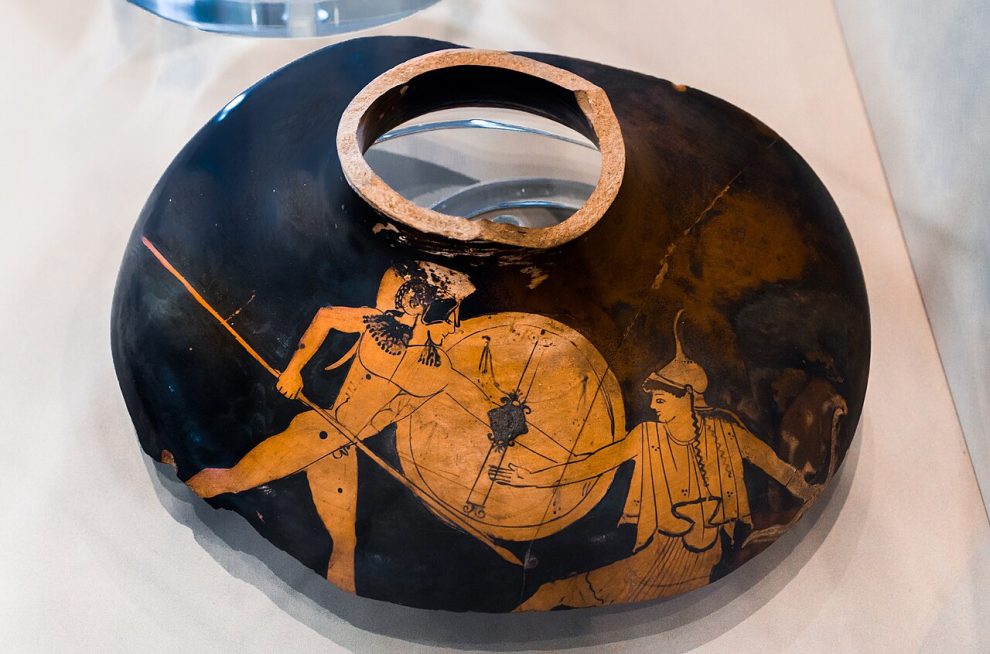
Attic red-figure kalpis (fragment), attributed to an imitator of the Berlin Painter: Achilles killing Penthesilea (ca. 490 BC), Museum der Universität Tübingen (MUT), inv. 64.1599. Photo by ArchaiOptix, via Wikimedia Commons, CC BY-SA 4.0 (no changes).

Who Was The Berlin Painter
Scholars use the Berlin Painter as the conventional name for an anonymous Attic (Athenian) red-figure vase painter, and they rank him among the most accomplished artists of his era. He worked roughly in the early 5th century BCE, and scholars have attributed more than 400 vases and fragments to his hand, an unusually large “known” output for an artist who never signed.
Writers often discuss him alongside other star painters of the time (notably the Kleophrades Painter) because their work reveals how quickly Athenian taste and technique evolved.
When Did The Berlin Painter Work
Most sources place his active career around c. 490–460s BCE, which matters because it’s a hinge moment in Greek art: the last strong pulse of the late Archaic style and the early rise of a more Classical visual language.
In pottery terms, this is when red-figure (introduced in the late 6th century BCE) becomes the dominant, confident medium for figure painting, less crowded, more controlled, and increasingly interested in the body’s believable presence rather than decorative patterning. The Berlin Painter doesn’t just participate in that shift; he becomes one of the clearest case studies for how it happens on real objects people handled, stored, gifted, traded, and displayed.
Identifying An Anonymous Master
If you’ve ever wondered how anyone can say “this vase is by the Berlin Painter” when it isn’t signed, you’re not alone, and you’re asking the right question. The short version is that attribution relies on patterns that are hard to fake consistently: the way an artist draws ankles, eyes, ears, fingertips, the rhythm of drapery folds, the spacing of compositions, and the habits of storytelling.
Over time, scholars grouped vases by “hands” (consistent stylistic signatures) and built an attribution tradition that’s still refined today. The Berlin Painter is a classic example because his work is so internally consistent: once you learn what to look for, the family resemblance becomes persuasive.
Why Some People Search “Painter Berlin”
You’ll sometimes see “Painter Berlin” in searches, but it’s basically a word-order flip, not a different person. “Berlin Painter” is a modern label, one of many scholarly nicknames used when an artist’s real identity is unknown. The name typically comes from a key object (“name vase”) associated with a museum or collection, which then becomes a convenient handle for talking about that painter’s wider body of work.
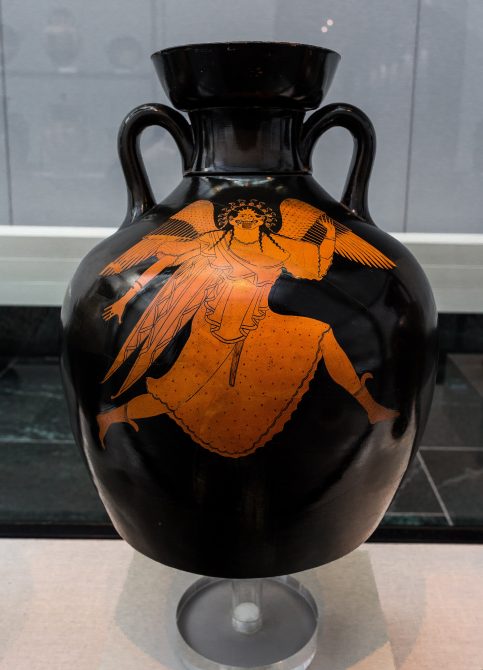
Attic red-figure amphora (Panathenaic shape), attributed to the Berlin Painter: running Gorgon pursuing Perseus (Staatliche Antikensammlungen, Munich, inv. 2312). Photo by ArchaiOptix, via Wikimedia Commons, CC BY-SA 4.0 (no changes).
.jpg)
The Berlin Painter Style
What makes the Berlin Painter so compelling is not flashy complexity, it’s discipline. His vases often feel like someone turned down the background noise so the main figure can finally breathe. Instead of filling every inch with ornament, he builds a composition around a single figure or a tight pair, then lets the surrounding dark field do real visual work.
That restraint is exactly why his figures can feel “quietly monumental.” They don’t need a crowd of secondary details to look important; the pose, contour, and placement carry the weight.
Isolated Figures On A Glossy Black Ground
One of his signatures is the dramatic isolation of figures against a glossy black background, with minimal framing elements. On many works, you get one main character, carefully centered, with just enough attributes, an instrument, a staff, a wreath, to tell you who you’re looking at and why they matter.
This approach can feel almost cinematic: the negative space becomes a spotlight. And because he’s so controlled with contour lines and drapery, the figure reads crisply even from across a room, exactly what you’d want if a vase was meant to be seen, not just used.
Shapes And Repertoire
The Berlin Painter didn’t limit himself to one vessel type, but certain shapes clearly suited his aesthetic better than others. He painted amphorae, hydriai, kraters, and smaller forms such as oinochoai and lekythoi, each with different functions in daily life, ritual, or social settings.
A quick way to think about it: shape affects storytelling. A tall vase gives you vertical presence and elegant silhouette; a wide bowl invites movement around the curve; an oil flask asks for intimacy and precision. The Berlin Painter understood those constraints and made them feel like strengths.
Amphorae And The Rise Of The Nolan Amphora
If you’re hunting for the phrase Berlin Painter amphora, this is why it comes up so often: amphorae let him do what he does best, balance, poise, and a strong figure that feels intentional rather than busy.
Hydriai, Kraters, Lekythoi And Smaller Forms
Beyond amphorae, he painted hydriai (water jars), kraters (mixing bowls for wine and water), and smaller shapes like jugs (oinochoai) and lekythoi (oil bottles). Even when the format changes, the logic stays consistent: a clear focal figure, elegant spacing, and lines that feel purposeful rather than decorative.
For readers who want to recognize a Berlin Painter vase in the wild, this matters: you’re not only looking at amphorae. You’re looking for a specific kind of compositional confidence across many shapes.
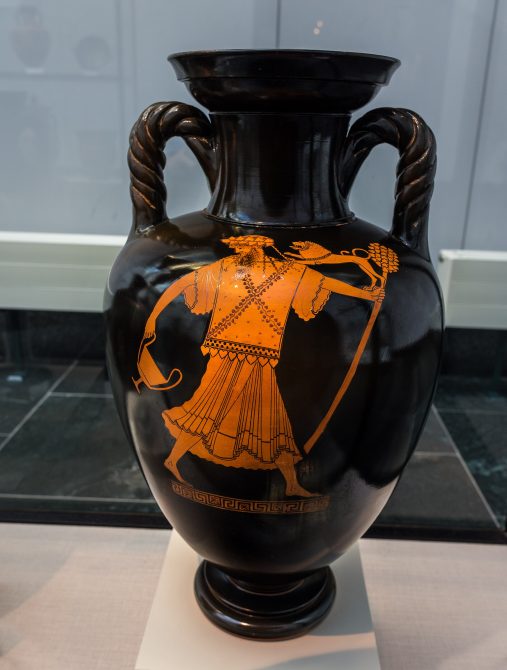
Attic red-figure neck-amphora with twisted handles, attributed to the Berlin Painter: Dionysos with kantharos, lion and thyrsos (Side A) and a satyr with wineskin (Side B), Staatliche Antikensammlungen, Munich, inv. 8766. Photo by ArchaiOptix, via Wikimedia Commons, CC BY-SA 4.0 (no changes).
.jpg)
Subjects And Iconography
The Berlin Painter’s subjects range across myth, ritual, athletics, and music, and he repeatedly returns to major gods and heroic narratives. What stands out is how he communicates character with very little clutter. Instead of staging a full narrative scene with multiple figures, he’ll choose a single moment: a deity in motion, a musician in performance, a youth poised in a quiet action.
This selective approach can actually make the subject feel more “real,” not less, because the viewer fills in the wider story. You don’t get the whole myth spelled out; you get the distilled essence of it.
Berlin Painter Amphora In Berlin
The painter’s nickname comes from his “name vase,” an amphora in Berlin’s collection. The Berlin Painter was named by Sir John Beazley in 1911 after this vessel, which features Hermes and a satyr, an image that reflects both the painter’s crisp figure style and his interest in mythic personalities presented with unusual clarity.
Even if you never see this specific amphora in person, it functions like a reference point: when scholars say “Berlin Painter,” this is the anchor object that helped crystallize the identification of the hand and the larger attributed corpus.
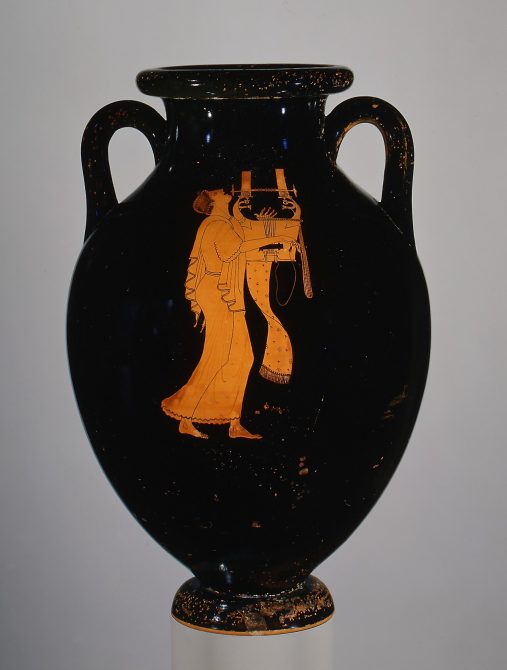
Terracotta amphora (jar), attributed to the Berlin Painter, ca. 490 B.C. (The Metropolitan Museum of Art, acc. 56.171.38). Open Access image (CC0) from The Met, via Wikimedia Commons — CC0 (no changes).
_MET_gr56.171.38.R.jpg)
Berlin Painter Vase Highlights In Major Museums
When you’re looking at a museum label that says “Attributed to the Berlin Painter,” focus on three quick checks:
Composition: Is the scene unusually uncluttered?
Figure presence: Does the main figure feel stable and intentional, not decorative?
Line quality: Are contours and drapery controlled and confident?
If all three click, you’re probably in Berlin Painter territory.
The Kithara Player Amphora At The Met
One of the most famous Berlin Painter works is the kithara player amphora associated with the Metropolitan Museum of Art. The Met’s object record identifies it as an Attic red-figure terracotta amphora, dated around ca. 490 BCE, and attributed to the Berlin Painter.
Why does it get singled out so often? Because it captures the Berlin Painter’s strengths in one glance: a musician rendered with dignity, an instrument that echoes the vessel’s curves, and a composition that feels both minimal and emotionally complete. Even without a crowded narrative, you understand the moment, performance, prestige, and poise.
Ganymede Bell-Krater And Other Star Pieces
Another frequently cited highlight is a bell-krater scene involving Ganymede, a mythic figure whose story appears in multiple Classical visual traditions. In Berlin Painter hands, these mythic subjects tend to be less about spectacle and more about presence: the figures read as psychologically legible, not just symbolically correct.
Across his “star pieces,” you’ll keep seeing the same choices: selective details, strong silhouettes, and the sense that the painter wants you to look at the human body, how it stands, turns, carries weight, rather than getting lost in ornamental noise.
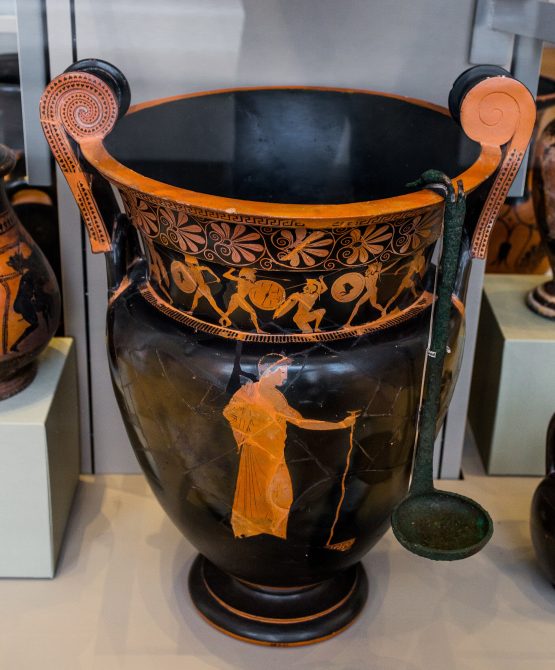
Attic red-figure volute-krater by the Berlin Painter (ca. 500–490 BC), Fitzwilliam Museum, Cambridge (inv. GR.5.1952): komast with kantharos and barbitos; youth in mantle; hoplites fighting on the neck. Photo by ArchaiOptix, via Wikimedia Commons, CC BY-SA 4.0 (no changes).
.jpg)
Workshop, Followers, And Legacy
The Berlin Painter didn’t work in isolation. He’s commonly discussed within a larger Athenian ecosystem of workshops, apprenticeships, and stylistic influence. Sources note his connections to earlier red-figure developments and his role in training or influencing younger painters over a long career.
His work also has a broader “afterlife”: archaeologists found many of his vases in Italy, reminding us that Athenian pottery traveled widely and earned value far beyond Athens.
Scholars and curators have renewed modern attention through research and exhibitions on his world and context, which explains why he still appears in academic writing and museum storytelling today.
Conclusion
If you take one thing away, let it be this: the Berlin Painter is a master of less. He builds power through restraint, isolated figures, confident contour, and compositions that treat empty space as a deliberate design choice, not an absence.