
Key Highlights
- Discover the stories behind ancient Greek pottery, artifacts that reveal details about daily life, mythology, and history.
- Learn why museums are crucial for understanding the evolution of Greek art, from the Geometric period to the Hellenistic era.
- Explore the world’s top museums for Greek vase painting, including spectacular collections in Athens, Malibu, and Boston.
- Get a quick guide on how to “read” a Greek vase, understanding shapes like the amphora and the meaning behind their designs.
- Find out which ancient Greek pottery museums you should visit first, whether you’re traveling to Greece or staying closer to home.
Overview
There’s a particular kind of quiet that settles over you when you stand in front of an ancient Greek vase. The painter has been dead for two and a half thousand years, and yet the figures moving across the clay, athletes mid-stride, gods locked in argument, a woman pouring wine at a symposion, feel immediate. Alive, somehow. That’s what good storytelling does, and Greek pottery is among the oldest visual storytelling we have.
Ancient Greek pottery museums are, in the most literal sense, windows into a civilization that shaped much of the world we still live in. They hold not just beautiful objects but evidence, of what people ate, how they mourned their dead, which myths they told their children, and what they thought was worth painting on the thing they drank wine from. The collections scattered across Athens, Los Angeles, Boston, Cambridge, and beyond are some of the most extraordinary repositories of human experience anywhere on Earth.
This guide covers what Greek pottery actually tells us, how to read it intelligently as a visitor, and where in the world you’ll find the most significant collections. Whether you’re planning a trip to Athens or just want to know what to look for the next time you wander into a classics gallery, here’s everything worth knowing.
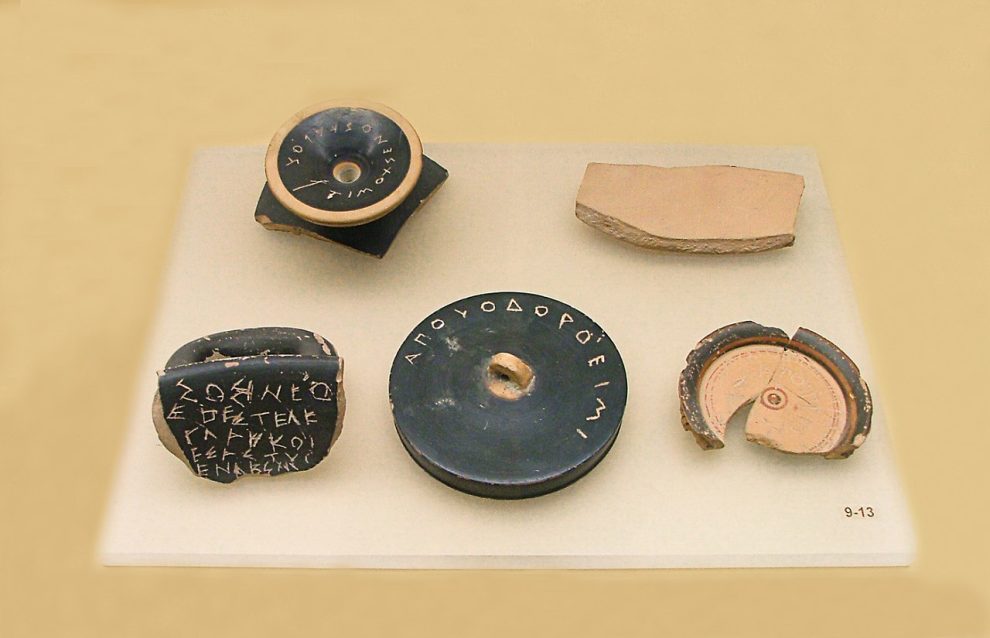
Photo: Dorieo (Jerónimo Roure Pérez), via Wikimedia Commons — CC BY-SA 4.0.
Why ancient Greek pottery museums matter
There are arguments, good ones, for why painting, sculpture, and architecture deserve more scholarly attention than pottery. But those arguments quietly assume that pottery is somehow minor. It isn’t. For understanding the everyday texture of ancient Greek life, pottery is often the richest source we have, and the ancient Greek pottery museum collections around the world preserve that source in remarkable depth.
Pottery was everywhere in ancient Greece. People filled it with olive oil, wine, and grain, used it in religious rituals and athletic celebrations, and buried it with the dead. Crucially, painters also covered a significant portion of it with scenes that recorded the world around them in extraordinary detail. Archaeologists working on a site with no written records can still learn an enormous amount from the pottery: trade routes from the clay composition, dates from stylistic chronology, social practices from the painted scenes. In that sense, Greek pottery isn’t just art. It’s data.
Greek pottery as a historical record: from Geometric to Hellenistic eras
Ancient Greek pottery spans roughly a thousand years of production, and the stylistic changes across that period track broader shifts in Greek culture with surprising precision. It helps to know the main periods of ancient Greek pottery before you visit a collection, not because you need to be an expert, but because the labels make more sense once you understand what each period was doing.
The Geometric period (roughly 900–700 BCE)
Is exactly what it sounds like: pottery decorated with geometric patterns, meanders, triangles, bands of hatching, arranged in registers around the vessel. Human figures appear eventually, but they’re simplified to angular silhouettes. These pots are often funerary objects, made for high-status burials, and some of them are enormous, standing as tall as a person and serving as grave markers.
The Black-figure style
Emerged in Corinth and was perfected in Athens from roughly the 7th century BCE. Figures were painted in black slip on the natural orange-red clay, with details incised through the black with a stylus. The contrast is sharp and dramatic. Mythological scenes dominate, Herakles fighting the Nemean lion, Achilles dragging Hector’s body, Dionysus sailing across the sea on a vine-covered ship. Exekias, working around 540 BCE, is the acknowledged master of the form: his amphora showing Achilles and Ajax playing dice is one of the most studied objects in ancient art.
Red-figure, invented in Athens around 530 BCE
Reversed the color relationship: figures are left in the natural red of the clay, and the background is painted black. This allowed painters to use a brush for interior details rather than a sharp incising tool, producing a much more naturalistic line. The period from roughly 530 to 400 BCE, covering painters like the Berlin Painter, the Kleophrades Painter, and Douris, represents what many art historians consider the peak of Greek vase painting. Anatomy becomes convincing. Facial expressions register emotion. Drapery falls with real weight.
Hellenistic period (323 BCE onward)
Greek pottery had spread across a much wider world following Alexander’s conquests, and the styles became more varied. Decorated wares gave way to fine glossed pottery without figural decoration, and regional traditions multiplied. The Hellenistic collections in major museums offer a useful corrective to the Athens-centric view of Greek culture: this was a Mediterranean-wide phenomenon.
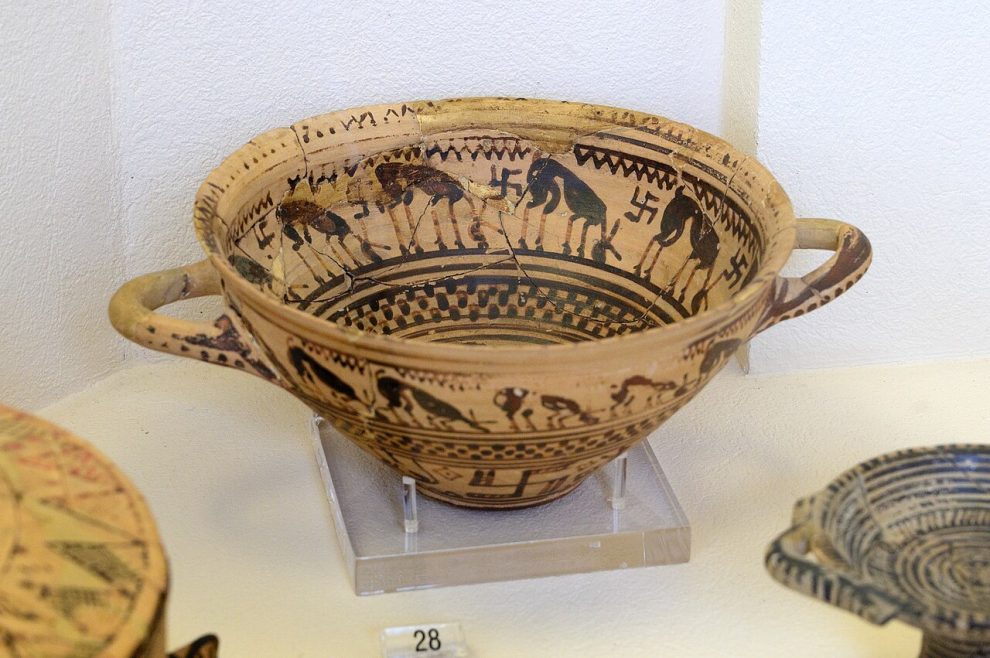
Geometric skyphos with deer (750–740 BC), Kerameikos Archaeological Museum, Athens — photo by Zde, via Wikimedia Commons (CC BY-SA 4.0).
What ancient Greek pottery reveals about daily life and mythology
If you want to understand what a symposion actually looked like, the reclining men, the wine mixed with water in a large krater, the music and the philosophical conversation and the erotic undercurrent, there is no better source than the pottery produced for it. Athenian vase painters were documenting the world they knew, and they knew the symposion intimately because their clients were the men who held them.
Athletic scenes are another consistent theme, particularly after the establishment of the Panhellenic games. Panathenaic amphorae, large vessels filled with olive oil given as prizes at the Athenian games, depict the events themselves: discus throwing, wrestling, chariot racing, running. These are not idealized fantasies; they’re records of specific competitions, sometimes even identifying the event by inscription.
Funerary pottery opens a different window. Ancient Greeks placed lekythoi, slim, narrow-necked oil flasks, in tombs and often painted them with scenes of mourning, farewell, and the journey to the underworld. In the 5th century BCE, painters created white-ground lekythoi by painting figures on a white slip instead of red clay, and the result feels almost ghostly by design: potters and painters made these vessels for the dead, and they wanted them to look the part.
Mythological scenes are everywhere, but they’re not always illustrating the versions of myths we know from Homer or Hesiod. Vase painters often depicted variant traditions, local versions, or moments that the literary sources don’t bother with. Scholars have used pottery to reconstruct lost plays, identify lost myths, and understand how stories changed as they traveled across the Greek world.
How to read a Greek vase: a visitor’s quick guide
Standing in front of a case of Greek pottery without some basic vocabulary is a bit like watching a film in a language you don’t speak, you catch the visuals but miss most of the meaning. A few key concepts will transform a museum visit.
Start with shape. Greek potters produced a fairly standardized range of vessel forms, each with a specific function. The amphora is the large two-handled storage and transport vessel, used for wine, oil, and grain, and is probably the shape you’ll see most often. The krater is a wide-mouthed mixing bowl where wine and water were combined; its size makes it a natural canvas for complex scenes. The kylix is the shallow, wide drinking cup, often decorated on the interior as well as the exterior, so that the drinker would see a scene as they drained it. The lekythos is the narrow oil flask mentioned above. The hydria, with its three handles (two for lifting, one for pouring), was specifically for water.
Next, look at the technique. Black-figure has incised detail lines; look closely and you’ll see fine grooves scratched through the black slip. Red-figure has painted interior lines; the figures have a warmer, more naturalistic quality. White-ground pottery is immediately recognizable from its chalky surface.
Finally, look at the composition. Greek vase painters were extraordinarily skilled at filling a curved surface with coherent narrative. Figures are identified by attributes, Athena has her helmet and aegis, Herakles has his lion skin and club, Hermes has his winged sandals and caduceus. Inscriptions naming figures appear frequently on Attic black- and red-figure; if you see Greek letters near a figure, they’re almost certainly giving you the name.
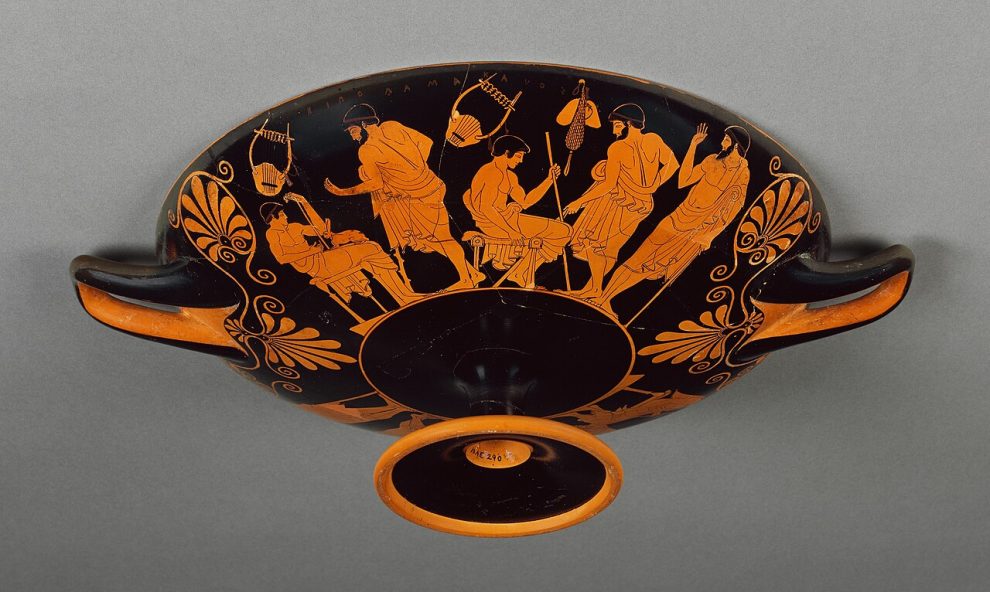
Attic kylix attributed to Douris (ca. 480 BCE), J. Paul Getty Museum (86.AE.290) — image courtesy of J. Paul Getty Museum, via Wikimedia Commons (CC0 1.0).
Top ancient Greek pottery museums around the world
The best ancient Greek pottery museum collections are spread across the globe, a legacy of 19th-century archaeology, diplomatic acquisitions, and the dispersal of material through legal and (in many cases) considerably less legal channels. What follows is a tour of the most significant collections, what makes each one worth visiting and what to look for when you get there.
National Archaeological Museum, Athens: the world’s most comprehensive collection
If you visit only one ancient Greek pottery museum in your life, make it the National Archaeological Museum in Athens. Nothing else comes close in scale or depth. The collection covers more than five thousand years of Greek history, and the pottery holdings alone, over 5,500 vases and minor arts objects displayed across fifteen dedicated rooms, represent the most comprehensive assembly of Greek ceramics anywhere in the world.
The chronological range is staggering. The earliest pieces date to the 11th century BCE; the latest reach into the 13th century CE. Walking through the pottery galleries is something like taking a slow walk through Greek civilization itself, watching styles emerge, peak, and transform. The Geometric room alone, with its monumental funerary amphoras, is worth the trip to Athens.
Practical notes: the museum is located in the Exarchia neighborhood of Athens, about a 20-minute walk from the Acropolis. It’s large enough that a full visit takes the better part of a day, more if you’re also taking in the sculpture and bronze collections, which you should. Audio guides are available, and the quality of labeling has improved significantly in recent years. Plan to go early, especially in summer, when the rooms can get crowded by late morning.
Don’t miss: the collection of Panathenaic amphorae, the Geometric-period grave amphoras from the Dipylon cemetery, and the extraordinary black-figure and red-figure holdings from Attic workshops. The museum’s arrangement by period rather than provenance makes stylistic comparison particularly easy.
Getty Villa, Malibu: Athenian vases in a purpose-built ancient setting
The Getty Villa in Malibu, technically within the city of Los Angeles, is an unusual institution in the best possible way. It was purpose-built to display ancient Greek and Roman art in a setting that attempts to evoke the ancient world: the architecture is modeled on a first-century Roman country villa, and the surrounding gardens are planted with species documented in ancient texts. The effect is genuinely different from the standard white-wall museum experience.
The Greek pottery collection is centered on Gallery 103, which focuses specifically on Athenian vases. The holdings include exceptional examples of both black-figure and red-figure work, and the curation tends toward depth over breadth, fewer objects, but with unusually detailed labeling and contextual information. The Getty backs its collection with one of the strongest scholarly teams in any ancient-art museum, and you can see that rigor in the way it presents every gallery.
Before you visit, book timed-entry tickets in advance because the Getty Villa requires them, and buy a separate parking ticket as well. Neither is expensive, but both require planning. The villa is located along Pacific Coast Highway and is most easily reached by car; public transit options are limited.
The building itself is a genuine draw. Whatever one thinks of the philosophical questions around recreating antiquity, standing in the peristyle garden with the Pacific visible beyond the hills and a black-figure kylix visible through the gallery window is an unexpectedly moving combination.
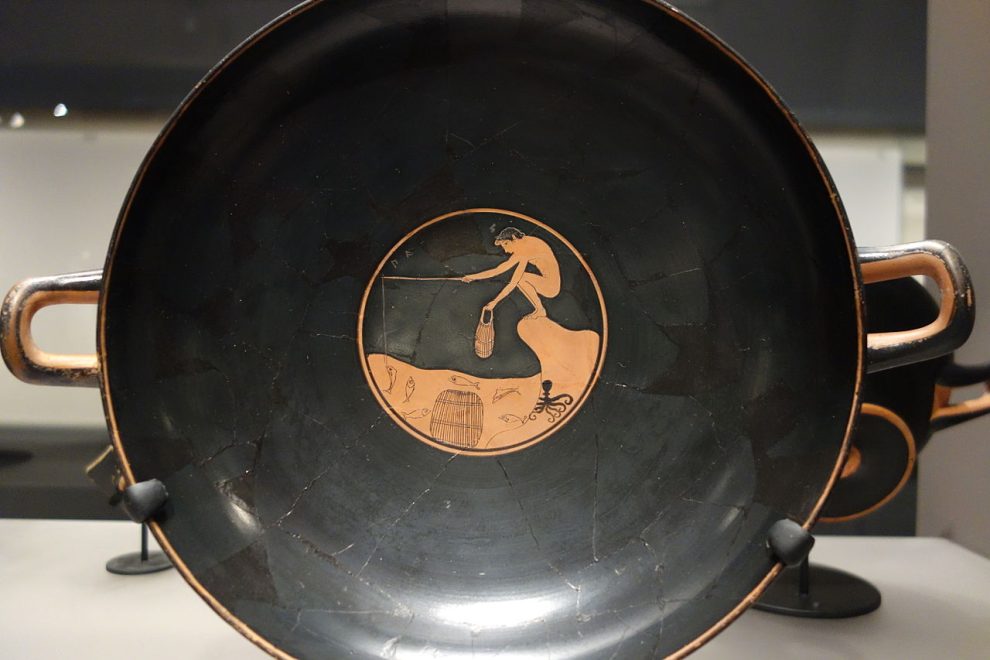
Photo by Marcus Cyron, via Wikimedia Commons — CC BY-SA 4.0.
Museum of Fine Arts, Boston: one of America’s finest classical collections
The Museum of Fine Arts in Boston holds one of the most respected collections of ancient Greek pottery in the United States, built over more than a century through purchase, gift, and excavation. The Greek and Roman department occupies dedicated galleries in the Art of the Ancient World wing, and the pottery collection covers the full range of periods and styles, from Geometric through Hellenistic.
What distinguishes the MFA’s collection is its breadth. While institutions like the Getty Villa go deep on Athenian vase painting, the Boston collection offers meaningful representation across periods and production centers: Corinthian, Laconian, East Greek, South Italian, and Attic pottery all appear in significant numbers. For someone interested in regional variation within Greek ceramics, or in the spread of ceramic traditions to the Greek colonies of southern Italy and Sicily, the MFA is a particularly valuable destination.
The museum is located on Huntington Avenue in the Fenway neighborhood, easily accessible by subway (Green Line, Museum stop). It’s large enough that you’ll want to plan which sections to prioritize; the Art of the Ancient World wing is well-signposted but can be overlooked by visitors primarily interested in the Impressionist or American collections. Allow at least two hours for the ancient section alone.
Kerameikos Archaeological Museum: Greek pottery at its source
The museum holds the excavated material in an intimate, manageable space, very different from the scale of the National Archaeological Museum. The Geometric-period grave goods are outstanding, as are the Black-figure and Red-figure pieces found in context rather than on the art market. Seeing pottery that was found a hundred meters away, still close to the graves it came from, is a qualitatively different experience from encountering the same objects in a decontextualized display case.
The site itself, the excavated archaeological zone surrounding the museum, is open to visitors and gives a tangible sense of the landscape: the ancient road to Eleusis, the line of grave monuments, the remains of workshops. Budget a half-day for both the museum and the site.
More must-visit ancient Greek pottery museums: Harvard, Tampa, and beyond
Beyond the flagship collections, several other institutions hold pottery holdings that are worth knowing about, either for specialist interest or because they offer something genuinely distinctive.
The Harvard Art Museums in Cambridge, Massachusetts, have a particular strength in symposion-related pottery, the kylikes, kraters, and drinking vessels that furnished the ancient Greek drinking party. The collection is modest in size but intelligently curated, and the museum’s digitized collection database is one of the best in the field for online research.
The Tampa Museum of Art in Florida holds the Joseph Veach Noble Collection, one of the most significant assemblies of Greek and South Italian painted pottery in the American South. Noble was a curator and scholar who spent decades acquiring and studying these objects, and the collection reflects serious expertise. It’s a genuinely surprising institution for a city not typically associated with classical antiquities.
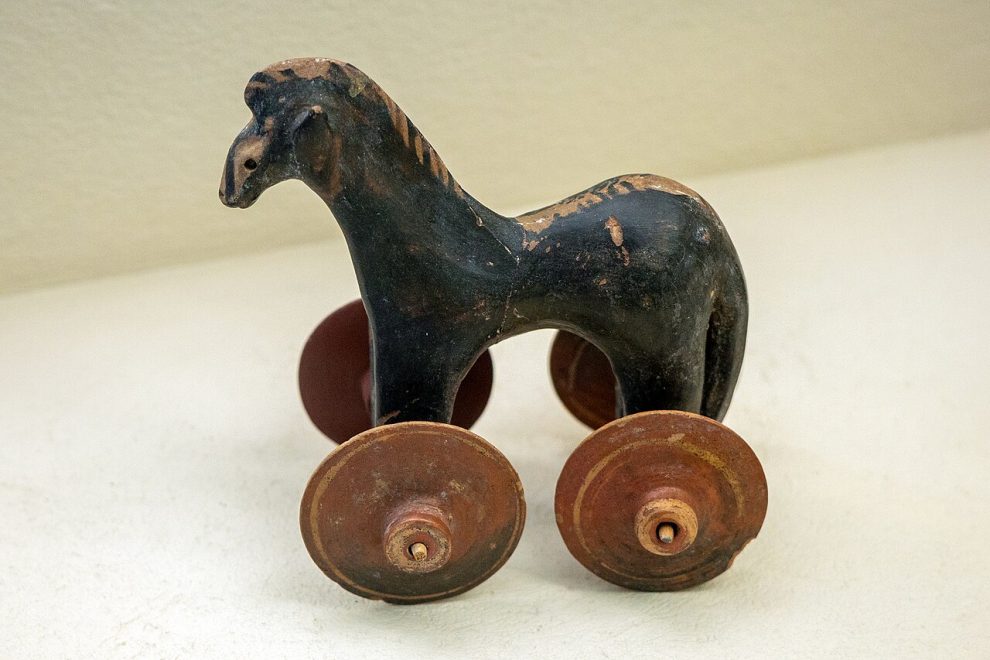
“Ancient Greek horse on wheels (Kerameikos)” — photo by Chepry (Andrzej Barabasz), via Wikimedia Commons (CC BY-SA 4.0).
Planning your visit to an ancient Greek pottery museum
Knowing which ancient Greek pottery museums hold the best collections is one thing. Getting the most out of an actual visit is another. A few practical considerations make a significant difference.
The first is simply preparation. Greek pottery rewards prior knowledge more than almost any other category of ancient art. Even an hour spent looking at images of key periods and shapes, the transition from Geometric to Black-figure, the difference between an amphora and a hydria, will transform how much you notice in the galleries. Most major museum websites publish digitized collections with high-resolution images; the Getty’s online collection and the British Museum’s are both excellent resources to browse before a visit.
The second is pacing. It’s genuinely tempting to rush through a pottery gallery, particularly in a large museum where the sculptures and bronzes often feel more immediately dramatic. Resist the impulse. Greek vase painting rewards sustained attention. Sit in front of a good piece for five minutes, long enough to read the composition properly, identify the figures, and notice what the painter chose to emphasize. You’ll leave with an entirely different experience than if you spent the same time walking past three dozen cases.
Athens vs. international: which ancient Greek pottery museum should you visit first?
If travel is on the table, the answer is almost always Athens, and specifically the National Archaeological Museum, with a day at the Kerameikos added if time allows. The case for going to the source isn’t just sentimental. Greek pottery, like most archaeological material, means more when seen in the context of the culture that produced it. Walking from the Acropolis to the National Archaeological Museum in a single day, or standing at the Kerameikos site while the pottery found there sits in cases twenty meters away, produces an understanding that no international collection can fully replicate.
That said, the practical case for international collections is real. Not everyone can get to Athens. And in some ways, a focused collection like the Getty Villa or the MFA Boston offers a more manageable introduction than the vast holdings of the National Archaeological Museum, which can be overwhelming on a first visit. If you’re new to Greek pottery and want to build your eye before confronting the full scale of an Athenian collection, a visit to a well-curated international institution is genuinely worthwhile preparation.
A reasonable approach, if you can manage it: visit an international collection first to build familiarity with the periods and styles, then make Athens the destination where everything clicks into a larger picture. The Kerameikos, in particular, is the kind of experience that changes how you think about everything you’ve seen before, not because the objects are necessarily the most spectacular, but because the context is so immediate and so clarifying.
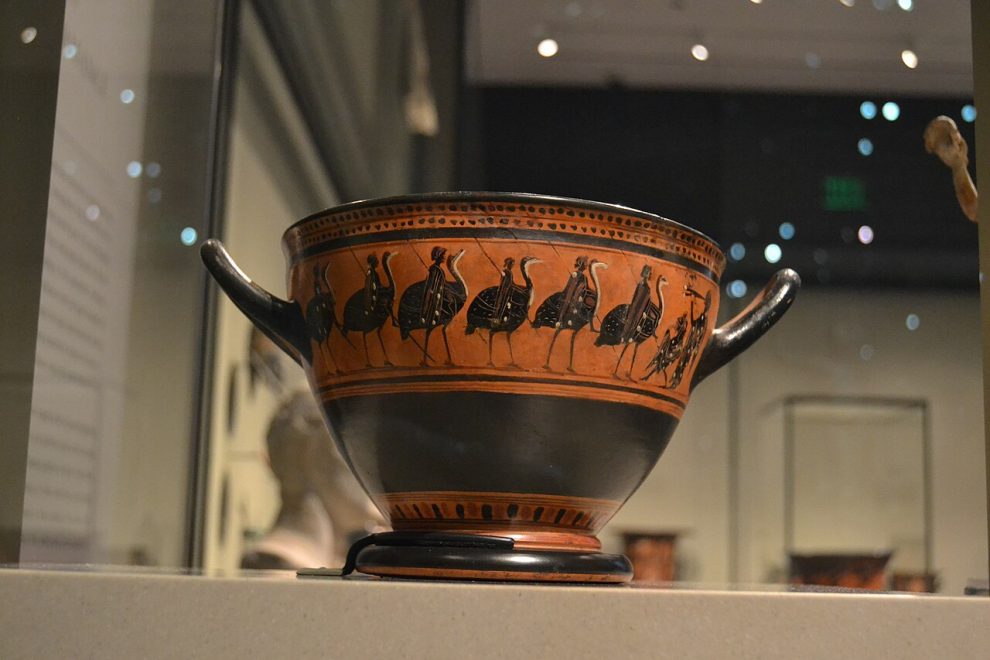
Ancient Greek painted cup (Ancient Collection, Museum of Fine Arts Boston) — photo by Marcus Cyron, via Wikimedia Commons (CC BY-SA 4.0).
Conclusion
There’s something almost improbable about the fact that these objects survive at all. Fired clay is fragile in one sense and extraordinarily durable in another, it doesn’t rust, doesn’t rot, doesn’t burn, and two and a half thousand years of burial often leaves it intact where bronze has corroded and wood has vanished entirely. The world’s ancient Greek pottery museums collectively preserve hundreds of thousands of objects that have outlasted the buildings that housed them, the cities that traded them, and the empires that tried to claim them.
The National Archaeological Museum in Athens is the place to start, there’s no competition. But the ancient Greek pottery museums of Malibu, Boston, Cambridge, Tampa, Thessaloniki, and a dozen other cities each hold pieces of that record. The clay is patient. It will wait. And when you’re ready to look, it has a great deal to say.
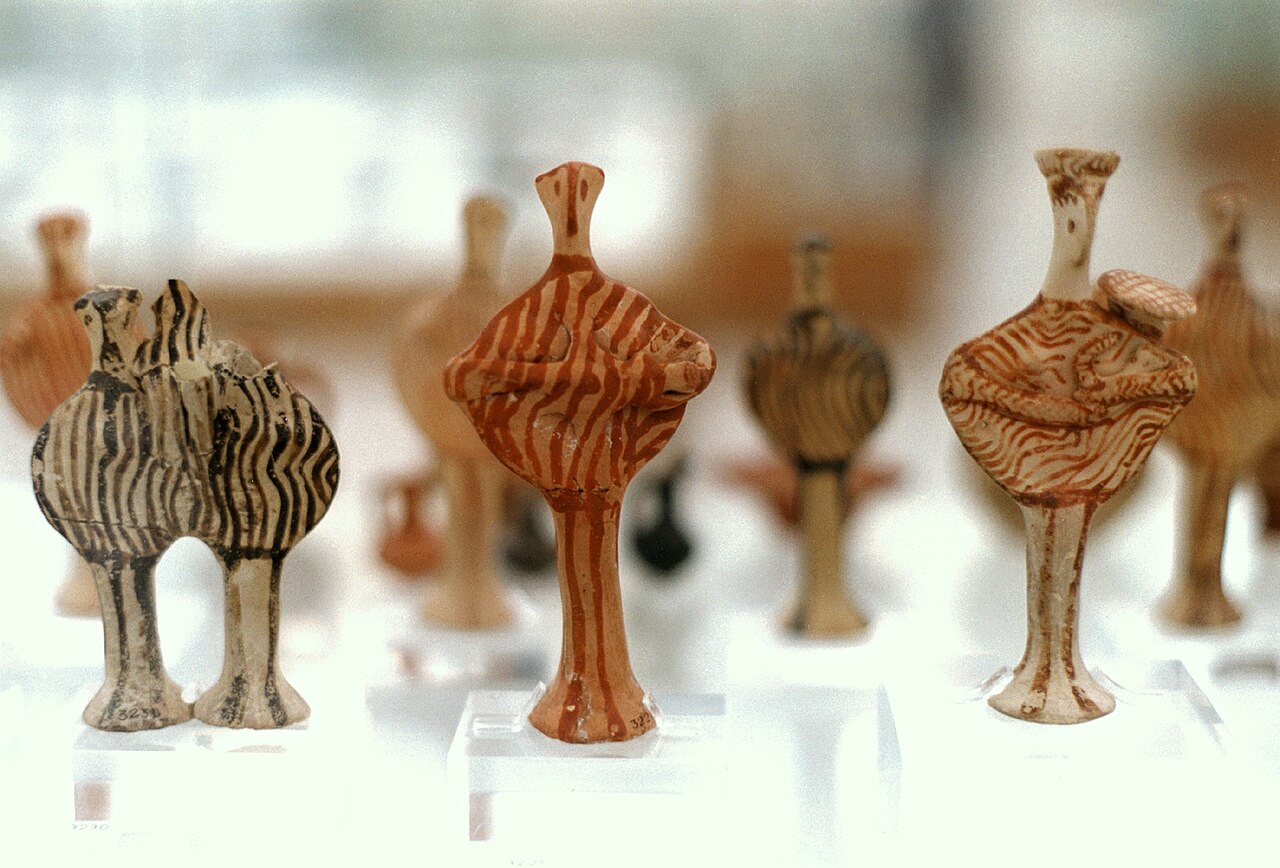
Featured image credit: “Bird Goddess Mycenaean NAMA 0034” by Zde, via Wikimedia Commons (CC BY-SA 3.0