
Key Highlights
- Ancient Greek symposiums were drinking parties for wealthy men, not just for revelry but also for intellectual discussion.
- These events followed strict rules, with a “symposiarch” or master of the symposium controlling the wine and proceedings.
- Only aristocratic men could attend, though female entertainers and courtesans were often hired for music and company.
- Discussions ranged from philosophy and politics to poetry, as famously depicted in Plato’s Symposium.
- Wine was always mixed with water, as drinking it pure was considered uncivilized.
- Entertainment included music, poetry recitals, and competitive games like kottabos.
When we hear the word “symposium” today, we usually picture a dry, academic conference filled with PowerPoint presentations and lukewarm coffee. But if you could travel back to classical Athens, you would find a very different scene. So, did ancient Greeks have symposiums? They absolutely did, but their version was a vibrant, ritualized drinking party that combined intoxicating wine with intense philosophical debate, competitive gaming, and live music. Far from a simple night at the tavern, the ancient Greek symposium was one of the most vital social institutions of the Hellenic world. It was the ultimate intersection of leisure, politics, and culture.
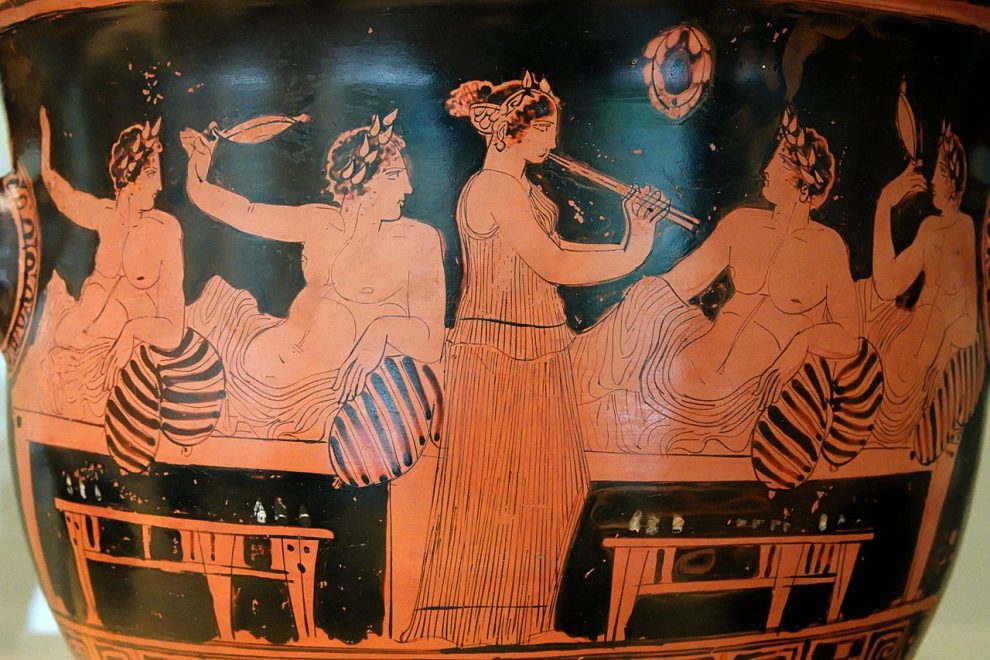
Image: Symposium scene by Nikias Painter, photographed by Marie-Lan Nguyen (Jastrow), via Wikimedia Commons, licensed under CC BY 2.5.

What Was an Ancient Greek Symposium?
To understand the ancient Greek symposium, we have to look at its literal translation. The term comes from the Greek word symposion, which translates directly to “drinking together.” It was distinct from a regular dinner party. The Greek world strictly divided the evening into two parts: the deipnon (the meal) and the symposion (the wine-drinking and intellectual gathering that followed).
To understand the meaning of symposium in ancient Greek culture, we should see it as a structured forum for aristocratic men. Once servants cleared the food tables, the real event began. Hosts perfumed the guests, placed floral wreaths on their heads, and served diluted wine to prepare them for an evening of shared dialogue, song, and camaraderie.
The Origins and History of the Ancient Greek Symposium
The symposium did not appear out of thin air in Classical Athens; its roots stretch back to the Archaic period (around the 7th and 8th centuries BC). Interestingly, the Greeks borrowed heavily from Eastern civilizations to create it. The Greeks actually adopted the famous practice of reclining on couches while dining and drinking from the royal courts of the Assyrians and Lydians. The Greeks took this foreign symbol of luxury and adapted it into their own democratic and aristocratic framework.
How the Symposium Evolved Over Time
Early Archaic banquets were often small, exclusive gatherings for warrior-aristocrats to cement alliances. However, as Greek city-states grew in wealth and stability, the institution evolved. By the Classical period (5th and 4th centuries BC), the symposium ancient Greek elites attended became larger, more theatrical, and highly formalized. It transitioned from a casual get-together into a sophisticated, highly regulated event complete with a strict rulebook.
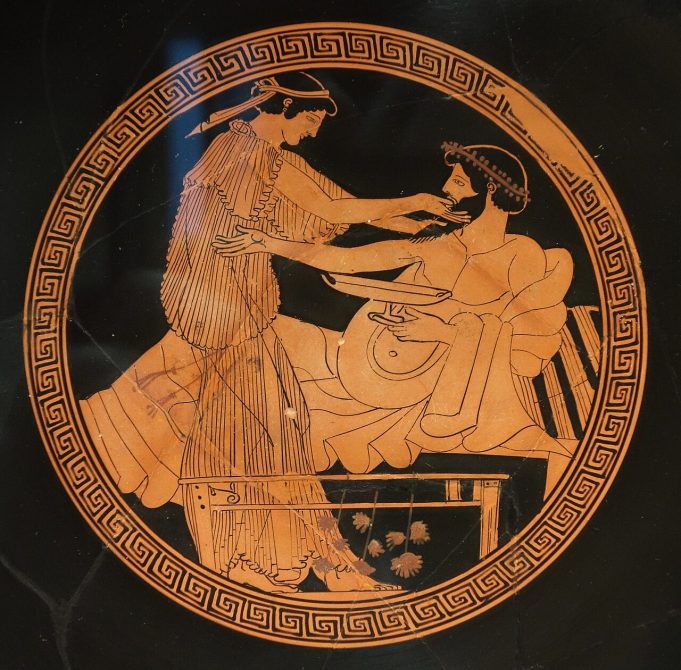
Photo of an Attic red-figure kylix with a symposium scene in the tondo, photographed by Mark Landon, via Wikimedia Commons, licensed under CC BY 4.0.
_tondo.jpg)
Where Did the Ancient Greek Symposium Take Place?
A symposium was not held in a public tavern; it took place in the private home of a wealthy citizen, specifically in a room called the andron (the men’s quarters). The architecture of the andron was fascinating. The doorway was built off-center to allow couches (klines) to be lined up perfectly against the four walls. Wealthier homes decorated their andron with beautiful pebble mosaic floors, making it the architectural showpiece of the household. Guests reclined on their left elbows, facing the center of the room, creating an intimate circle where everyone could see and hear each other.
Who Was Invited to a Symposium in Ancient Greece?
The guest list for an ancient Greek symposium was highly exclusive.
Adult male citizens made up the group, often accompanied by younger men whom elders were mentoring in aristocratic manners and politics. Greek society strictly excluded respectable wives and daughters from the andron. Only hired entertainers, flute-girls, and hetairai were present, educated, high-status courtesans who could hold their own in witty conversations and political debates. A typical gathering was intimate, usually ranging from 9 to 27 participants.
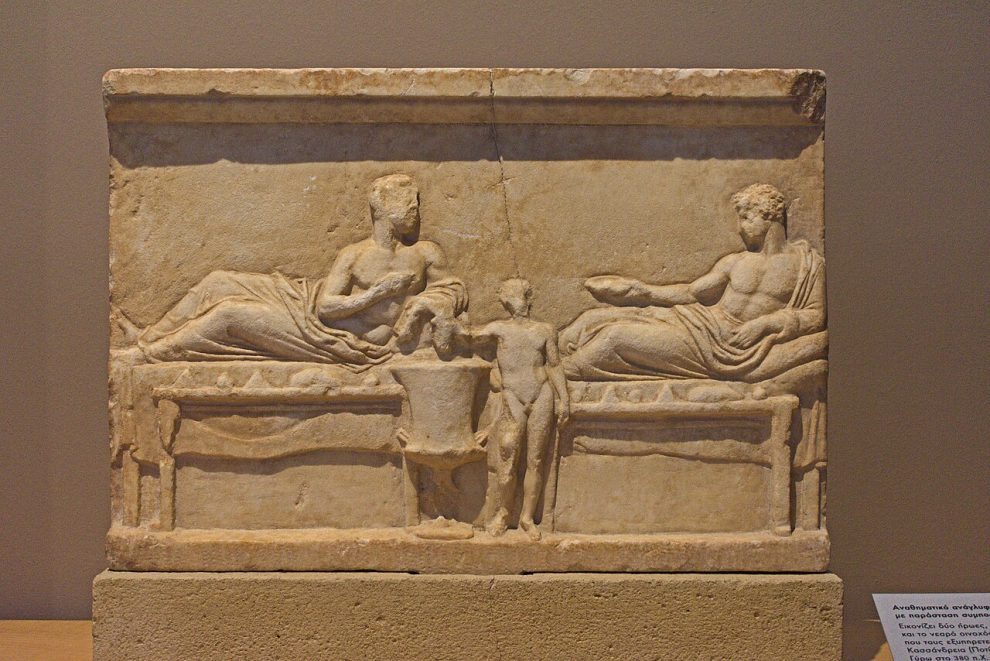
Votive relief depicting a symposium, photographed by Ymblanter, via Wikimedia Commons, licensed under CC BY-SA 4.0.

The Rules of the Ancient Greek Symposium
While it was a drinking party, it was anything but a chaotic free-for-all. The Greeks believed that unmixed wine led to madness and savagery, so drinking was governed by strict, traditional rituals. The evening began with prayers, hymns, and libations (pouring out drops of wine) to the gods. There were even penalties, ranging from light mockery to being forced to perform embarrassing tasks, for those who broke the house rules.
The Role of the Symposiarch (Master of Drinking)
To keep order, the guests elected a symposiarch (literally, the “ruler of the symposium”), usually by a roll of the dice. This master of drinking had total control over the night. He decided the wine-to-water dilution ratio, decreed how many cups everyone had to drink, and chose the topics of conversation. A good symposiarch knew exactly how to balance the wine so that the guests became witty and relaxed without descending into a drunken brawl.
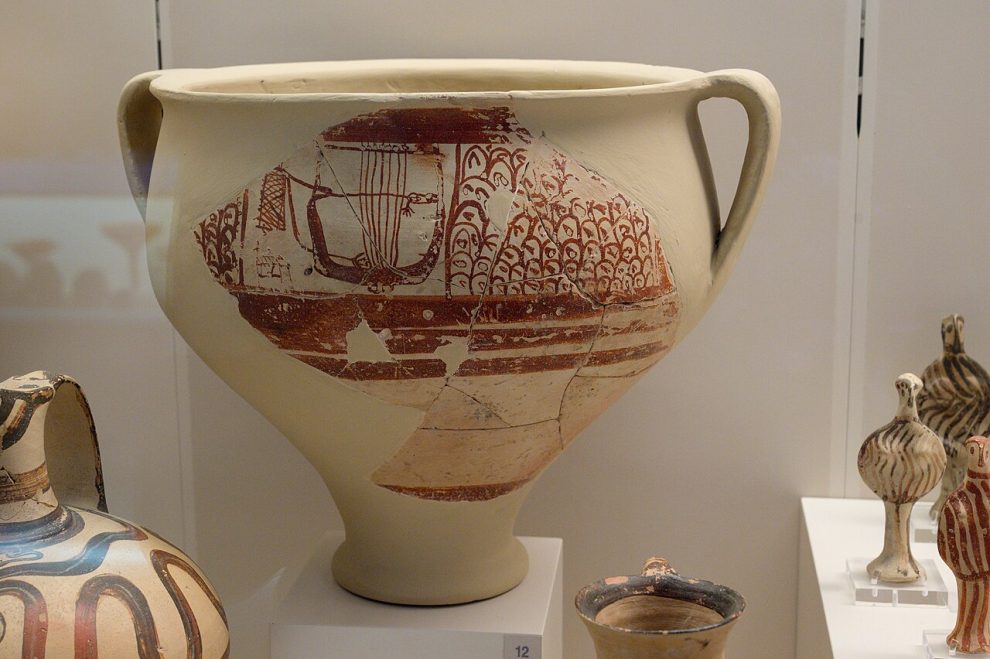
Krater with a lyre player, photographed by Zde, via Wikimedia Commons, licensed under CC BY-SA 4.0.

The Ancient Greek Banquet: Food, Wine, and Drinking Vessels
Before the wine was poured, guests partook in a light ancient Greek banquet symposium meal. This usually consisted of seasonal fare like olives, cheese, bread, nuts, figs, and roasted meats. Once the meal ended, the drinking vessels were brought out. The wine was mixed with water in a large, central urn called a krater. Attendants would scoop the wine out using a pitcher (oinochoe) and pour it into shallow, two-handled drinking bowls called kylikes. The Greeks always diluted their wine, usually at a ratio of three parts water to one part wine, viewing the drinking of straight wine as a “barbarian” trait.
Ancient Greek Symposium Entertainment
As the night wore on, ancient Greek symposium entertainment became the focal point of the evening. The andron transformed into a private theater filled with laughter, sensory delights, and playful rivalries. Guests would take turns singing skolia (competitive drinking songs), where one guest would sing a verse and point to another to improvise the next rhyme.
Music and Performance at the Symposium
Hired performers were a staple of sympotic life. Female musicians played the aulos (a double-reed wind ancient Greek musical instrument) and the barbiton (a type of lyre), filling the room with ambient melodies. Hosts also frequently hired acrobats, exotic dancers, and mimes to thrill the guests between rounds of wine.
Games and Competitions at the Symposium
Competition was central to Greek identity, and the symposium was no exception. The most famous game was kottabos. Guests would take the dregs of wine at the bottom of their kylix, hook their finger through the handle, and fling the liquid at a bronze target in the center of the room. Achieving a clear “clink” meant good luck in love! Rhetorical contests and riddle-solving were also highly popular.
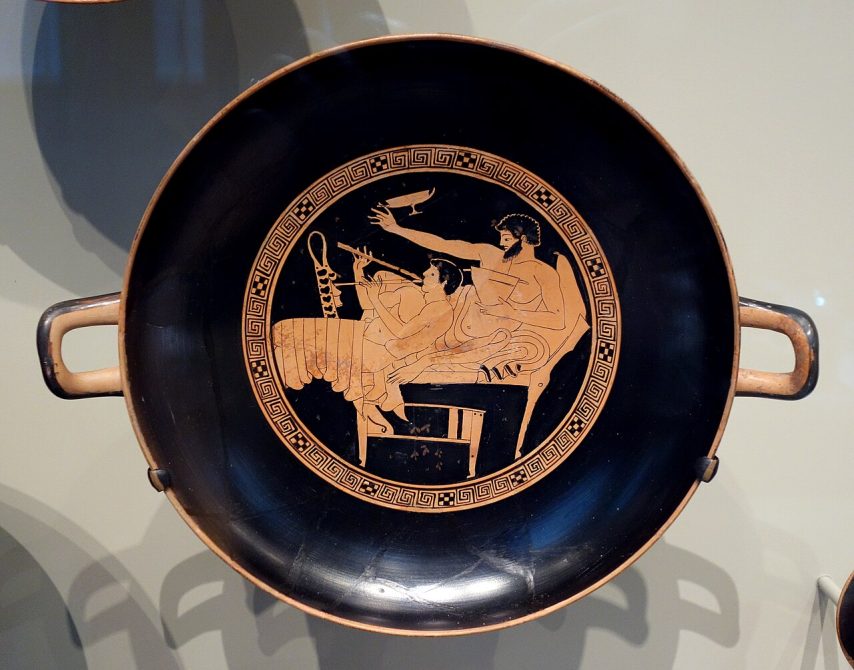
Photo of an Attic red-figure kylix with a symposium scene, photographed by Mark Landon, via Wikimedia Commons, licensed under CC BY 4.0.
.jpg)
Philosophy and Politics at the Ancient Greek Symposium
Behind the laughter lay a serious core. The symposium was where logos sympotikos (symposium speech) occurred. It was a safe space for men to debate philosophy, ethics, and civic policies. Plato and Xenophon both famously wrote literary works titled Symposium, portraying these gatherings as incubators for elevated philosophical thought. However, they were also political hotbeds. Because the andron was closed off from the public, aristocrats plotted political maneuvers there. In fact, aristocrats famously planned the oligarchic revolts of 411 BC in Athens inside symposiums.
Famous Symposiums in Ancient Greek Literature
The most famous symposium in literature is Agathon’s party in 416 BC, immortalized by Plato. The gathering featured towering intellectual heavyweights like Socrates and Aristophanes debating the nature of Love. The night took a dramatic turn when the charismatic, heavily intoxicated general Alcibiades crashed the party with a band of revelers, turning the intellectual debate into a beautiful chaos.
The Social Significance of the Symposium in Ancient Greece
The symposium was much more than just a leisure activity. It was the primary mechanism for reinforcing aristocratic identity. It acted as a social networking hub, a classroom for young men, and a testing ground for civic participation. In a culture without social media or corporate networking events, men built reputations, forged alliances, and passed cultural values down to the next generation in the andron.
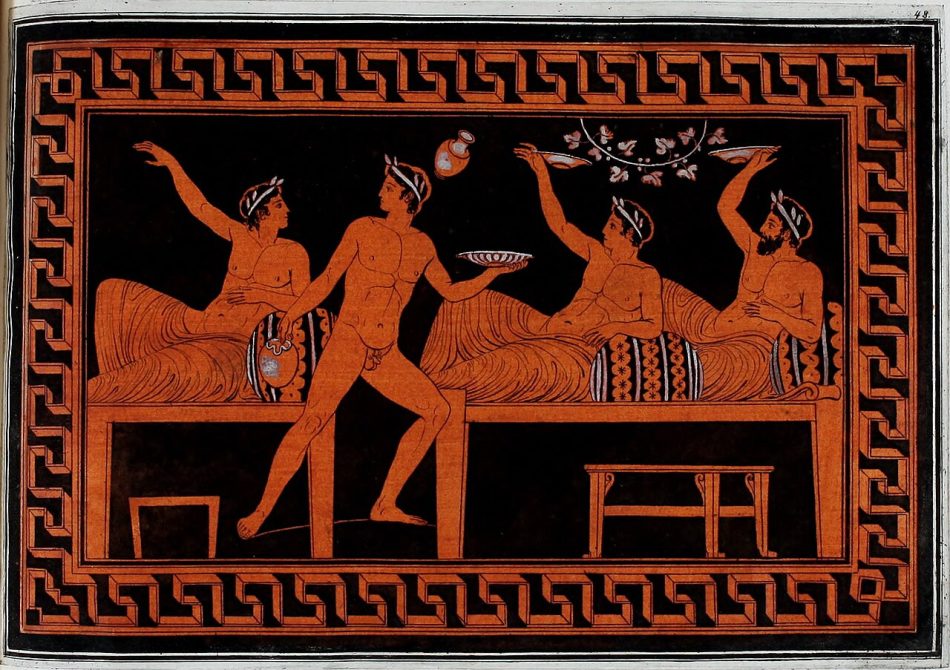
Plate from Collection of Etruscan, Greek and Roman antiquities from the cabinet of the Honourable William Hamilton (1766), via Wikimedia Commons, sourced from Internet Archive Book Images on Flickr, with no known copyright restrictions.
_(14780765575).jpg)
How the Greek Symposium Influenced Roman Culture
When Rome conquered Greece, they fell in love with Greek culture and adopted the symposium, though they altered it to fit Roman tastes. The Romans called their dinner parties a convivium (living together) or a comissatio (late-night drinking). Unlike the Greeks, Romans allowed high-status women to recline and attend alongside their husbands. Furthermore, while the Greek symposium prided itself on an illusion of equality among participants, Roman banquets were highly hierarchical, with better wine and food served to guests of higher social rank.
Conclusion
Ultimately, the the ancient Greek symposium was far more than a simple drinking party; it was a cornerstone of ancient social, political, and intellectual life. It was a space where rigid discipline tempered heavy drinking, and where people pursued pleasure and wisdom side by side. Whether tossing wine dregs at a target or debating the cosmic meaning of love, the Greeks proved that leisure and learning could occupy the exact same cup.
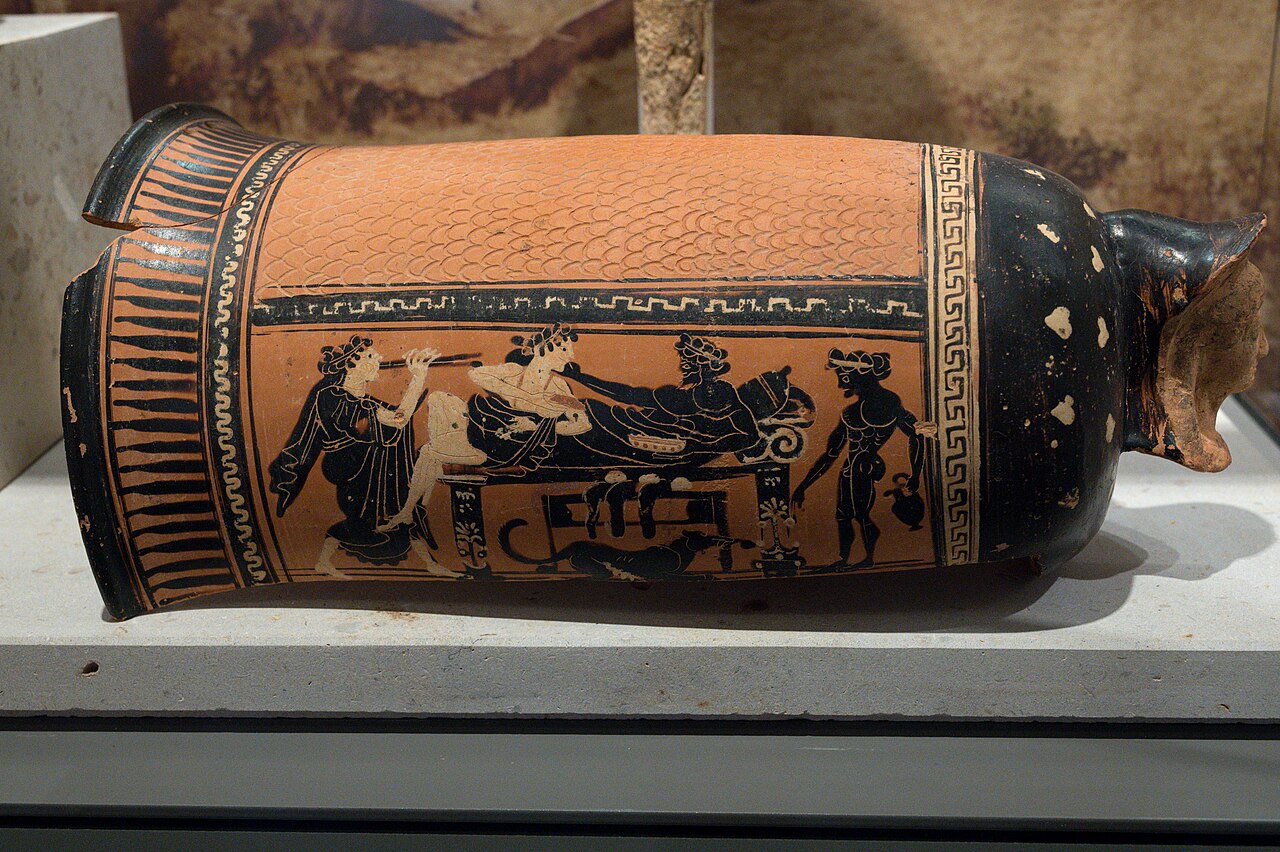
Feature image: Black-figure epinetron with a symposion scene, photographed by Zde and sourced from Wikimedia Commons, under CC BY-SA 4.0