
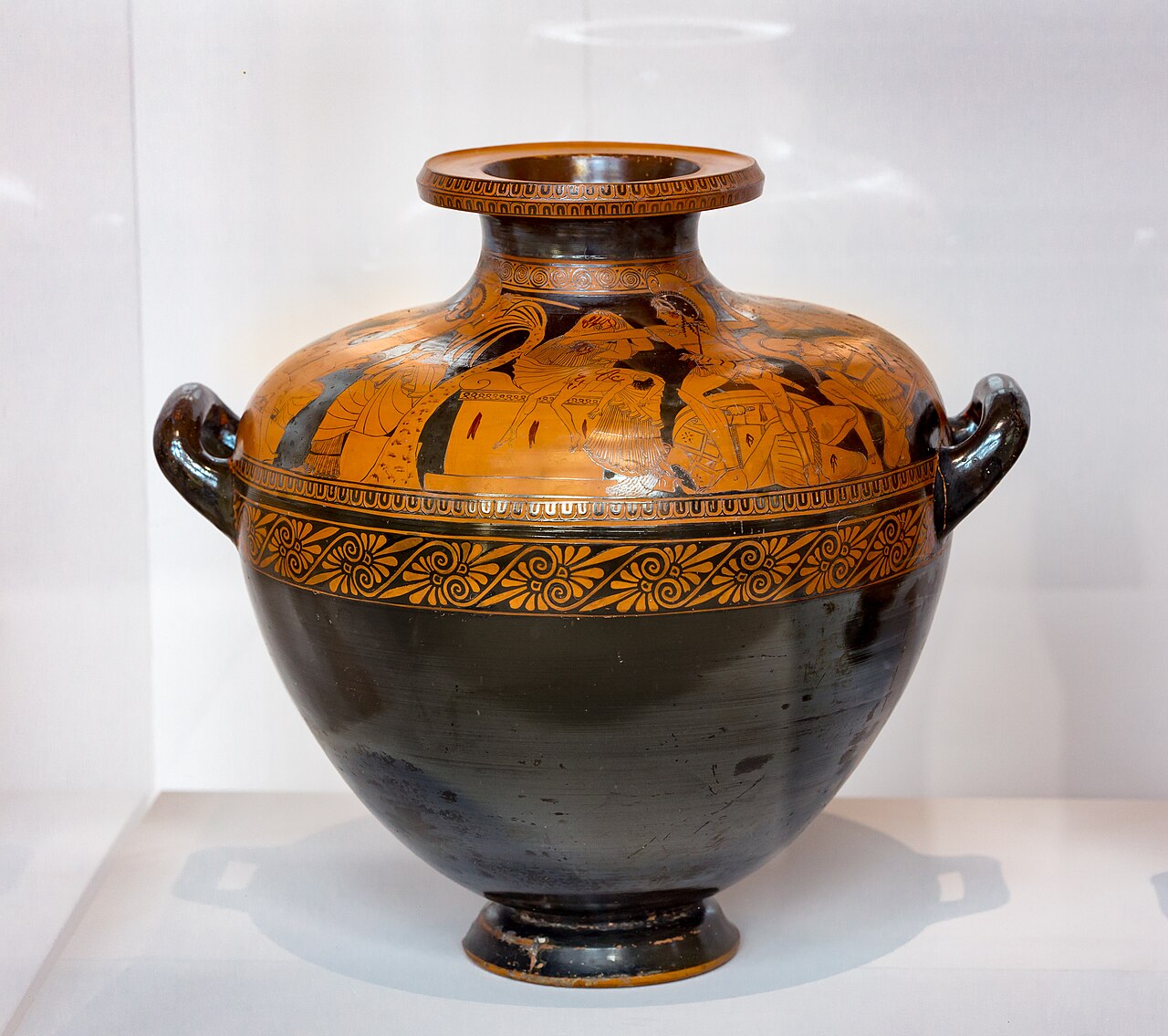
The Kleophrades Painter stands among the small number of Athenian ceramic artists whose work shaped the entire direction of ancient Greek pottery.
Active during one of the most turbulent and defining eras in Athenian history, roughly the four decades bracketing 500 BCE, he brought an emotional depth and technical precision to red-figure vase painting that few of his contemporaries matched. His identity remains unknown. His name is borrowed, as it was standard practice in ancient Athens to assign anonymous painters a conventional designation derived from a related potter or from a vessel in a notable collection. Yet the work speaks clearly enough, across more than a hundred surviving vessels held in museums from Naples to Munich to New York.
For anyone interested in the origins of Western ceramic art, in the workshops of ancient Athens, or in the visual culture of the Greek world, the Kleophrades Painter offers an essential point of entry.
The Kleophrades Painter was an anonymous Athenian vase painter active from approximately 510 to 470 BCE, widely recognized as one of the finest ceramic artists of the late Archaic period. His name derives from an inscription by the potter Kleophrades on a cup now held in the Cabinet des Medailles in Paris. Working primarily in the red-figure technique, he produced large-format vessels including calyx kraters, hydrias, neck amphorae, and Panathenaic prize amphorae. The Beazley Archive Pottery Database directly attributes 113 vases to him. His figures are identifiable by long, slender eyes, strong chins, and an expressive rendering of emotion that set a new standard for Attic vase painting.
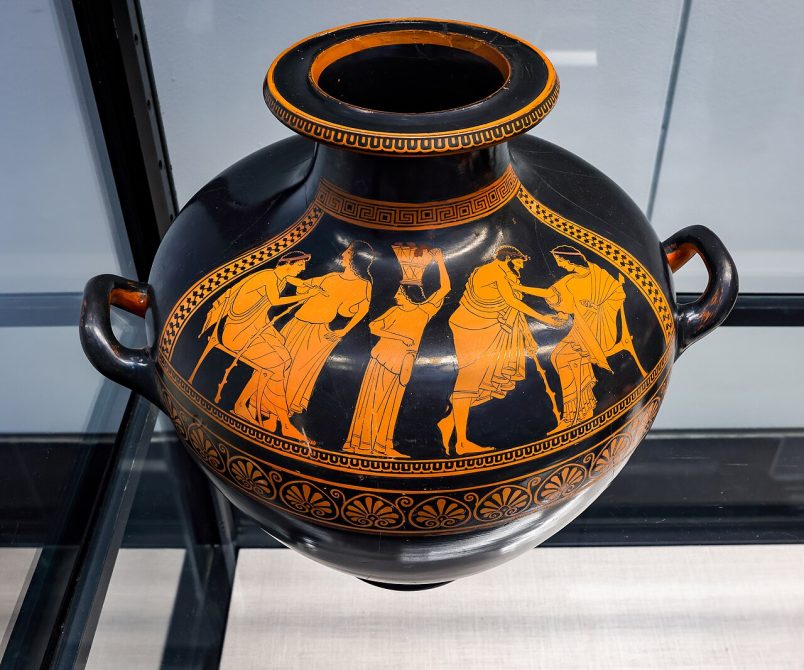
Attic red-figure kalpis attributed to the Kleophrades Painter, ca. 480 BC. Photo by ArchaiOptix, via Wikimedia Commons, licensed under CC BY-SA 4.0. No changes were made.
Who Was the Kleophrades Painter?
The name “Kleophrades Painter” was assigned in 1910 by the British classicist John Beazley, who spent decades systematically attributing Athenian vases to individual painters on the basis of stylistic analysis. Beazley took the name from a potter’s inscription, Kleophrades, found on a cup now in the Cabinet des Medailles in Paris. The painter himself decorated vessels thrown by that potter, and so the association held.
For a period, scholars believed they had identified the painter’s actual name. A pelike in Berlin carried an inscription reading Epiktetos, and researchers briefly designated him Epiktetos II to distinguish him from a contemporary painter of the same name. In 1981, however, the art historian John Boardman demonstrated that the inscription on the Berlin pelike was a modern forgery. The painter returned to anonymity, known only through the work.
What scholarship has established with reasonable confidence is his lineage within the Athenian craft tradition. The Kleophrades Painter is generally believed to have been the son of the potter Amasis, a prominent figure in the Athenian Kerameikos district who gave his name to the celebrated Amasis Painter. His early works closely follow the style of Euthymides, a leading member of the Pioneer Group, the circle of red-figure painters who first fully developed the potential of the new technique in the decades around 500 BCE. The Kleophrades Painter is not listed as a formal Pioneer, but he almost certainly worked within or alongside the Pioneer workshop, which also included Euphronios and Smikros.
He later taught his own students, among them the Berlin Painter, who became one of the defining figures of the early Classical period in Attic vase painting.
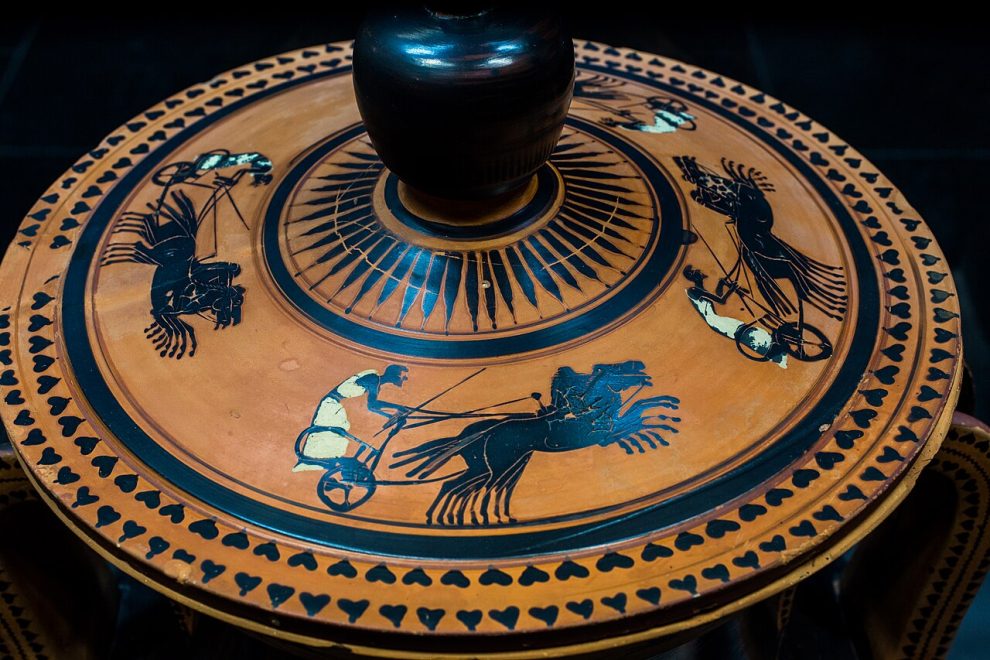
Attic red-figure belly amphora attributed to the Kleophrades Painter, ca. 500 BC, showing a warrior leaving home. Photo by ArchaiOptix, via Wikimedia Commons, licensed under CC BY-SA 4.0. No changes were made.
When and Where Did He Work?
The Kleophrades Painter was active from approximately 510 BCE to 470 BCE, a span of roughly four decades. These years overlapped with the Persian Wars, the sacking of Athens by the Persian army in 480 BCE, and the subsequent Greek victories at Salamis and Plataea. His most emotionally charged works, including the famous Vivenzio Hydria depicting the Sack of Troy, are thought to have been painted in the immediate aftermath of the Persian destruction of the Acropolis.
He worked in Athens, almost certainly in the Kerameikos, the district north of the Agora where the city’s pottery industry was concentrated. The vases he decorated were produced for a broad market. Although some pieces may have served Athenian civic and religious functions, the majority of surviving attributed vessels were found in Italy, particularly in Etruscan burial sites in Vulci, in the modern province of Viterbo. This distribution reflects the scale of Athenian ceramic exports in the fifth century BCE, when Attic pottery was traded throughout the Mediterranean world.
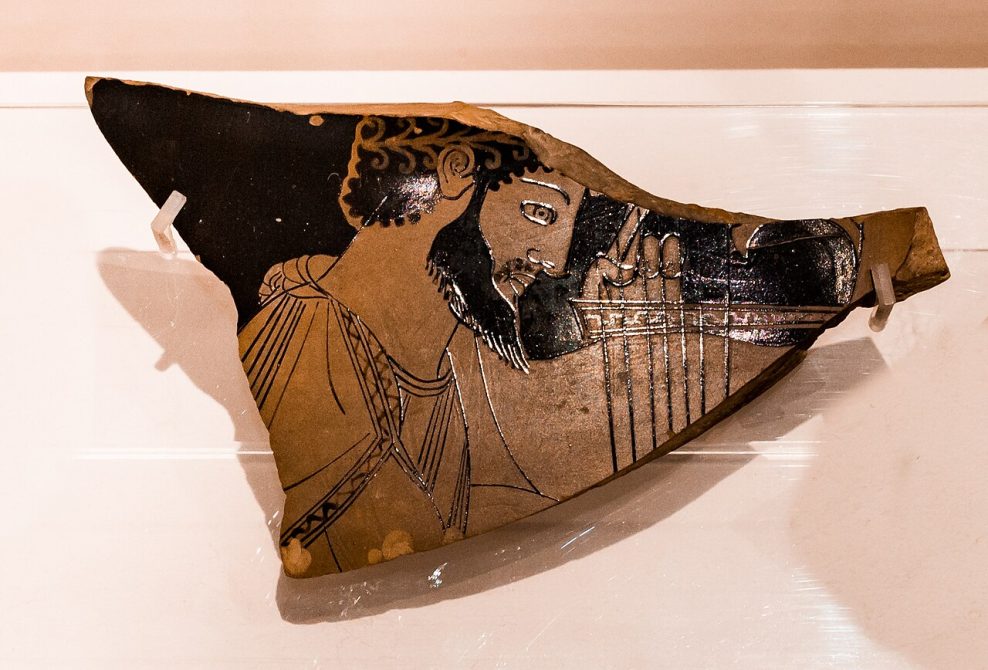
Attic red-figure vase fragment attributed to the Kleophrades Painter, ca. 490–470 BC, showing a kitharoidos playing the kithara. Photo by ArchaiOptix, via Wikimedia Commons, licensed under CC BY-SA 4.0. No changes were made.
Style and Technique: How to Recognize His Work
Attribution in the field of ancient Greek ceramics relies primarily on visual analysis of recurring stylistic traits across multiple works. The Kleophrades Painter has a distinctive vocabulary that scholars have identified consistently across his attributed pieces.
Facial Features and Figural Drawing
His figures tend toward the monumental. They are large, well-proportioned, and robustly drawn, with a physical solidity that suits the broad surfaces of the large-format vessels he preferred. The faces are particularly telling: his figures have long, slender eyes and strong, well-defined chins. The inner detail of the ear is rendered in a recognizable way, and this small element alone has helped scholars confirm or question attributions.
Emotional Range and Narrative Ambition
What most distinguishes the Kleophrades Painter from his contemporaries is the emotional register of his scenes. Earlier Attic vase painters often presented mythology as spectacle, with figures arranged in formal, balanced compositions. The Kleophrades Painter pushed toward something more charged. His scenes carry grief, violence, determination, and pathos in ways that feel genuinely expressive rather than decorative. Art historians have noted that the quality of grief visible in the Vivenzio Hydria represents a departure not only for this painter but for Attic vase painting as a whole up to that point.
Technique and the Transition Between Styles
Although firmly associated with the red-figure technique, in which the background of a vessel is painted black and figures are left in the natural red of the fired clay, the Kleophrades Painter was equally at home in black-figure, the older tradition in which figures are painted in black silhouette over a red ground. His career traces the transition between these two traditions. On his earliest vessels, the ornamental borders and decorative patterns are done in black-figure while the main figurative scenes are red-figure. As his career progressed, the red-figure technique gradually took over both zones. He also made limited use of the white-ground technique, a refined variation typically associated with funerary vessels.
Scholars have observed that his brushwork carries a confident, relief-like quality. His relief lines, the slightly raised outlines that define forms in red-figure painting, are bold and decisive, giving his figures weight and physical presence.
Preferred Vessel Shapes
The Kleophrades Painter favored large-format vessels that gave him room for ambitious multi-figure compositions. The four shapes he returned to most consistently were calyx kraters, hydrias, neck amphorae, and Panathenaic prize amphorae. He also decorated stamnoi, pelikai, loutrophoroi, cups, and psykters, though in smaller numbers.
His preference for large surfaces is not incidental. The expansive shoulder of a hydria, or the tall body of a neck amphora, allowed him to construct panoramic narrative scenes of a kind that smaller vessels simply cannot accommodate.
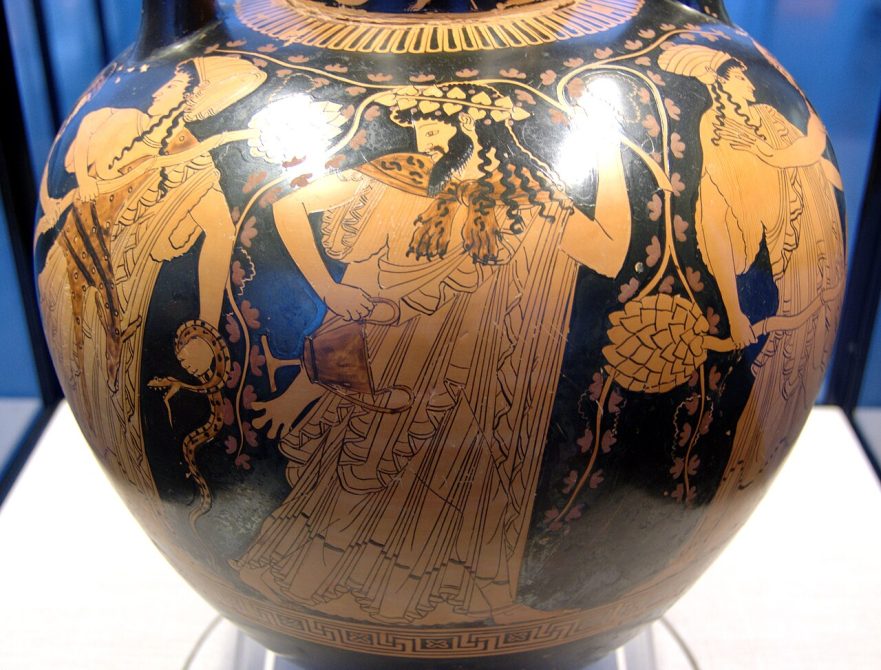
Attic red-figure pointed amphora by the Kleophrades Painter, 500–490 BC, showing a Dionysiac thiasos. Photo by Bibi Saint-Pol, via Wikimedia Commons, public domain. No changes were made.
Key Works
The Vivenzio Hydria (Sack of Troy)
Held at the Museo Nazionale Archeologico in Naples, this kalpis-type hydria is among the most discussed works in the history of Greek vase painting. The shoulder of the vessel carries a continuous panoramic scene depicting the fall of Troy, known in ancient Greek as the Iliupersis. The narrative moves from left to right: Aeneas flees with his elderly father Anchises on his back and his young son Ascanius leading the way; Cassandra clutches the cult image of Athena as the lesser Ajax seizes her; the aged Priam sits at an altar, holding the body of his grandson Astyanax, who has already been killed by Neoptolemos; a Trojan woman attacks a Greek soldier with a household pestle. Elsewhere, the sons of Theseus rescue their grandmother Aithra amid the general destruction.
The painting is extraordinary in several respects. A continuous multi-figure narrative encircling the shoulder of a hydria is without clear precedent. The depiction of grief, particularly in the figure of Priam, achieves a depth of pathos rarely seen in Attic vase painting before this period. Scholars have also noted a possible contemporary resonance: the work appears to date to shortly after the Persian sack of Athens in 480 BCE, when the parallel between the mythological destruction of Troy and the living memory of the Acropolis in ruins would have been immediately felt.
Panathenaic Prize Amphorae
The Kleophrades Painter completed a number of Panathenaic prize amphorae, vessels awarded to victors at the Panathenaic Games in Athens. By long-standing convention, these vessels were always produced in the black-figure technique regardless of the prevailing fashion, and they always depicted Athena Promachos, the goddess in full martial stance, on the obverse. The Kleophrades Painter’s Panathenaic amphorae are identifiable by specific details: a winged horse (Pegasus) appears on Athena’s shield, and the position of her spear in relation to her head and face follows a consistent compositional formula. A fine example from c. 500 BCE is held in the collection of the Metropolitan Museum of Art in New York.
Dionysiac Amphora (Munich)
An important red-figure amphora now in the Staatliche Antikensammlungen in Munich depicts Dionysus accompanied by maenads and satyrs. The work is a strong example of the painter’s approach to the Dionysiac subject matter he returned to throughout his career. The figures possess the physical solidity and expressive energy that characterize his mature style.
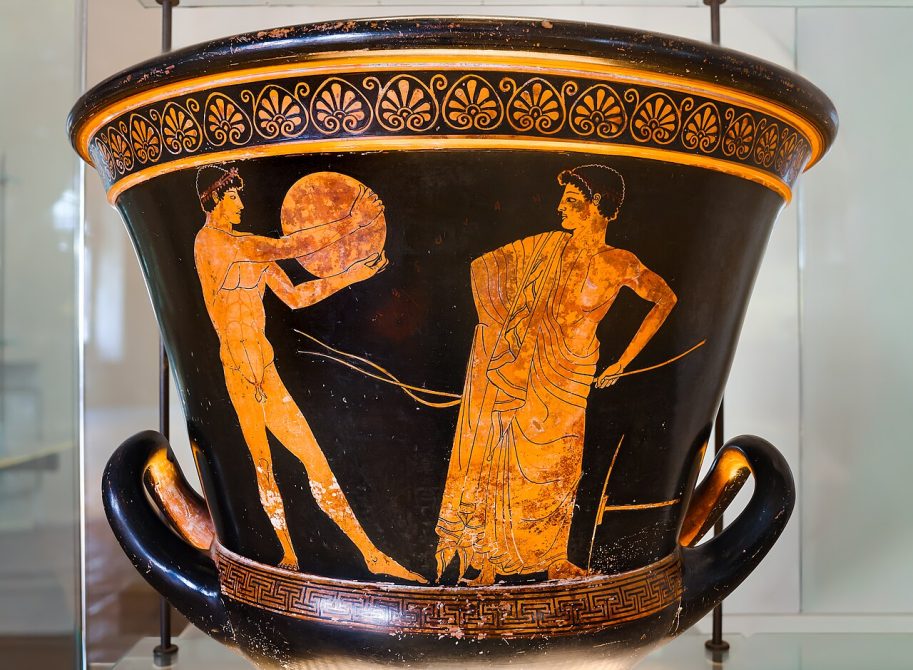
Attic red-figure calyx krater attributed to the Kleophrades Painter, ca. 500–490 BC, showing a discobolos, trainer, and acontist. Photo by ArchaiOptix, via Wikimedia Commons, licensed under CC BY-SA 4.0. No changes were made.
Legacy and Influence
The Kleophrades Painter is consistently placed among the two or three greatest vase painters of the late Archaic period. His principal rival for that position is the Berlin Painter, his own student, who developed a contrasting style of deliberate formal restraint and quiet precision. Where the Kleophrades Painter favored density, emotional weight, and large figurative panoramas, the Berlin Painter moved toward isolated figures on clean black grounds. Together they defined the range of possibilities available to Attic red-figure painting in the early fifth century BCE.
The Beazley Archive Pottery Database lists approximately 227 vases either directly attributed to, closely associated with, or compared to the Kleophrades Painter. Of these, 113 are direct attributions. The distribution of his surviving work across the major museum collections of Europe and North America reflects both the quality of his output and the scale of the ancient Athenian export trade. Most of his attributed vases were found in Etruscan sites in central Italy, which purchased Attic ceramics in large quantities throughout the sixth and fifth centuries BCE.
The Boot Painter and the Troilos Painter are also counted among those who worked in his circle or under his influence. In several cases, the Boot Painter and the Kleophrades Painter appear to have decorated vessels produced by the same potter at roughly the same time, suggesting they may have shared a workshop.
Why the Kleophrades Painter Still Matters
The enduring interest in the Kleophrades Painter goes beyond the quality of individual vessels. His work sits at a pivotal moment in the history of Western art: the transition from the stylized conventions of Archaic decoration toward the greater naturalism and psychological depth that would characterize the Classical period. In that sense, he is not simply a skilled craftsman working within an established tradition, but someone actively expanding what vase painting could express.
His use of the ceramic surface as a space for genuine narrative, complete with emotional consequence and visual drama, anticipates concerns that would later define panel painting, fresco, and the figurative arts more broadly. The Sack of Troy hydria in particular shows what a painted vessel could achieve when the painter treated it not as a decorative object but as a medium for storytelling.
For those exploring the origins of Greek ceramic traditions, or seeking to understand the roots of Attic black-figure and red-figure pottery, the Kleophrades Painter is an indispensable figure. Attic Black’s own work in reviving ancient Athenian ceramic techniques draws on the same tradition this painter helped define. To learn more about these techniques and the workshop culture of the ancient Kerameikos, explore our guide to red-figure and black-figure pottery, or consider joining one of our pottery workshops in Athens where these methods are practiced by hand.
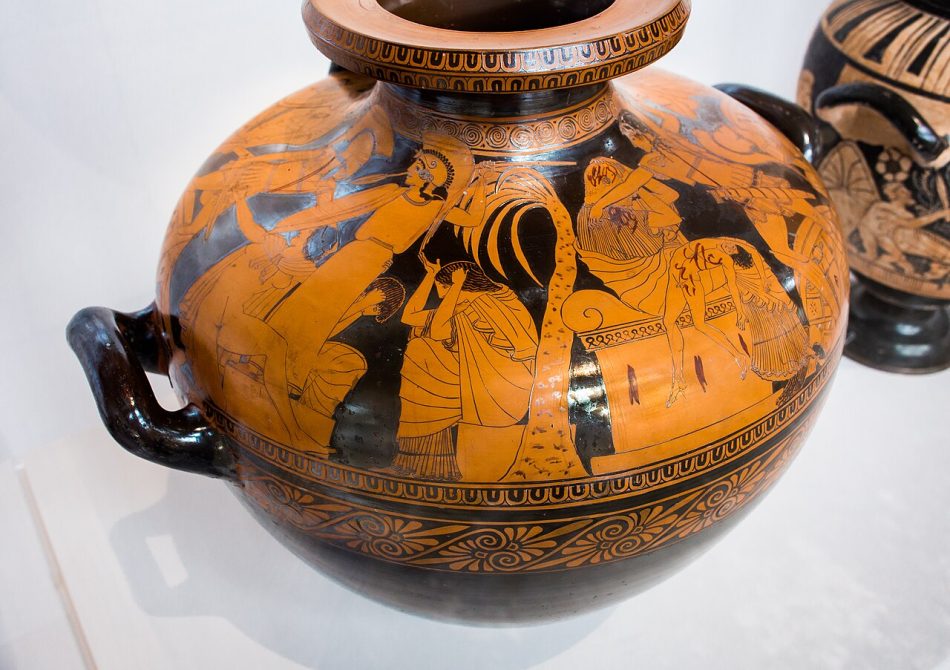
Attic red-figure hydria attributed to the Kleophrades Painter, ca. 490–480 BC, showing the Ilioupersis, or fall of Troy. Photo by ArchaiOptix, via Wikimedia Commons, licensed under CC BY-SA 4.0. No changes were made.
Frequently Asked Questions
What is the Kleophrades Painter known for?
The Kleophrades Painter is known as one of the finest red-figure vase painters of ancient Athens, active from approximately 510 to 470 BCE. He is particularly associated with large-format vessels carrying emotionally charged mythological scenes, most notably the Vivenzio Hydria depicting the Sack of Troy.
Why is the Kleophrades Painter anonymous?
His true name is unknown. Ancient Greek vase painters rarely signed their work, and modern scholars identify individual painters by assigning conventional names based on a related potter, a significant collection, or a key attributed vessel. The name “Kleophrades Painter” comes from a potter’s inscription on a cup in Paris.
Where can I see works attributed to the Kleophrades Painter?
Attributed vessels are held in major museum collections worldwide. The Vivenzio Hydria is at the Museo Nazionale Archeologico in Naples. A Panathenaic prize amphora is in the Metropolitan Museum of Art in New York. A Dionysiac amphora is at the Staatliche Antikensammlungen in Munich. The Cabinet des Medailles in Paris holds the cup that gave him his name.
How does the Kleophrades Painter relate to the Pioneer Group?
The Kleophrades Painter was not a formal member of the Pioneer Group but is believed to have worked in close proximity to it. His teacher, Euthymides, was a leading Pioneer. He absorbed the group’s innovations in red-figure draftsmanship and went on to develop those ideas in his own mature work.
Who were the Kleophrades Painter’s students?
His most notable student was the Berlin Painter, who became one of the defining figures of early Classical Attic vase painting. The Boot Painter and the Troilos Painter are also associated with his workshop or artistic circle.
Featured image: Attic red-figure hydria attributed to the Kleophrades Painter, ca. 490–480 BC, depicting the Ilioupersis, or fall of Troy. Photo by ArchaiOptix, via Wikimedia Commons, licensed under CC BY-SA 4.0. No changes were made.