
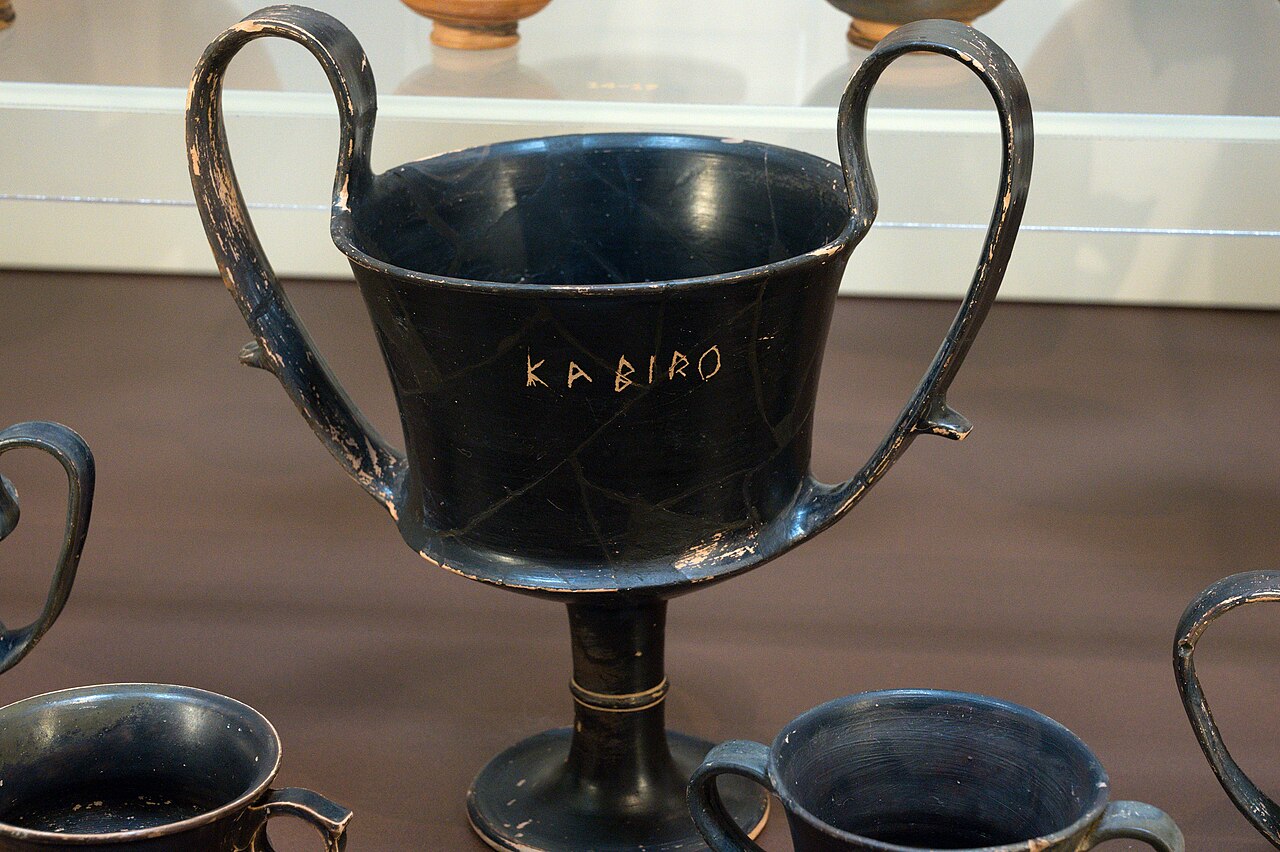
Ancient Greek black glaze, often called Attic black gloss, is not a modern glaze or black paint.
It is an exceptionally fine, iron-rich clay slip applied to a vessel and transformed in a three-stage firing cycle. Controlled oxidation, reduction, and re-oxidation turn the treated surface glossy black while exposed clay returns to its characteristic red-orange color.
For centuries, the polished black surfaces of Athenian pottery resisted easy explanation. The finish could appear deep and reflective, almost metallic, yet it was achieved without modern pigments, synthetic coatings, or the recipes now associated with ceramic glaze. Its durability was equally striking. On well-preserved vessels, the black surface has retained its color and sheen for more than two millennia.
The answer lies not in a single secret ingredient, but in a carefully coordinated system of clay selection, particle refinement, surface preparation, kiln atmosphere, and timing. Ancient Athenian potters understood how iron-bearing clay behaved in fire with a level of control that remains technically demanding today.
Known today as black glaze, black gloss, or Classical Greek black slip, this surface was fundamental to Attic black-figure pottery, red-figure pottery, and fully black-coated vessels. Understanding it reveals why ancient Greek pottery technique was both an artistic practice and a form of sophisticated materials science.
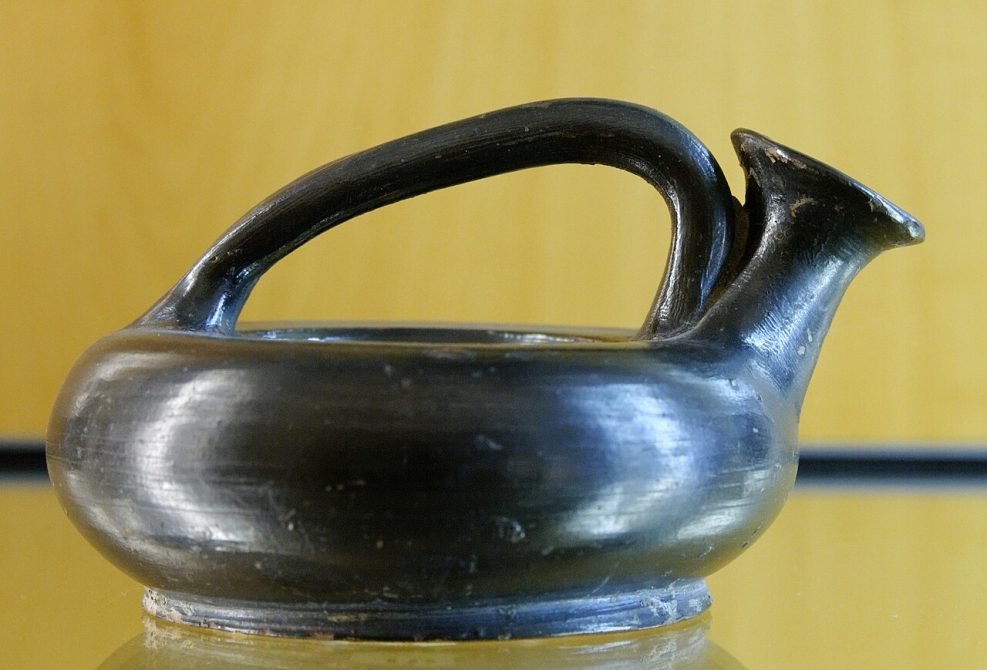
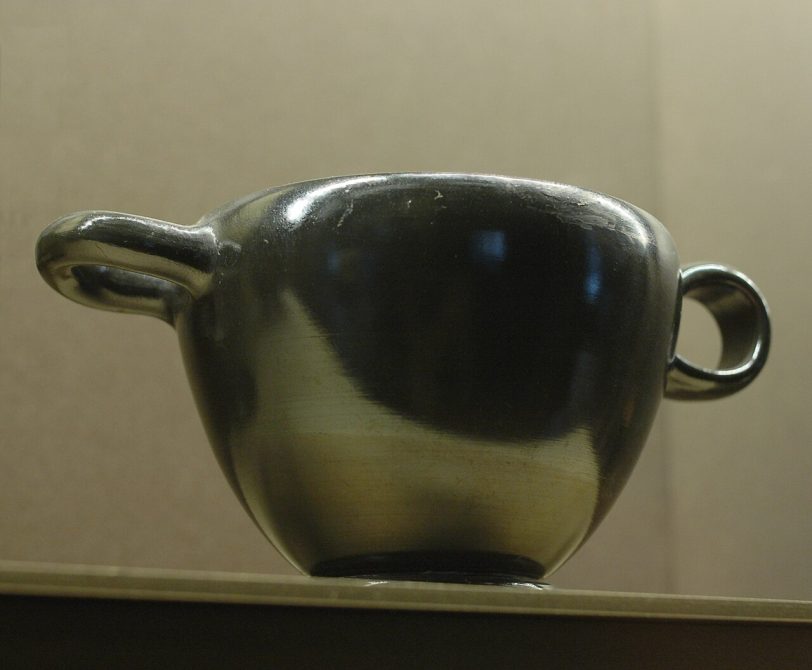
Attic black-glaze askos, 5th century BC, Museum of Fine Arts of Lyon. Photograph by Marie-Lan Nguyen, via Wikimedia Commons, licensed under CC BY 2.5. No changes were made.

What Is Ancient Greek Black Glaze?
The term “black glaze” is useful but potentially misleading. In modern ceramics, a glaze generally refers to a formulated coating that melts into a glassy layer during firing. Ancient Attic black gloss began instead as a suspension of very fine clay particles in water. Ceramic specialists therefore often describe it as a slip, a clay paint, or a sintered slip.
This distinction matters. The black was not brushed onto a finished vessel as color. It emerged from the same broad family of iron-bearing clay materials as the vessel itself. During firing, however, the fine slip and the coarser ceramic body reacted differently. The slip became dense, smooth, and partly vitrified, while the untreated body remained more porous.
The visual contrast between glossy black and warm red-orange was created by controlling those physical differences inside the kiln. It was an effect produced through matter and atmosphere, not an added black pigment.
The finish appears in several related traditions:
- In black-figure pottery, figures and ornamental details were painted in slip, then sharpened with incised lines.
- In red-figure pottery, the background was covered with slip while figures were left in the color of the vessel body.
- In black-glazed ware, most or all of the surface was coated, emphasizing the vessel’s form, proportions, and sheen.
These approaches used the same essential black-gloss technology, although workshop practices, clay preparation, application, and firing quality varied.
The Attic Clay Behind the Surface
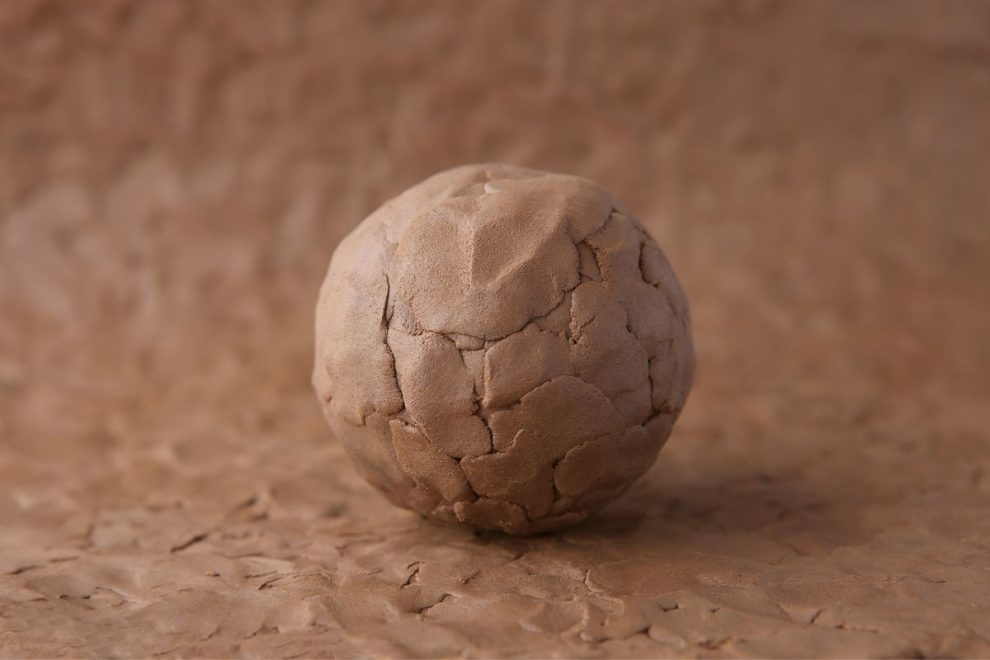
The material story begins with the geology of Attica. Athenian ceramic production drew on iron-bearing clays whose mineral composition could produce the familiar reddish body and dark gloss under the right firing conditions. Yet clay dug from the ground was not ready to become black slip.
The vessel body required a workable mixture with enough plasticity and structure for throwing, joining, and drying. The surface coating required something far finer. Potters selected and processed suitable non-calcareous, iron-rich clay to obtain a suspension rich in very small particles, often associated with illitic clay minerals.
This relationship between local geology and finished color is explored further in Attic Black’s guide to Attic clay and the origins of ancient ceramics.
Levigation: refining clay with water
Levigation separates particles by size through water and settling. Clay is mixed with water to create a suspension. Heavier grains and unwanted inclusions settle more quickly, while the finest particles remain suspended longer. The upper liquid can then be transferred and processed again, gradually concentrating the fraction best suited to a smooth coating.
This refined liquid slip could be applied to a leather-hard vessel with a brush, by dipping, or through a combination of methods, depending on the desired design. Because its particles were extremely small and evenly distributed, the coating already had the potential to form a compact surface. Burnishing or careful smoothing could further influence the finish, but the decisive transformation took place in the kiln.
There was no simple universal Attic black glaze recipe in the modern sense. Raw materials differed by source, and successful results depended on the relationship among mineral composition, particle size, slip thickness, vessel body, temperature, kiln atmosphere, and cooling. A recipe copied as a list of ingredients would capture only a small part of the craft.
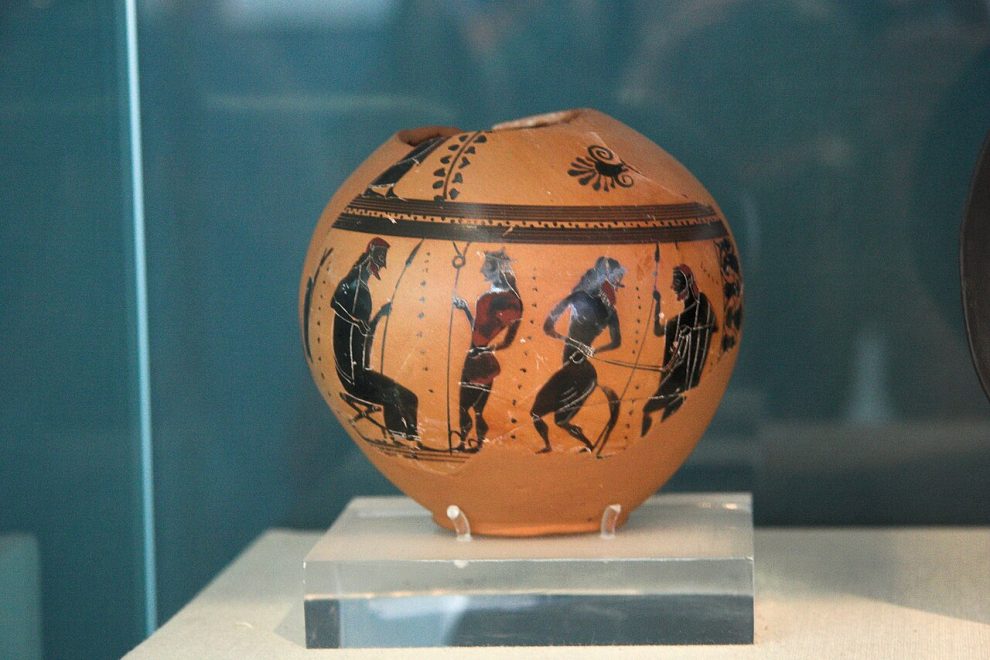
Ancient Greek black-figure pottery depicting Midas, Hermes and Silenos, circa 550 BC, Archaeological Museum of Eleusis. Photograph by Zde, via Wikimedia Commons, licensed under CC BY-SA 4.0. No changes were made.

The Three-Stage Iron-Reduction Firing Process
The characteristic red and black of Attic pottery were produced in a single firing that changed atmosphere three times. This oxidation, reduction, and re-oxidation sequence demanded careful management of temperature, airflow, fuel, and timing.
Ancient kilns did not provide digital readings or automated atmosphere controls. Potters judged conditions through accumulated experience, observing the fire, smoke, draft, and the behavior of test pieces. The structure and operation of these firing chambers are examined in Attic Black’s article on the ancient pottery kiln and its historical techniques.
Stage 1: oxidation turns the clay red
During the first stage, air circulated through the kiln as the temperature rose, commonly described as reaching around 800°C before the cycle moved toward its hotter reducing phase. With oxygen available, iron compounds in both the vessel body and the slip oxidized. Red hematite, Fe₂O₃, contributed to the red-orange appearance of the clay.
At this point, coated and uncoated areas were broadly similar in color. The sharp distinction familiar from finished Attic pottery had not yet formed.
Stage 2: reduction turns the vessel black
In the second stage, potters restricted the oxygen entering the kiln and introduced conditions that produced a smoky, reducing atmosphere. Accounts often mention green wood as part of this shift. Incomplete combustion generated gases, including carbon monoxide, that drew oxygen from iron oxides in the clay.
The entire vessel darkened as red iron oxides were converted into reduced, darker phases, including magnetite, Fe₃O₄, along with other iron-bearing compounds identified in scientific studies. Temperatures could rise toward roughly 900 to 950°C, although exact reconstructions vary by kiln, material, and experimental protocol.
The fine slip responded differently from the coarser body. Its small particles fused closely together through sintering and partial vitrification, forming a dense layer with very low porosity. This compact surface would become crucial in the final stage.
Stage 3: re-oxidation restores the red body
In the last stage, air was allowed back into the kiln as firing conditions changed and the load began its controlled transition toward cooling. Oxygen could penetrate the porous, uncoated clay body, converting reduced iron compounds back toward red hematite. Those areas returned to a warm terracotta color.
The dense slip layer admitted oxygen far less readily. Its reduced iron compounds remained dark, so the coated areas stayed black. One firing therefore produced two colors from closely related clay materials.
This selective re-oxidation is the central technical achievement. The outcome depended on the slip becoming sufficiently dense during reduction without overfiring, peeling, streaking, or losing adhesion. Too much air at the wrong moment, uneven heat, an unsuitable clay fraction, or an incorrect coating thickness could alter the result.
Attic black-slip glaux skyphos, Athens, circa 450–400 BC, Louvre Museum. Photograph by Jastrow, via Wikimedia Commons. Released into the public domain. No changes were made.


How Black Glaze Shaped Greek Vase Painting
Black gloss was not simply a finish laid over decoration. It was part of the visual language of ancient Greek vase painting.
In the black-figure technique, the painter used refined slip to create silhouettes against the red clay ground. Details were cut through the coated surface with a sharp point, revealing the lighter body beneath. Added red and white could provide further accents. The method gave artists strong contours and a disciplined graphic structure. Attic Black’s study of black-figure Greek pottery examines the technique and its narrative possibilities in greater detail.
Red-figure pottery reversed the arrangement. Painters covered the background in slip and reserved the figures in red, using painted lines rather than incision for much of the internal detail. This allowed more fluid treatment of anatomy, drapery, movement, and spatial relationships. The contrast still depended on the same firing chemistry, as explained in this overview of Greek red and black pottery techniques.
Fully black-glazed vessels demonstrate another dimension of the material. Without narrative scenes, the gloss draws attention to profile, handles, foot, rim, and the movement of light across the form. Some surfaces appear mirrorlike; others are softly lustrous, brownish, mottled, or marked by firing variations. These differences can reveal choices in preparation and firing as well as the uncertainties inherent in kiln work.
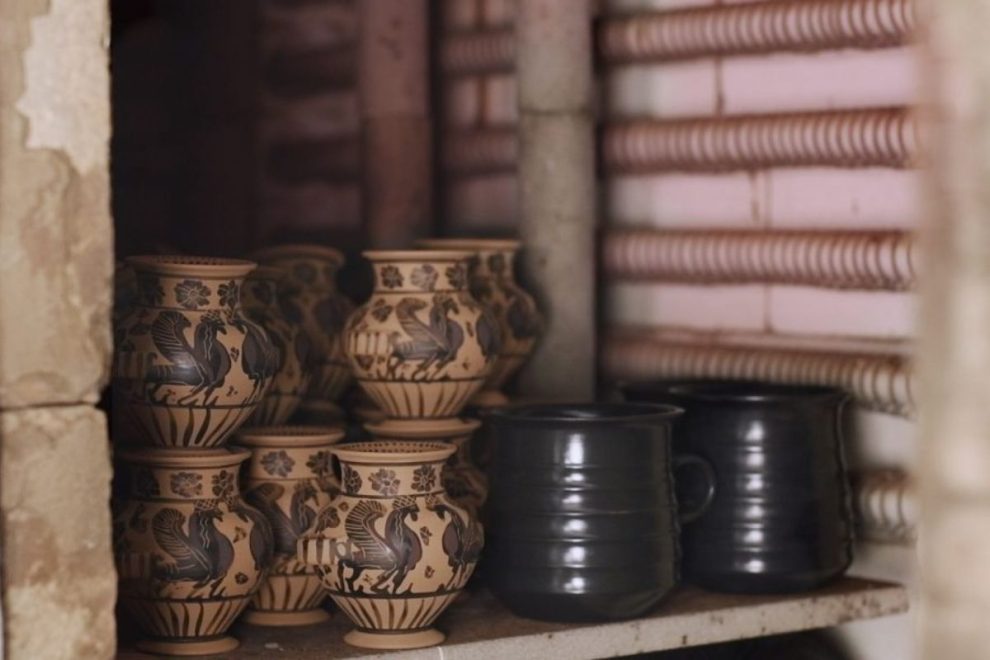
Why Authentic Attic Black Glaze Is Difficult to Reproduce
Modern ceramics offer many reliable ways to make a pot black. Commercial stains, oxides, underglazes, and formulated glazes can produce consistent color with far less risk. They can create an attractive surface, but they do not reproduce the historical process simply because the result looks similar.
Authentic Greek ceramics reproduction requires the maker to rebuild a chain of interdependent decisions:
- Clay selection: The slip and body must contain suitable minerals and respond compatibly during drying and firing.
- Particle refinement: Levigation must isolate a very fine and stable clay fraction.
- Application: Slip consistency and thickness affect adhesion, coverage, and sheen.
- Drying: Uneven moisture can cause cracking, distortion, or separation before firing begins.
- Kiln control: Oxidizing, reducing, and re-oxidizing conditions must occur in the correct sequence and temperature range.
- Placement and airflow: Different areas of a kiln can experience different heat and atmosphere, producing variation within one firing.
- Judgment: The process must be adjusted to the specific clay, kiln, weather, fuel, and load rather than followed as a fixed formula.
The challenge is not merely to obtain black. It is to achieve a stable, adherent, finely lustrous black surface while allowing exposed clay to recover its red color. Even small deviations may yield grey, brown, uneven, or overly vitrified results.
Scientific analysis has clarified the mineral transformations involved, but information alone does not replace workshop knowledge. Reproduction depends on repeated testing and a practical understanding of how material behaves at each stage.
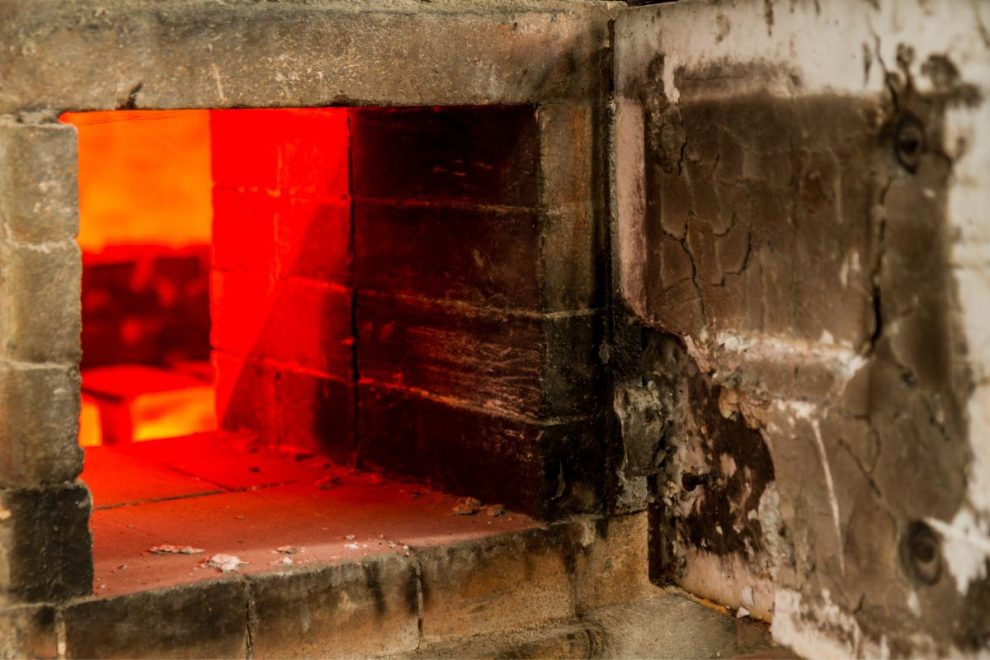
Reviving an Ancient Greek Pottery Technique in Athens
The reconstruction of Attic black gloss connects archaeology, conservation science, and living ceramic practice. It asks modern makers to study ancient objects closely, source and refine appropriate clays, reconstruct firing conditions, and accept the disciplined experimentation that historical processes require.
At the Attic Black studio in Athens, this work is grounded in the study of ancient prototypes and the physical realities of clay and fire. Reproductions do more than imitate the outline or painted subject of a surviving vase. They investigate the sequence by which an object was originally made.
For visitors, students, and ceramic practitioners, workshop visits and training offer a closer view of the knowledge embedded in Greek ceramic craft. Handling clay, observing slip preparation, and learning how vessel form relates to decoration make the technical achievement easier to understand than appearance alone can convey.
The Enduring Significance of Attic Black Gloss
Ancient Greek black glaze is a record of controlled transformation. Iron-rich clay, refined by water and altered by fire, became both image and surface. The process united local material, workshop discipline, and precise management of the kiln atmosphere.
Its importance lies partly in its beauty, but also in the knowledge it preserves. The finish shows that ancient Athenian potters were not working with a mysterious black coating. They were directing chemical and physical changes through experience refined across generations.
Attic Black continues this inquiry through handmade ceramic reproductions created in Athens with close attention to historical materials and methods. Readers can explore the collection of Attic-inspired ceramics or encounter the process in the studio, where the surface reveals what no modern paint can substitute: the visible result of clay, atmosphere, and fire acting together.
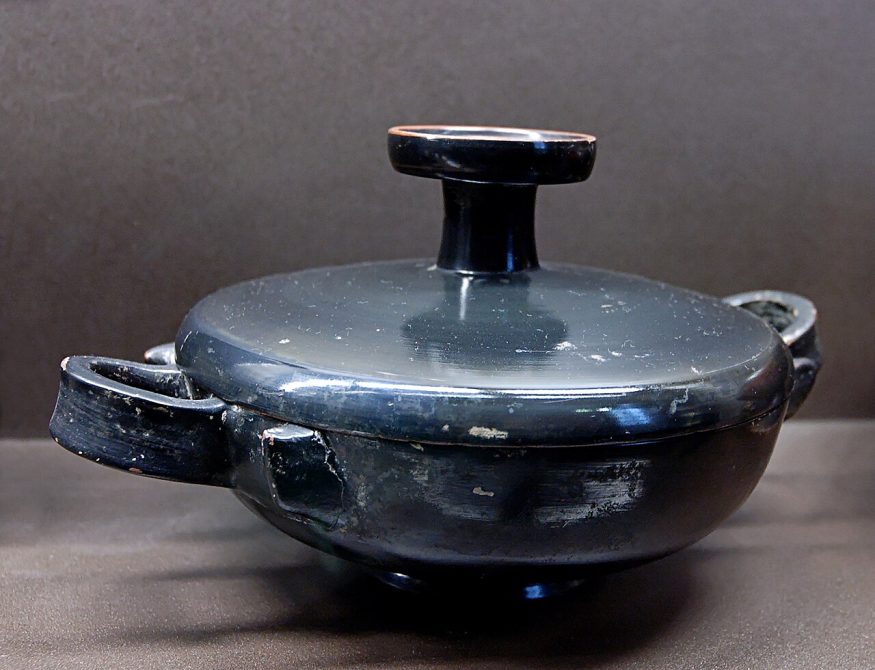
Attic black-glaze lekanis, circa 450–440 BC, Louvre Museum. Photograph by Jastrow, via Wikimedia Commons. Released into the public domain. No changes were made.


Frequently Asked Questions
Is ancient Greek black glaze actually a glaze?
Not in the usual modern sense. It began as a highly refined, iron-rich clay slip. During firing, the slip sintered and partly vitrified into a dense, glossy layer, which is why specialists also use the terms black gloss or black slip.
What made Attic pottery turn black?
A reducing kiln atmosphere changed iron compounds in the clay into darker mineral phases. The fine slip became dense enough to resist re-oxidation, so it remained black when oxygen returned to the kiln.
Why did the unpainted clay turn red again?
The uncoated vessel body remained porous. During the final re-oxidizing stage, oxygen entered the clay and converted iron compounds back toward red hematite, restoring the red-orange color.
Was the same process used for black-figure and red-figure pottery?
Yes. Both relied on refined clay slip and a three-stage firing cycle. The principal difference was compositional: black-figure painters coated the figures, while red-figure painters coated the surrounding background and reserved the figures in red.
Can ancient Attic black glaze be reproduced today?
It can be closely reproduced through suitable clay selection, levigation, careful application, and controlled oxidation, reduction, and re-oxidation. Results remain demanding because the variables are interdependent and historical kilns did not use automated controls.
Featured image: Black-glaze kantharos with the incised inscription “KABIRO,” 5th century BC, Archaeological Museum of Thebes. Photograph by Zde, via Wikimedia Commons, licensed under CC BY-SA 4.0. No changes were made.