
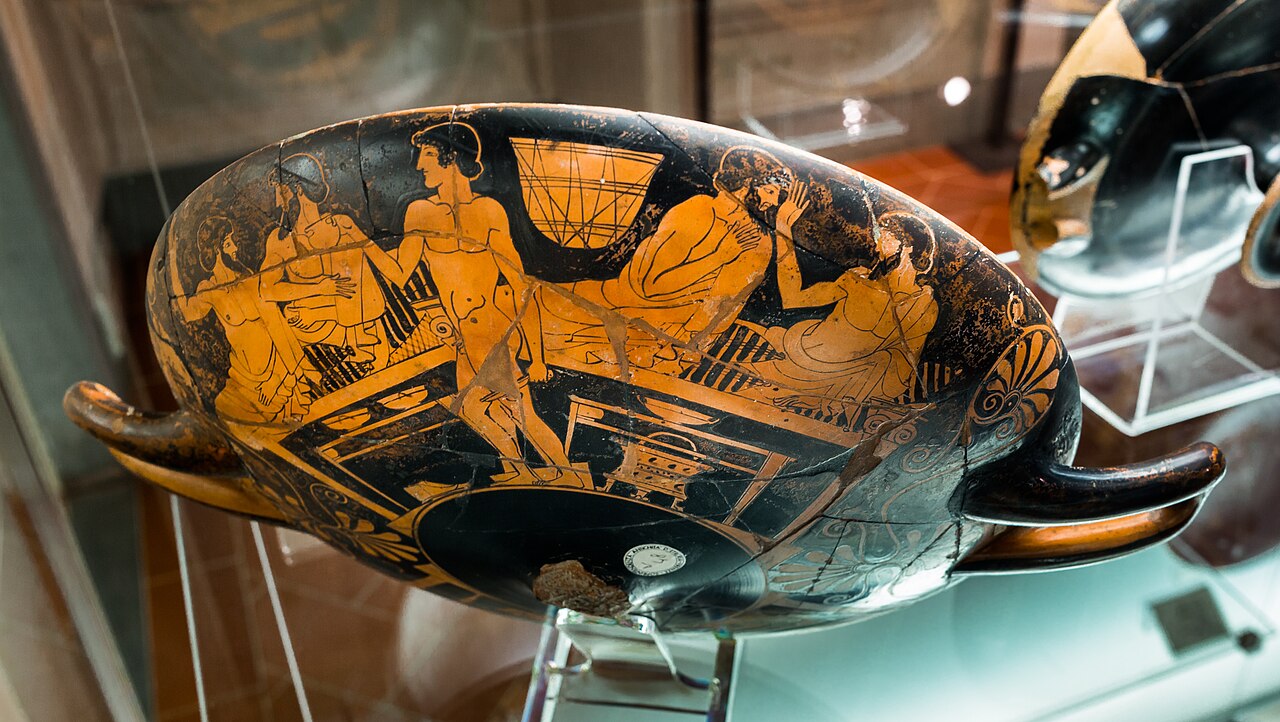
Few figures in the study of ancient Greek ceramics left as clear a signature, as Douris the vase painter.
Working in Athens during the early fifth century BCE, Douris turned the ordinary drinking cup into a record of daily Athenian life: a boy reciting his lesson, a musician tuning a lyre, a woman spinning wool by the hearth, an athlete receiving a wreath. His name survives on more vases than almost any other Attic painter of his generation, giving historians and museum curators an unusually direct link to one artist’s hand across a career that likely spanned four decades. This profile looks at who Douris was, the potters who shaped his cups, the subjects that defined his output, and why his kylikes remain a benchmark for Attic red-figure pottery today.
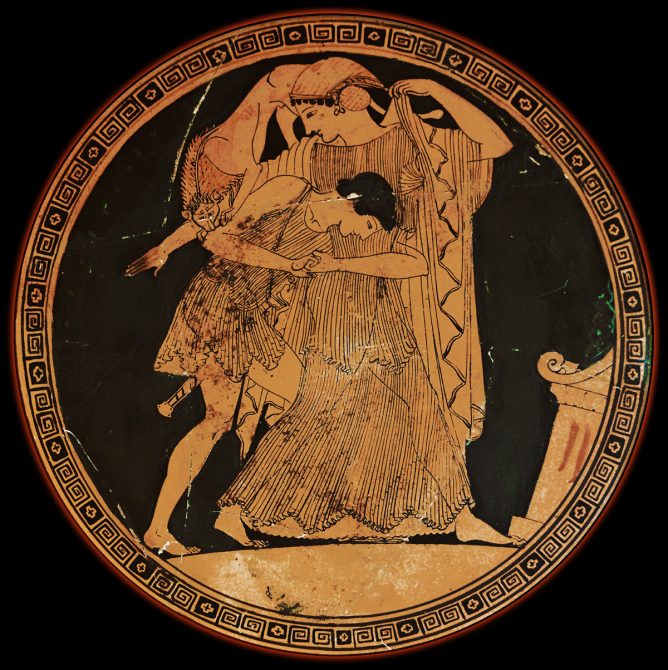
Peleus and Thetis on an Attic red-figure kylix by the Douris Painter, c. 490 BCE. Image via Wikimedia Commons, original photograph by Jastrow. CC0 1.0.
Who Was Douris? Athens’ Most Prolific Vase Painter
Douris was active in Athens from around 500 to 460 BCE, a period art historians place at the transition between the late Archaic and early Classical styles. His signature, either as painter or as potter and painter, appears on close to forty surviving vases, and scholars attribute the decoration of somewhere between 250 and 300 additional vessels to his hand based on style alone. That combination of signed and attributed work makes him one of the most documented Attic red-figure vase painters of the fifth century BCE.
Although red-figure work defines his reputation, a handful of black-figure vases have also been attributed to Douris, a reminder that many Athenian workshops still moved between both techniques well into the fifth century. His draftsmanship was known for fine, controlled line work, and several of his compositions are thought to echo monumental wall paintings of the period that no longer survive, an indirect window onto a tradition of Greek painting that is otherwise lost.
Art historian John Beazley, whose attribution system still shapes the study of Attic pottery, divided Douris’s career into four stylistic phases based on details as small as the drawing of a collarbone or the arrangement of a meander border. Favorite-name inscriptions praising youths such as Chairestratos, Hippodamas, and Polyphrasmon help date these phases and place individual cups within his working life.
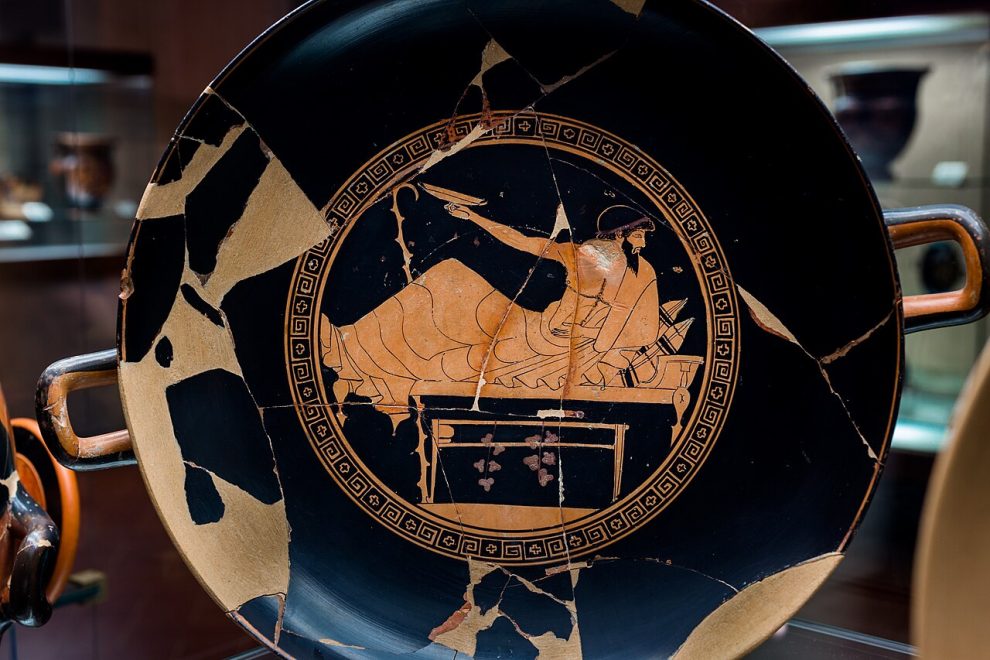
Attic red-figure kylix by Douris, c. 485–480 BC, depicting a symposion. Photo by ArchaiOptix via Wikimedia Commons, licensed under CC BY-SA 4.0. No changes were made.
The Potters Behind Douris’s Kylikes
A vase painter in ancient Athens rarely worked alone. Painters decorated pots thrown by specialist potters, and the resulting partnership shaped both the surface available for decoration and the finished object’s quality. Early in his career, Douris painted vessels potted by Kleophrades and by Euphronios, both established figures in the Athenian ceramic trade of the late sixth century BCE.
A Defining Partnership with Python
Douris’s most significant and lasting collaboration was with the potter Python. Together, the two produced a long series of signed kylikes that represent the core of Douris’s surviving output. As a Douris kylix painter, working almost exclusively on the kylix, the standard drinking cup shape of the Athenian symposium, gave him a wide, shallow surface, a tondo at the center of the interior, and two broad exterior bands, ideal for both single dramatic scenes and continuous narrative. That partnership with Python is part of why so much of what survives from Douris’s hand is cup, rather than krater or amphora, based.
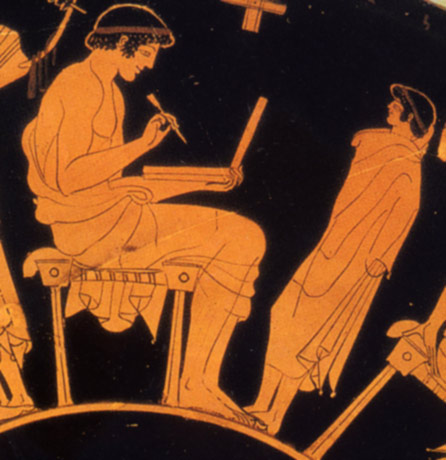
Ancient Greek man with a wax tablet, painted by Douris, c. 500 BC. Photo by Pottery Fan via Wikimedia Commons, licensed under CC BY-SA 3.0. No changes were made.
Everyday Athens on a Drinking Cup
What sets Douris apart from many of his contemporaries is not only his output but his subject matter. Alongside the mythological scenes expected of a fine Attic cup, Douris painted the details of ordinary Athenian life with an attentiveness that still reads clearly today.
The Schoolroom and Music Lesson Cup
Among his best known works is a kylix now in Berlin, often called Douris’s school cup, which shows the stages of a boy’s education across its interior and exterior. One register depicts a lesson in music, with a teacher tuning a lyre while a pupil looks on; another shows a boy reciting poetry from a scroll while his teacher checks the text. The composition remains one of the clearest surviving pictures of how reading, writing, and music were taught in a private Athenian household, rather than a public school in the modern sense.
Women at Home
Douris also painted scenes of women engaged in domestic work, including wool-working, one of the most common daily activities of an Athenian household and a task closely tied to a woman’s role in managing it. These scenes are quieter than his symposium and mythological compositions, but they add an important layer to Douris’s record of Athenian daily life, one that includes the household as much as the drinking party or the gymnasium.
Athletes, Youths, and the Symposium
Many of Douris’s kylikes turn to the world of young men: athletes training or receiving a wreath, courtship scenes between an older and younger man, and the drinking parties and processions, known as komoi, that followed a symposium. Satyrs and maenads appear frequently as well, tied to the wine god Dionysos and to the atmosphere of the symposium itself. Together, these scenes suggest that many of Douris’s cups were made with that setting specifically in mind, meant to be turned in the hand and studied by a drinker reclining at an Athenian banquet.
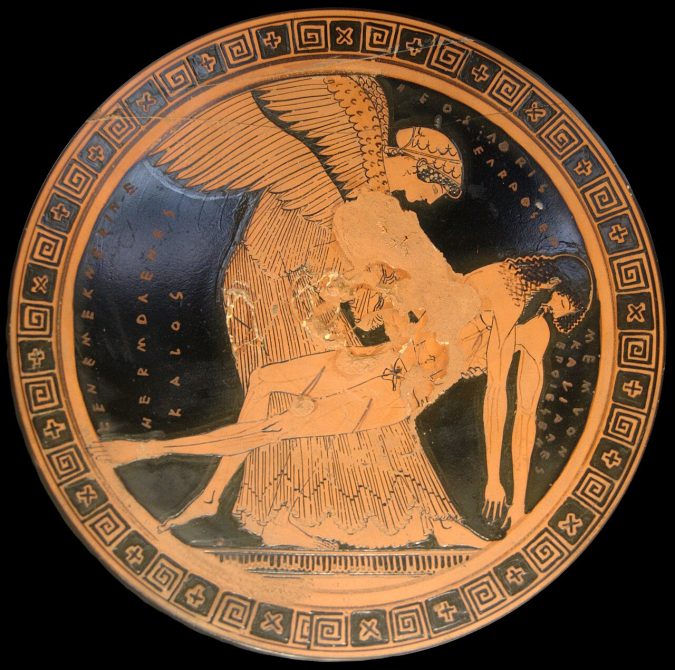
Eos lifting the body of her son Memnon, interior of an Attic red-figure cup by Douris, c. 490–480 BC. Photo by Bibi Saint-Pol via Wikimedia Commons. Public domain. No changes were made.
Eos and the Pietà of Memnon: Douris’s Mythological Masterpiece
Douris’s most celebrated mythological composition appears on a kylix now in the Louvre, dated to around 490 to 480 BCE. Its interior tondo shows the goddess Eos, dawn personified, cradling the body of her son Memnon, the Ethiopian king killed by Achilles at Troy. Often called Memnon’s Pietà for its echo of later religious imagery, the scene is remarkable for its restraint: rather than depicting battle, Douris chose the quiet moment of a mother’s grief, with Eos’s wings wrapped protectively around her son’s lifeless body. The composition is frequently cited as one of the most emotionally direct images to survive from Attic vase painting, and it remains a touchstone for how the ancient Greek cup painter Douris used mythological subjects to explore feeling rather than only action.
Is the Berlin Foundry Cup a Work by Douris?
Readers researching Douris often come across the Berlin Foundry cup, and the two are sometimes mentioned together, so the connection is worth clarifying directly. The Berlin Foundry Cup, housed in the Altes Museum alongside Douris’s own school cup, is a red-figure kylix from around 490 to 480 BCE showing the interior of a bronze foundry: workers polishing a life-sized statue, assembling another, and tending a furnace. It is attributed not to Douris but to an anonymous contemporary known as the Foundry Painter, who trained in the workshop of the Brygos Painter rather than with Python.
The confusion is understandable. Both cups are Late Archaic kylikes from Athenian workshops, both are now in Berlin, and both are frequently studied together as evidence of specialized craft in the ancient city, one showing a schoolroom, the other a metalworking shop. But they are the work of two different hands, and treating them as a single artist’s output would misstate the record. What the Berlin Foundry Cup does share with Douris’s own output is a fascination with craftsmanship itself, a subject Athenian vase painters returned to again and again.
Douris’s Place Among Attic Red-Figure Painters
When historians discuss Douris red-figure pottery today, his name sits alongside major contemporaries such as the Berlin Painter, known for isolating single figures against a plain black background, and the workshop that produced the Kleophrades Painter‘s vases. Compared to these contemporaries, Douris stands out for the sheer range of his subject matter and the clarity of his line work, qualities that made his cups desirable both in Athens and, based on where many have been recovered, among Etruscan buyers in Italy.
His output belongs to the broader tradition of Attic pottery, the ceramics produced in and around Athens that set the standard for fine painted pottery across the ancient Mediterranean. Within that tradition, Douris’s kylikes occupy a particular place: proof that a small drinking cup, no larger than a modern soup bowl, could carry storytelling as ambitious as anything painted on a large krater or amphora. His work sits within the wider development of Attic red-figure pottery, the technique that replaced black-figure painting as the dominant style in Athenian workshops during the sixth and fifth centuries BCE.
The Kylix, the Symposium, and Why Douris’s Cups Still Matter
Nearly everything Douris painted was made for use, not display in the modern sense. The kylix was a working object, passed from hand to hand at a drinking party, tipped back to drink from, and studied closely only when empty, at which point the interior tondo scene came into full view. Understanding Douris’s work means understanding that context: a cup showing a schoolroom or a mythological scene of grief was meant to prompt conversation among men reclining together over wine, not simply to be admired on a shelf.
That connection between object and occasion is part of what makes Douris’s kylikes so valuable to historians of ancient Athenian drinking culture today. His cups are not only art; they are evidence of how Athenians taught, drank, mourned, and told stories to one another.
Douris’s Legacy in Attic Black’s Hand-Painted Kylikes
The tradition Douris helped define, decorating a kylix with the same care given to a public monument, still shapes how fine ceramics are made in Athens today. At Attic Black, that same relationship between shape and story guides every hand-thrown kylix and cup that leaves the studio. Each piece is thrown, fired, and painted using techniques descended from the same workshops Douris once supplied, turning a functional drinking vessel into a small, considered work in its own right.
For readers who want to move from studying Douris’s cups to understanding how they were made, Attic Black’s collection of hand-painted kylikes and cups offers a direct, practical connection to that same craft, along with the Athens workshops where the techniques are still taught and practiced by hand.
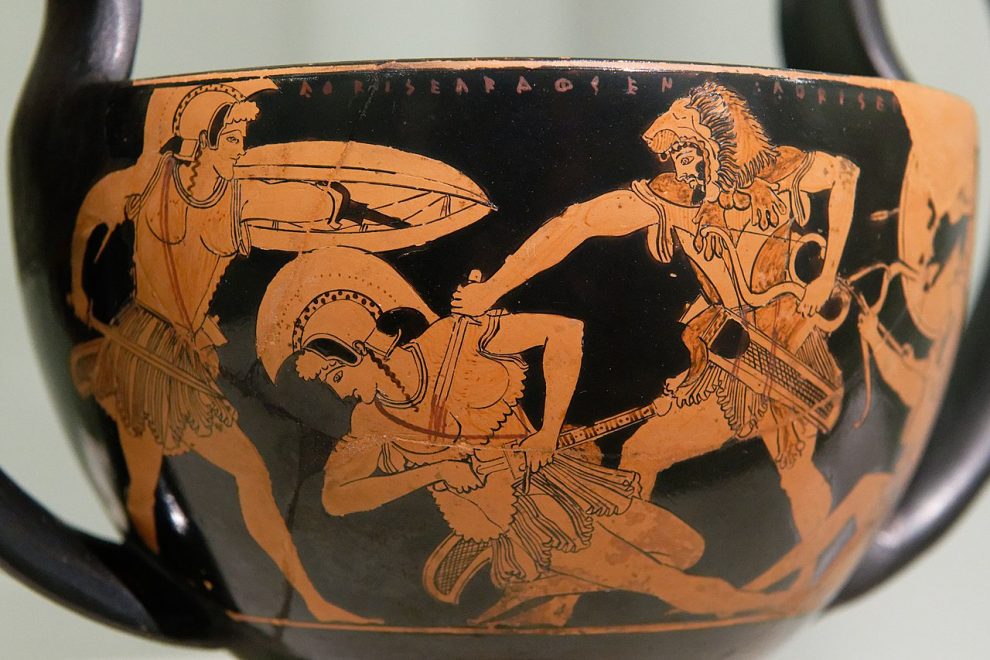
Attic red-figure kantharos by Douris, c. 490–480 BC, depicting Herakles fighting the Amazons. Photo by Marie-Lan Nguyen via Wikimedia Commons, licensed under CC BY 4.0. No changes were made.
Conclusion
Douris remains one of the clearest individual voices to survive from the workshops of ancient Athens. Across close to three hundred surviving vases, he moved between schoolroom, symposium, and myth with equal skill, leaving behind cups that still tell us how Athenians lived, learned, and grieved. His partnership with the potter Python, his mastery of the kylix shape, and his willingness to paint both grand mythological drama and quiet domestic moments continue to make Douris the vase painter one of the most rewarding figures in the study of Attic red-figure pottery, and a lasting reference point for anyone drawn to the craft of the painted Greek cup.
Frequently Asked Questions
Who was Douris in ancient Greek pottery?
Douris was an Attic vase painter active in Athens from roughly 500 to 460 BCE, known for decorating kylikes, or drinking cups, with scenes of daily life and Greek mythology. He signed nearly forty surviving vases and is credited with the decoration of around 280 to 300 more.
What is Douris best known for?
Douris is best known for his kylikes, particularly a schoolroom cup showing music and reading lessons and a mythological cup in the Louvre depicting the goddess Eos carrying the body of her dead son Memnon.
Did Douris paint the Berlin Foundry Cup?
No. The Berlin Foundry Cup, which depicts a bronze foundry workshop, is attributed to a different Athenian artist known as the Foundry Painter, a contemporary of Douris who trained in the workshop of the Brygos Painter.
What potters did Douris work with?
Douris painted vessels for the potters Kleophrades and Euphronios early in his career before entering a long, prolific partnership with the potter Python, which produced most of his surviving signed kylikes.
Where can Douris’s vases be seen today?
Vases attributed to Douris are held in major museum collections worldwide, including the Louvre in Paris, the Altes Museum in Berlin, the British Museum in London, and the Metropolitan Museum of Art in New York.
Feature image: Attic red-figure kylix, c. 485–480 BC, in the manner of Douris / Painter of London E 55. Photo by ArchaiOptix via Wikimedia Commons, licensed under CC BY-SA 4.0. No changes were made.