
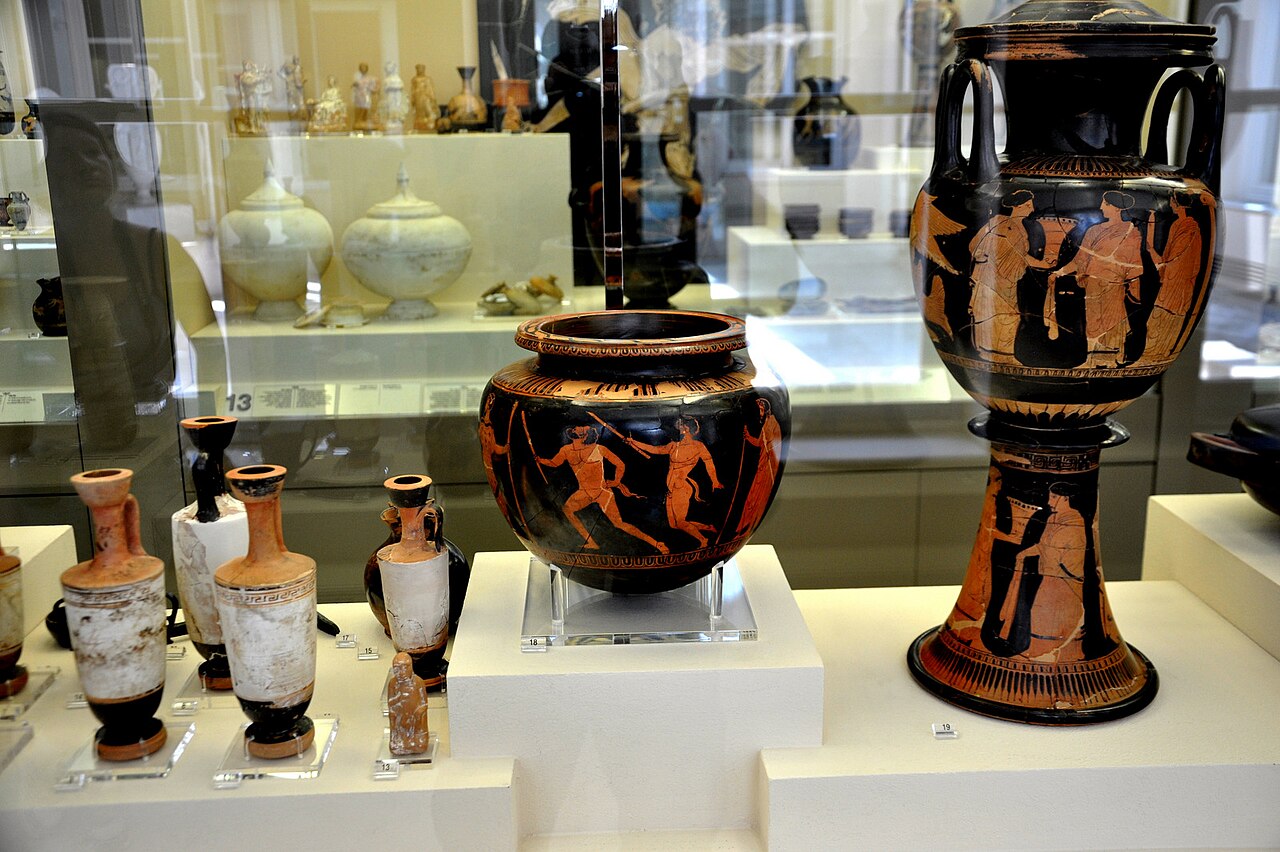
The Kerameikos was the potters’ quarter of ancient Athens.
A district northwest of the Acropolis named after the Kerameis, the community of potters who worked there. Clay deposited by the Eridanos river supplied their workshops. The same ground held the city’s largest cemetery outside the Dipylon and Sacred Gates, and its Greek root, keramos (potter’s clay), gave English the word ceramic.
The Kerameikos potters quarter is the reason the word ceramic exists in English. Long before the term described floor tiles, tableware, or heat shields, it pointed to one neighborhood of ancient Athens, where generations of craftsmen dug clay beside a small river, threw vessels on the wheel, and fired them in kilns within sight of the city walls. Much of the black-glazed and painted ware now admired as Attic pottery came from this corner of the city or the streets around it.
This article walks through the district as an Athenian potter would have known it: the clay of the Eridanos, the workshops near the Sacred Gate and the Dipylon Gate, the cemetery that grew up around them, and the monumental funerary vases that made the area famous. It closes with practical notes for visiting the Kerameikos archaeological site, which reopened in September 2026 after a three-year renovation.
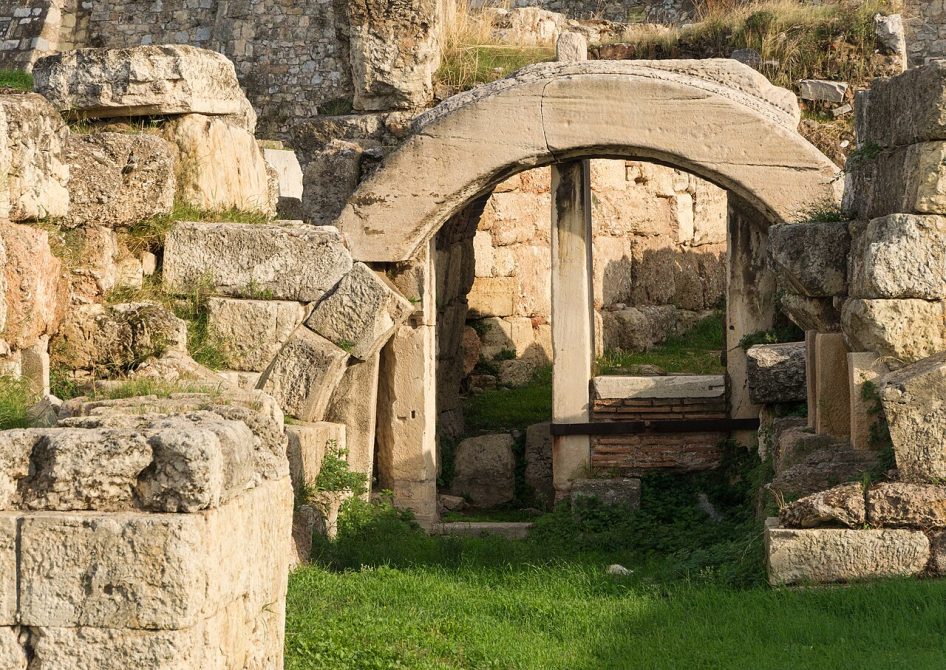
Ancient stone arch at the Kerameikos archaeological site in Athens, near the Sacred Way. Photo: Jebulon / Wikimedia Commons / CC0 1.0. No modifications made.
What Was the Kerameikos? The Potters’ Quarter of Ancient Athens
The Kerameikos was a district on the northwest edge of ancient Athens that served two purposes at once. It was one of the main places where the city’s pottery was made, and it was the city’s principal burial ground. Both roles depended on the same landscape: low ground along the Eridanos river, crossed by the most important roads leaving Athens.
Politically, the area belonged to the deme of the Kerameis (literally “the potters”), one of the local units of Attica, assigned to the Akamantis tribe. When the Themistoclean wall was built in 478 BC, it cut the district in two. Archaeologists still use the resulting labels: the Inner Kerameikos, inside the wall, was the working potters’ quarter that stretched toward the Agora, while the Outer Kerameikos, beyond the gates, held the cemetery and the Demosion Sema, the state burial ground where Pericles delivered his funeral oration in 431 BC.
The name was also used loosely in antiquity. The travel writer Pausanias calls the Agora itself “Kerameikos,” a puzzle that has long interested historians of Athens. Excavated potters’ debris suggests why: from the Protogeometric period until at least the early seventh century BC, potters worked in the area that later became the Agora, so the name followed the craft as the city grew around it. In practice, the Athens potters quarter was a broad zone of workshops rather than a single walled compound.
Where Does the Word Ceramic Come From?
The English word ceramic comes from the Greek keramikos, meaning “of pottery,” which derives from keramos, a word for potter’s clay, earthenware, and roof tile. The potters themselves were the kerameis, and their district became the Kerameikos. English adopted “ceramic” in the mid-nineteenth century, with its spelling shaped by the French céramique.
Where keramos itself came from is less certain. Linguists have proposed links to words for burning or mixing, but none is settled, and some scholars think the term may be older than Greek, borrowed from a language spoken in the region before it. Ancient Athenians had their own explanation. Pausanias records a tradition that the district was named for a hero, Keramos, son of Dionysus and Ariadne, and a Byzantine lexicon, the Suda, says the deme took its name both from the potter’s craft and from sacrifices offered to that hero. For Athenians, the craft and the hero were two sides of the same story.
So when a modern lab speaks of “advanced ceramics,” it is, quite literally, naming a street of workshops beside the Eridanos.
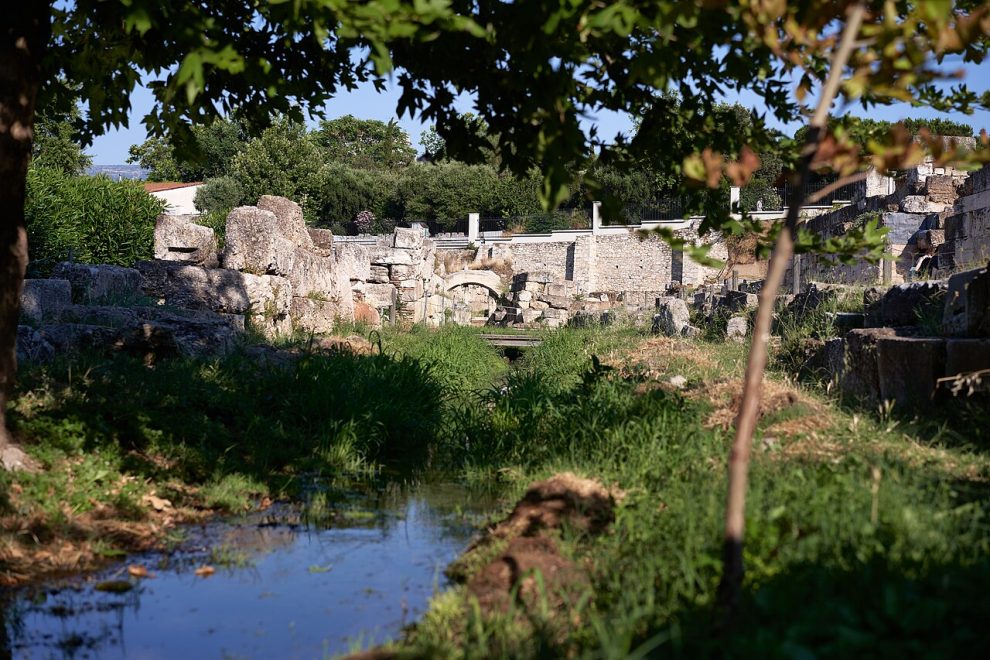
The Eridanos River flowing through the ancient Kerameikos cemetery in Athens, Greece. Photo: George E. Koronaios / Wikimedia Commons / CC0 1.0. No modifications made.
Clay, Water, and the Eridanos River
Kerameikos Athens pottery began with geography. The Eridanos, a modest stream that once flowed from the slopes of Lykabettos through the city, left fine river clays along its banks. Potters had the three things their craft required within a few steps: workable clay, a steady supply of water, and open ground for kilns and drying yards.
Water mattered as much as the clay. Raw earth was mixed with water in settling basins so that stones and coarse grains sank while the finest particles stayed suspended. Repeating this process, known as levigation, produced the smooth body that Athenian vases are known for, and an even finer fraction became the slip used for decoration. The iron in Attic clay is what gives the fired surface its orange tone and, under the right firing, its deep black.
Location helped too. The district sat where traffic left the city for Eleusis, the Academy, and the Piraeus road network, so workshops stood beside the busiest routes in Attica. Buyers, mourners, and festival processions all passed through.
How a Kerameikos Workshop Worked
Workshops rarely survive as standing buildings, so much of what is known comes from what potters threw away. Excavations between the city wall and the Academy have uncovered waste pits filled with misfired vessels, broken test pieces, and kiln debris. One sealed pit from the late fourth century BC held over a hundred vases and thousands of fragments, most likely from one or two collapsed kilns. Its contents show a single workshop producing for three markets at once: Athenian officials, ordinary households, and export. Other pits in the deme of the Kerameis have been linked to the circles of well-known red-figure painters.
A finished vase passed through a sequence of skilled stages:
Preparing the clay: levigating, wedging, and aging the body until it was even and plastic.
Forming: throwing on the potter’s wheel, with large vessels built in sections and joined while leather-hard.
Decorating: painting with a refined clay slip rather than a true glaze.
Firing: a three-phase kiln cycle of oxidation, reduction, and reoxidation that turned the slip a lasting black while the clay body returned to orange. This is the chemistry behind ancient Greek black glaze.
Remarkably, the craft never left the area. After Germanic Heruli raiders destroyed the Pompeion in AD 267, potters set up workshops over its ruins in the fourth century, and fine glazed pottery from the sixth century onward shows that the quarter kept earning its name well into the Byzantine era.
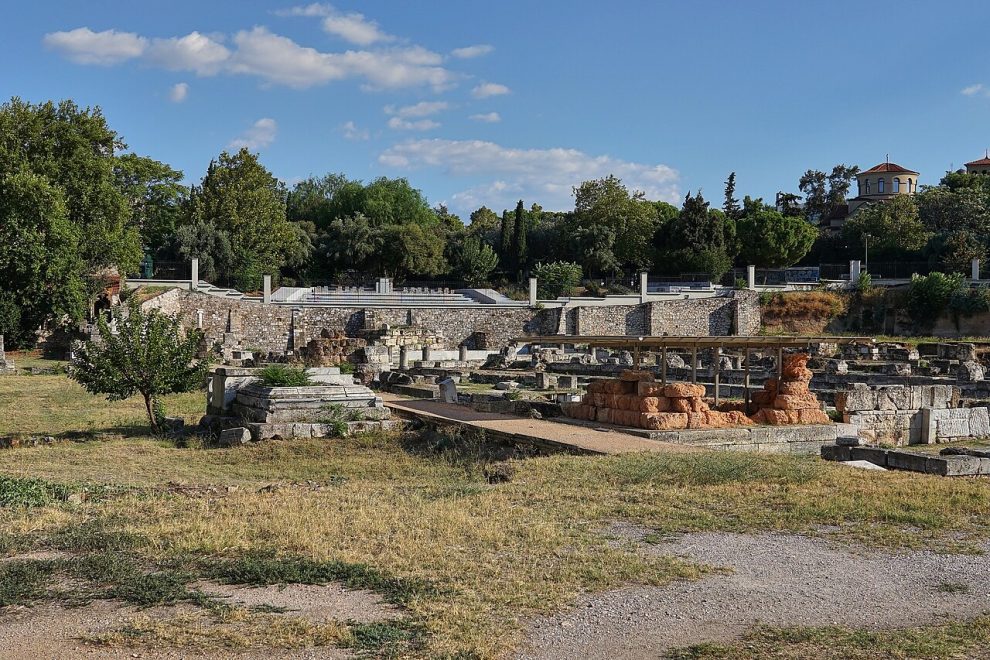
Remains of the ancient Dipylon Gate at the Kerameikos archaeological site in Athens, Greece. Photo: George E. Koronaios / Wikimedia Commons / CC0 1.0. No modifications made.
The Sacred Gate and the Dipylon Gate
The Themistoclean wall was raised in haste after the Persian invasion of 480 to 479 BC, and builders pulled overturned grave monuments into its foundations. Two of its gates opened onto the Kerameikos, and each framed a different kind of departure from the city.
The Sacred Gate: Here the Sacred Way set out for Eleusis, about 20 kilometers away, carrying the annual procession of the Eleusinian Mysteries. The gate was built to let the Eridanos pass through it in a stone channel, so the river that fed the workshops also ran beneath the city wall.
The Dipylon Gate: The name means “double gate,” after its paired entrances. It was among the largest city gates of the Greek world. A broad road ran from it to Plato’s Academy, and in the other direction the Panathenaic Way led through the Agora up to the Acropolis.
Between the two gates stood the Pompeion, where equipment for the great processions, above all the Panathenaia, was prepared and stored. Festival vessels, offerings, and the everyday wares of a city on the move all passed through this crowded threshold, and archaeologists have traced a pottery workshop directly in front of the Dipylon. For potters, the gates were both a landmark and a marketplace.
Kerameikos Ancient Athens: From Workshops to the Great Cemetery
It can seem strange that a manufacturing district was also a burial ground, but the two grew from the same conditions. The marshy land along the Eridanos was used for graves as early as the third millennium BC. Greek custom placed cemeteries outside city walls along major roads, and the roads out of Athens ran straight through the potters’ territory.
Over time the cemetery became a showcase for the city. Archaic families raised ever larger mounds and monuments along the south bank of the Eridanos. In the Classical period, carved marble stelae and family plots lined the so-called Street of Tombs, among them the grave enclosure of Dionysios of Kollytos, crowned by a marble bull carved around 345 to 340 BC. Near the Dipylon, the Demosion Sema received Athenians who died in war and leading statesmen of the city.
Excavation has shaped how this cemetery is understood. Systematic digging began in 1870 under the Greek Archaeological Society, and the German Archaeological Institute has worked at the site since 1913. Construction of the Kerameikos metro station uncovered around 1,000 graves of the fifth and fourth centuries BC, along with a mass grave linked to the plague that struck Athens during the Peloponnesian War. Because the area held both workshops and graves, it has yielded an unusually large body of high-quality pottery, from production debris to vessels placed with the dead.
Dipylon Gate Pottery: Why Funerary Vases Were Made and Set Up Here
Dipylon pottery refers to the monumental Geometric vases found in the cemetery near the Dipylon Gate. Made in Athens in the mid-eighth century BC, they served as grave markers: kraters for men and amphorae for women. Some stand well over a meter tall, and they carry some of the earliest human figures in Greek painting.
The name is a modern convenience. The vases were found near the Dipylon in the nineteenth century, but the gate itself was built nearly three centuries after they were made. What linked them to this ground was the cemetery, and the workshops that stood a short walk from the graves they would mark.
Making them demanded real technical command. Potters threw these vessels on the wheel in several sections and joined them before painting the surface in bands of meanders, zigzags, and animal friezes. Around the handles, painters placed funeral scenes: the prothesis, where the dead lies in state surrounded by mourners with raised arms, and the ekphora, the procession to the grave. Nearly fifty vases are attributed to the workshop of the so-called Dipylon Master, active around 760 to 735 BC. Openings in some vessels may have allowed offerings poured into them to reach the ground below.
The best known pieces have traveled far from the Kerameikos. The Dipylon Amphora is in the National Archaeological Museum in Athens, and a large Dipylon krater is displayed at the Metropolitan Museum of Art in New York. For a closer look at one of these vessels, see our study of the Dipylon Krater and Geometric pottery.
Funerary demand did not end with the Geometric period. In later centuries, workshops supplied marble stelae with painted and carved vase shapes, tall loutrophoroi for those who died unmarried, and Classical white-ground lekythoi, slender oil flasks painted with quiet scenes of mourning and placed at graves. The link between the potter’s quarter and the cemetery lasted for centuries.
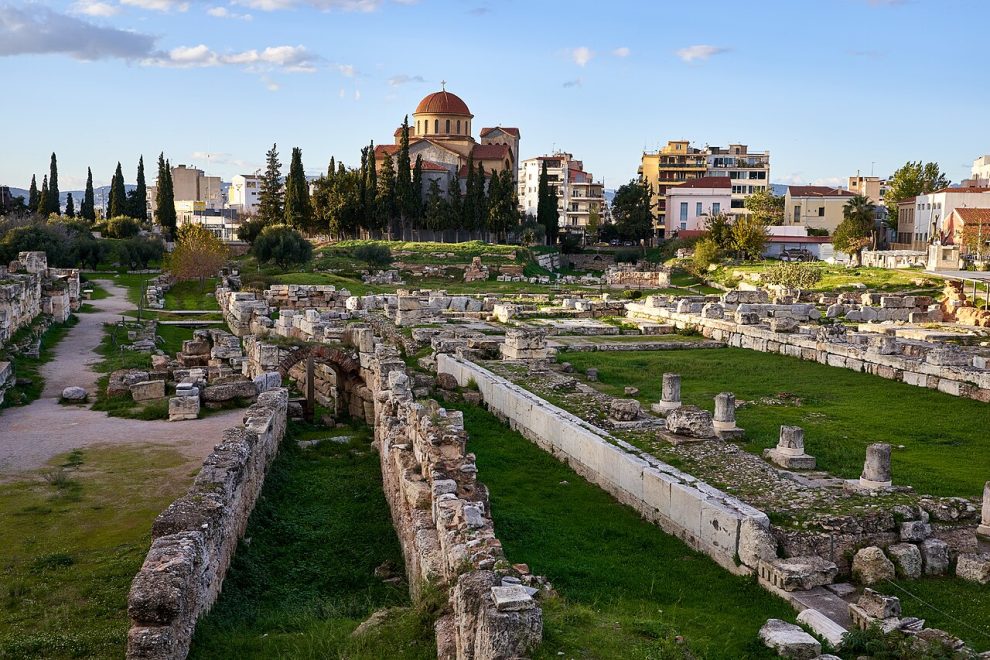
View of the ancient Kerameikos cemetery in Athens, with the Eridanos riverbed and the Pompeion. Photo: George E. Koronaios / Wikimedia Commons / CC0 1.0. No modifications made.
Visiting the Kerameikos Archaeological Site Today
The Kerameikos archaeological site reopened to visitors on September 15, 2026, after a renovation carried out between 2023 and 2026 with about four million euros in EU Recovery Fund financing. The site and its museum were closed from May 2025 during the works.
The upgrade changes how the ground reads on foot. New routes open roughly an extra acre of previously isolated ground, and visitors no longer loop back to the entrance on Ermou Street: a new exit building on Agion Asomaton Street adds a café, a shop, and areas for study and rest, with improved access for wheelchair users, older visitors, and families. Thousands of new trees and shrubs have also been planted across the site.
Getting there: The entrance is at 148 Ermou Street, a few minutes’ walk from Thissio metro station, with Kerameikos station also close by.
Tickets: Admission is €10 and covers both the site and the museum. Greek archaeological sites traditionally move to reduced pricing and shorter hours in the winter season, so check the official Ministry of Culture page before you go.
Time needed: Allow about two hours for an unhurried visit to the site and museum. The Ancient Agora is a short walk east, and the two sites fit comfortably into one morning.
When to go: Autumn is an ideal season. October brings cooler weather and thinner crowds, and the softer light suits the stelae and the reed beds along the Eridanos.
What to Look For If You Love Pottery
The Eridanos at the Sacred Gate: Find the river channel where it passes through the wall. This is the water source of the Athens potters quarter, still visible in the middle of a modern city.
The Kerameikos Museum: Opened in 1938, it displays finds from the German excavations, mostly funerary sculpture and pottery, arranged chronologically from early burials to the Roman period. Look for Geometric grave vases, Classical lekythoi, and the Kerameikos Kouros, a marble youth found on site in 2000.
Replica vases along the paths: Some vessels on display across the site are painted replicas by a vase painter certified by the Ministry of Culture, helping visitors picture the markers in their original settings.
The Agora Museum: Finds from the Inner Kerameikos are shown in the Ancient Agora Museum in the Stoa of Attalos, a natural next stop. For a wider view of where Attic vases ended up, see our guide to ancient Greek pottery museums around the world.
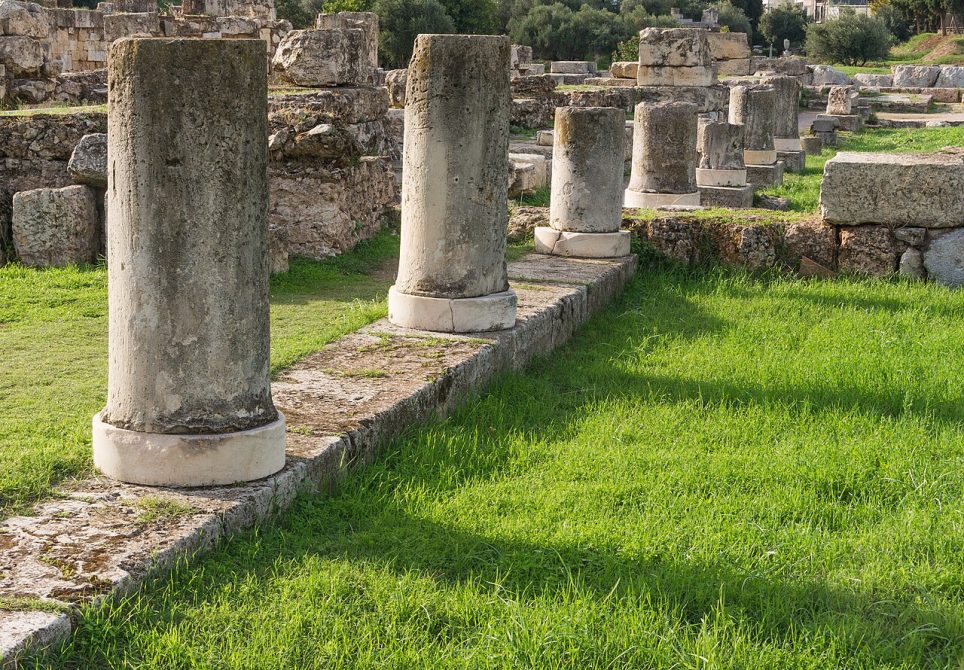
Ancient columns of the Pompeion at the Kerameikos archaeological site in Athens, Greece. Photo: Jebulon / Wikimedia Commons / CC0 1.0. No modifications made.
Continuing the Craft in Athens Today
Walking from the Sacred Gate to the Dipylon makes one thing clear: the vases in the museum cases were local work, made from local clay by people who lived beside these roads. That same logic of material and method is the foundation of the Attic Black studio in Athens. The studio works with clay chosen and refined for Attic behavior, prepares its own slips, and fires its pieces through the three-phase cycle that produced the black surfaces of Classical Athens.
For travelers who want to follow a visit to the Kerameikos with time at the wheel, Attic Black offers pottery workshop visits and training in Athens, where the steps described above can be seen and tried firsthand. Those who prefer to bring the tradition home can browse the studio’s black-glazed ware, made with the same methods.
Frequently Asked Questions About the Kerameikos
Why is it called the Kerameikos?
The district is named after the kerameis, the potters who lived and worked there, from the Greek keramos, meaning potter’s clay. Ancient tradition also connected the name to Keramos, a hero described as a son of Dionysus and Ariadne.
What is the Kerameikos known for?
The Kerameikos is known as the potters’ quarter of ancient Athens and as the city’s largest ancient cemetery. It contains the Sacred Gate and the Dipylon Gate, the start of the Sacred Way to Eleusis, the Street of Tombs, and the findspot of the famous Geometric Dipylon vases.
Is the word ceramic really from the Kerameikos?
Yes, through a shared root. Both the district name and the word ceramic come from the Greek keramos. The adjective keramikos (“of pottery”) passed into French and then into English in the nineteenth century.
Is the Kerameikos open to visitors?
Yes. The Kerameikos archaeological site and museum reopened on September 15, 2026, after renovation works. A single €10 ticket covers both. Opening hours change with the season, so confirm them on the official Ministry of Culture website before visiting.
Where can you see pottery from the Kerameikos?
Finds are displayed in the Kerameikos Museum on site, the National Archaeological Museum in Athens (home of the Dipylon Amphora), and the Ancient Agora Museum. Other Kerameikos vases are held by major museums abroad, including the Metropolitan Museum of Art in New York.
The Kerameikos Potters’ Quarter, Then and Now
The Kerameikos potters quarter brought together everything Athenian pottery needed: river clay from the Eridanos, water for refining it, open ground for kilns, and roads full of buyers, pilgrims, and mourners. The same ground became the city’s great cemetery, which is why so many masterpieces, from the Geometric Dipylon vases to Classical lekythoi, were both made and set up within a short walk of each other. And because the craft was so closely tied to this place, its name lives on in every language that uses the word ceramic.
Today the renovated site lets visitors trace that story on foot, from the river channel at the Sacred Gate to the museum’s grave vases. To understand what those workshops produced at their height, continue with our guide to Attic pottery and Athenian culture.
Featured image by: Grb16 / Wikimedia Commons / CC BY-SA 3.0. No modifications made.
