
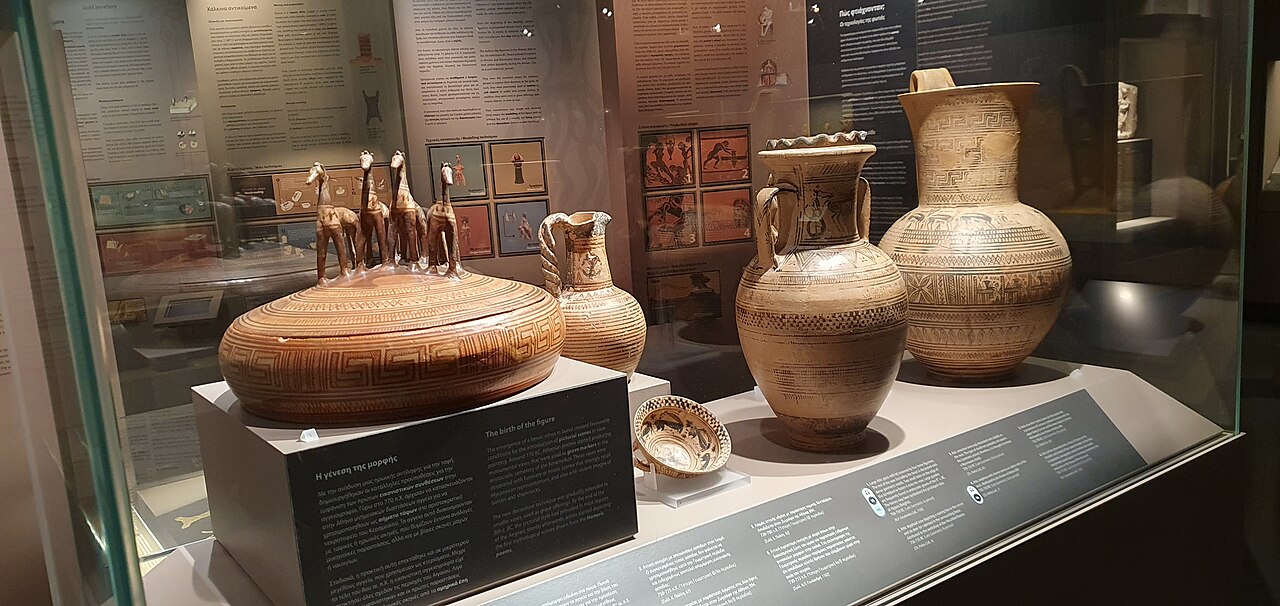
This Ancient Greek pottery timeline covers the key periods, styles, and dating methods—from Geometric to Hellenistic.
Key Highlights
- Ancient Greek pottery evolved from simple geometric patterns to complex narrative scenes.
- The timeline covers distinct styles, including Geometric, Orientalizing, Black-Figure, and Red-Figure.
- Geometric pottery used precise shapes, while the Archaic period introduced black-figure pottery with incised details.
- Vase painting reached its peak with red-figure pottery, which allowed for greater realism and detail.
- Pottery shapes like the amphora and krater were designed for specific daily uses.
- The decline of figure painting in the Hellenistic period led to new, simpler decorative styles.
Ancient Greek pottery is one of those rare subjects where “timeline” is not just a tidy way to organize information, but a genuinely useful lens for understanding an entire civilization. Because clay survives when most other materials do not, pots and sherds show up in homes, graves, sanctuaries, shipwrecks, workshops, and marketplaces, quietly recording what people ate, drank, traded, gifted, mourned, and celebrated. When we talk about an ancient Greek pottery timeline, we are really talking about the evolving habits of potters and painters over centuries: how shapes change, how decoration shifts, how techniques improve, and how regional tastes rise and fall.
This guide is designed to be readable first and scholarly enough to be trustworthy, so you can move from quick period recognition to a deeper sense of why these objects matter and how experts date them.
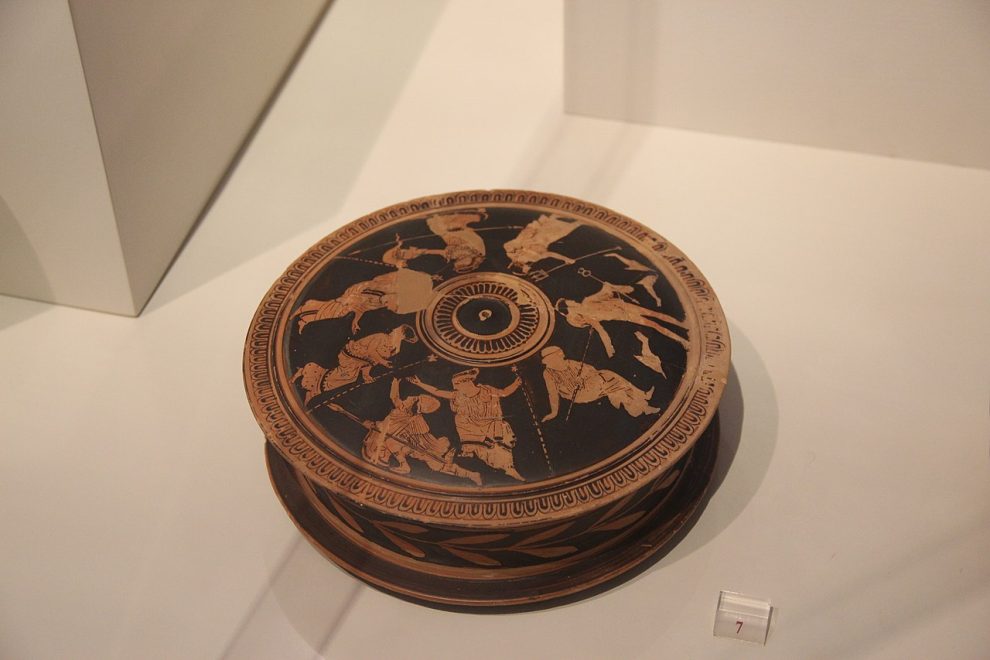
Ancient Greek red-figure pyxis (lid detail), Ancient Greek Vase Gallery, National Archaeological Museum of Greece (Athens). Photo by Gary Todd (CC0) via Wikimedia Commons.
Ancient Greek Pottery Timeline at a Glance
- Aegean Bronze Age foundations (before c. 1050 BCE): Minoan and Mycenaean traditions that shaped later Greek ceramic language.
- Sub-Mycenaean to Protogeometric transition (late 11th century BCE into early 10th century BCE): a bridge phase leading into renewed precision.
- Protogeometric (roughly c. 1025–900 BCE): compass-drawn circles and arcs, clean structure, and the fast wheel’s influence.
- Geometric (c. 900–700 BCE): meanders, registers, and eventually stylized narrative scenes, including monumental funerary vessels.
- Orientalizing / Protoattic / Proto-Corinthian (c. 700–600 BCE): Near Eastern-inspired motifs, animal friezes, and a stronger push toward storytelling.
- Archaic to Classical vase painting (c. 620–320 BCE): black-figure, then red-figure, plus white-ground for more delicate funerary work.
- Late Classical and Hellenistic (4th–1st century BCE): black-glazed luxury wares, added color, molded relief, and shifting consumer markets.
How Archaeologists Date Greek Pottery
The reason pottery is such a powerful historical tool is that it is both abundant and stylistically sensitive. Archaeologists rarely date a vessel by “vibes” alone; they rely on a combination of context and comparison.
Context means the layer or setting where pottery is found. If a sherd comes from a sealed floor deposit, a grave, or a well-documented destruction layer, that context can narrow the date significantly. Style means the recognizable visual and technical habits of a period: patterns, figure types, proportions, and how painters handle details. When specialists compare these traits across many sites and layers, they build sequences that are surprisingly stable over time, a process often described as typology and seriation, backed up by stratigraphy and cross-dating.
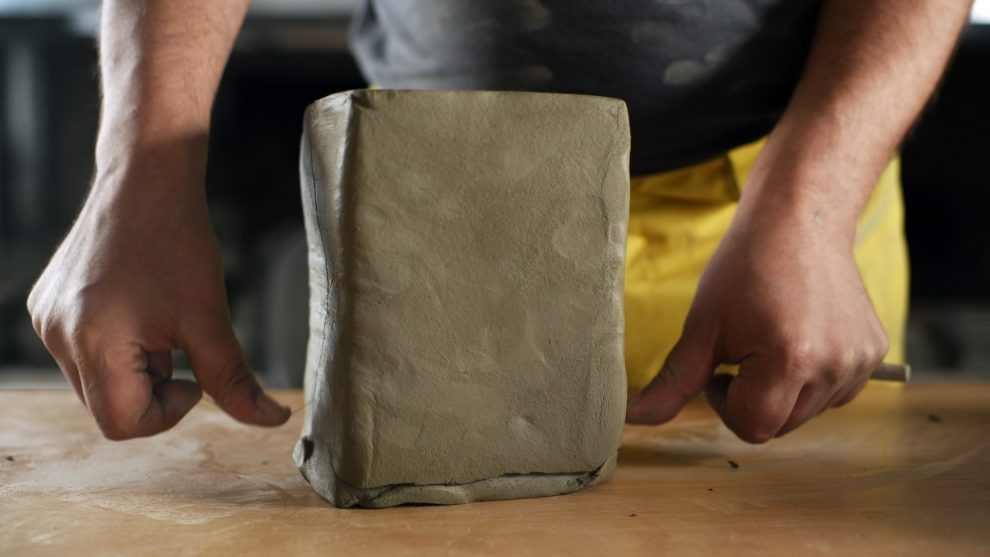
How Ancient Greek Pottery was Made
Clay, Levigation, and why Attic Clay Matters
Greek pottery begins with geology. Potters did not simply dig clay and start throwing; they refined it, often by washing and settling it so heavier impurities dropped out and the usable particles remained. This refinement helps explain why some ceramics look smoother, fire more evenly, or take slip more predictably.
Attic clay, associated with the region around Athens, matters because it tends to fire to a warm orange-red that creates a dramatic contrast with the black gloss surface produced by slip and kiln control. While “Attic clay” is sometimes used casually as a shorthand for quality, the deeper point is that local clay chemistry and preparation contribute to the look of finished pottery, and those differences can help experts link vessels to production zones.
Wheel Throwing, Joining Parts, and Clay Slip
Slip, in the Greek context, is not just decorative paint. It is a refined clay mixture applied to create the glossy black areas we associate with Greek black-figure and red-figure pottery, and its behavior in the kiln is central to the entire visual effect.
Three-Stage Firing and the Black Gloss Finish
The famous red-and-black look is, at heart, controlled chemistry. Both red-figure and black-figure rely on a three-stage firing process: an oxidizing stage, a reducing stage (with reduced oxygen and smoky conditions), and a final re-oxidizing stage where the unslipped clay returns to orange while the glossed areas remain black. This is why Greek “black” is not simply pigment; it is the result of carefully manipulating kiln atmosphere and temperature.
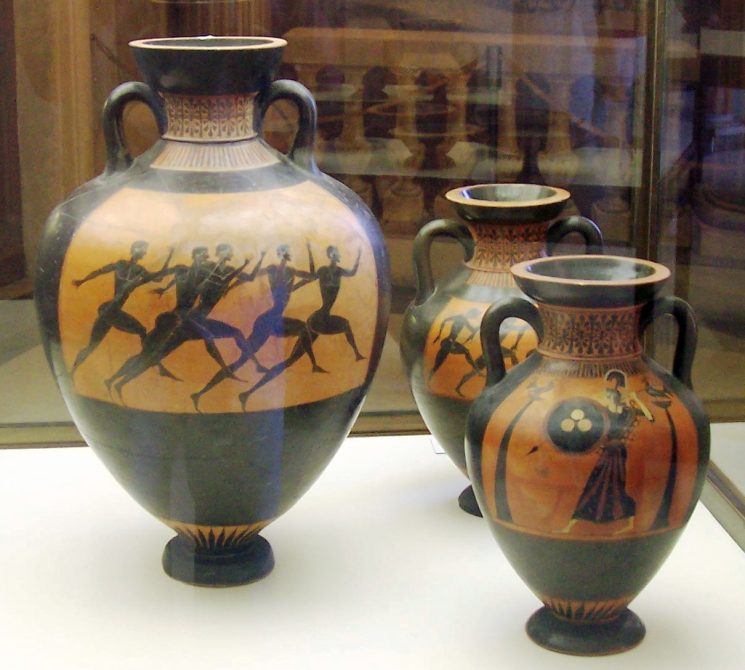
Panathenaic amphora (Vatican Museums). Photo by HombreDHojalata, via Wikimedia Commons, CC BY-SA 3._
Major Pottery Shapes and What They Were For
Storage and Transport Vessels (amphora, hydria, pithos)
Some shapes are remarkably stable over time because their function demands it. Amphorae were designed for storage and transport, especially for goods like wine and oil, with handles positioned for lifting and pouring. Hydriai often served for carrying water, and pithoi were large storage containers that could anchor an entire household’s provisions.
When you see a shape repeated across centuries, it often means the form solved a real-world problem so well that innovation was unnecessary, or at least slower and more subtle.
Symposion Set: Mixing and Drinking (krater, kylix, kantharos)
To understand Greek pottery, it helps to picture a social scene rather than a museum shelf. At the symposium, guests mixed wine in kraters and served it into cups like kylikes, while kantharoi and other drinking shapes helped stage the ritual performance of sociability. People held, passed, and discussed these vessels, which is why potters and painters turned them into a bold canvas for imagery, humor, flirtation, status, and storytelling.
The symposium also makes pottery intensely “public,” even indoors, because guests use these vessels in full view of everyone around them.
Oils, Perfumes, and Funerary Rituals (lekythos and beyond)
Lekythoi and related small vessels often connect to oil, perfume, and funerary practice. Some were practical containers, but many, especially in later periods, were tied to burial and commemoration, where the object’s symbolic role could matter as much as its day-to-day utility.
This is where the pottery timeline overlaps with emotion. A delicate funerary vessel does not simply show a style; it shows a social practice and a way of honoring the dead.
.jpg)

Foundations Before the “Main” Timeline (before c. 1050 BCE)
Aegean Bronze Age Influences (Minoan and Mycenaean)
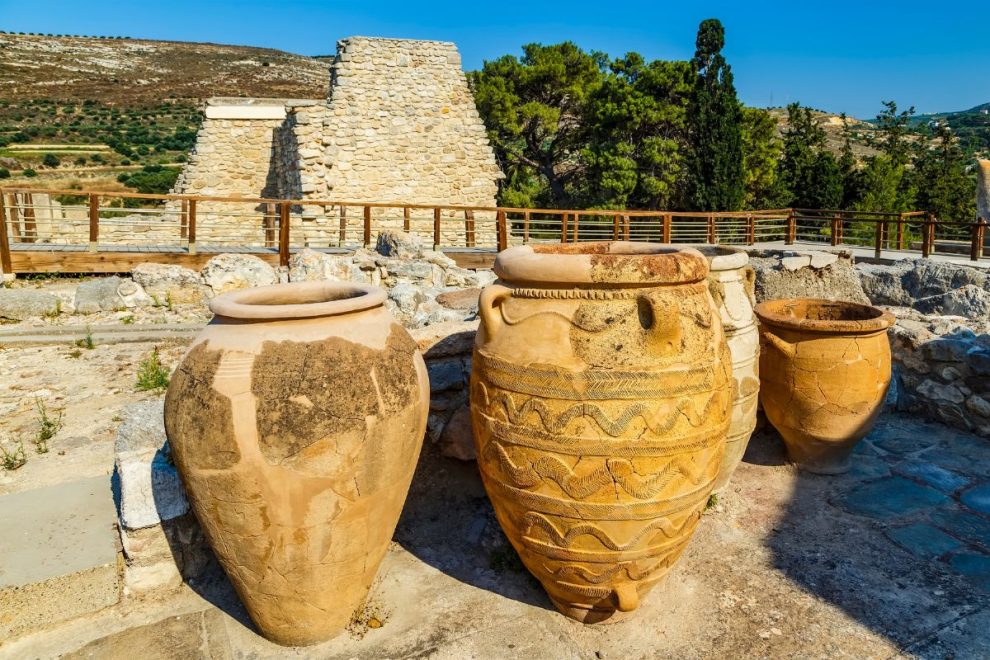
Before the first “Greek” ceramic phases that students learn to recognize, the Aegean already had mature pottery traditions. Minoan and Mycenaean wares established a visual confidence and a technical baseline that later communities inherited, adapted, and sometimes deliberately departed from. This is not a straight line of progress, but it is a lineage of ideas: preferred shapes, decorative instincts, and the relationship between pottery and elite culture.
Sub-Mycenaean to Proto-Geometric Transition
After the collapse of palatial systems, pottery styles simplify and then gradually reorganize. The transition into Protogeometric is often described as a “reawakening” of technical precision, where clean structure and controlled motifs return, supported by improved pottery wheel use and more deliberate design choices. Chronological models often place the Sub-Mycenaean/Protogeometric shift in the later 11th century BCE, though regional site evidence can vary.
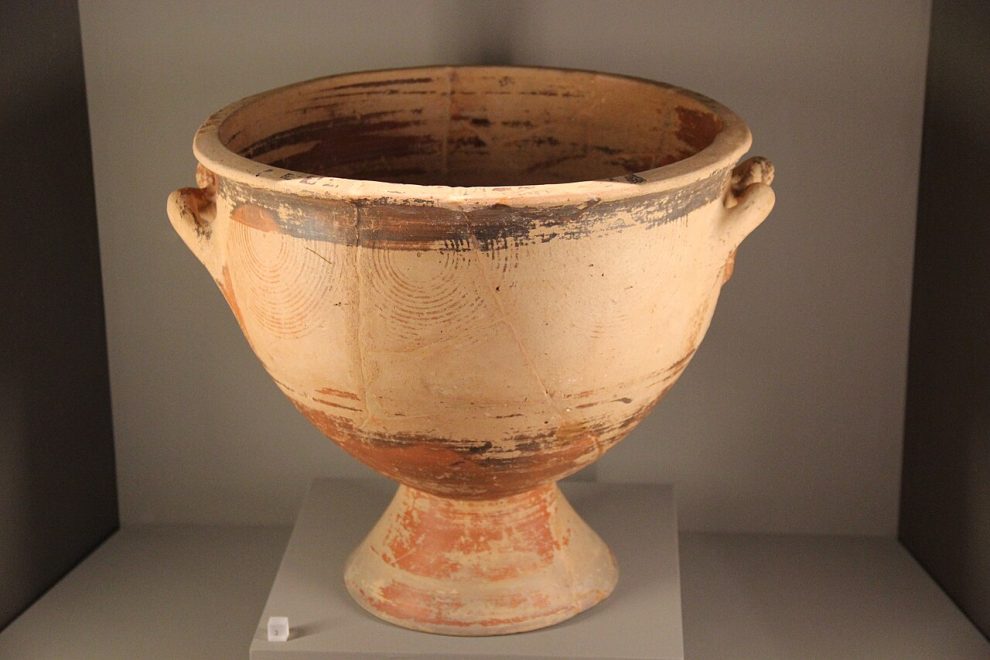
Ancient Greece Protogeometric pottery, Ancient Greek Art Gallery, Museum of Cycladic Art (Athens). Photo by Gary Todd (CC0) via Wikimedia Commons.
.jpg)
Protogeometric Pottery (c. 1050–900 BCE)
Motifs, Compass Work, and Early Workshop Centers
Protogeometric pottery is one of the easiest early phases to recognize once you know what to look for: compass-drawn circles, arcs, and carefully placed bands that emphasize structure and proportion. Scholarship often notes the leading role of Attica and central Greek production in shaping the style’s “classic” look, even as it spreads and takes on local variation.
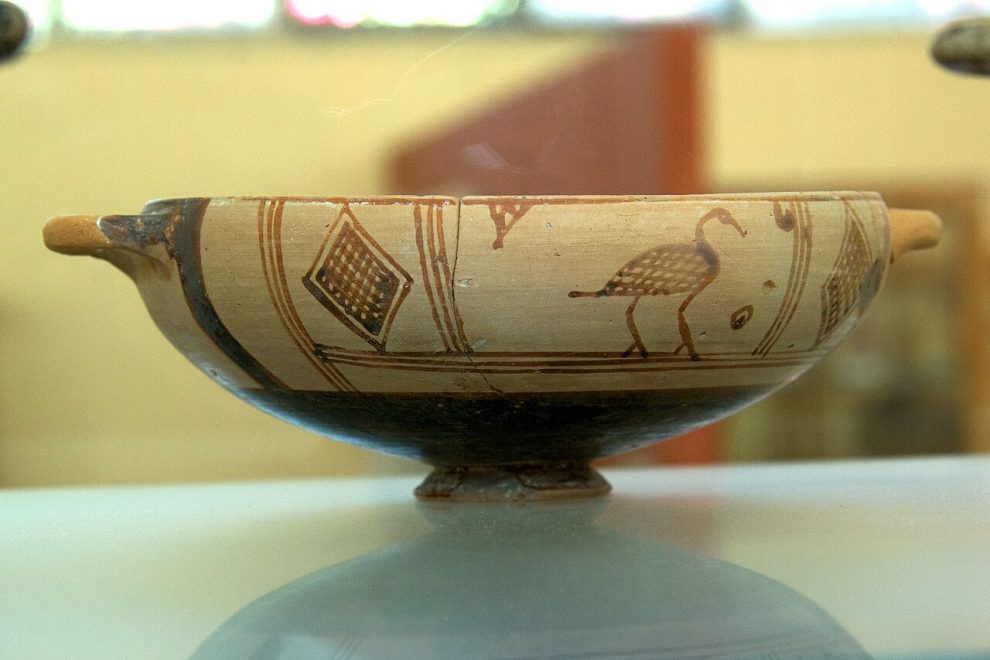
Photo by Zde, via Wikimedia Commons (CC BY-SA 4.0).
Geometric Pottery (c. 900–700 BCE)
Early, Middle, and Late Geometric Styles
The Geometric period is named for its patterns, but its real story is growth. Early Geometric work tends to be more restrained, Middle Geometric increases complexity and density, and Late Geometric expands the repertoire to include figures and clearer narrative moments. A common scholarly subdivision places Early Geometric around 900–850 BCE, Middle around 850–760 BCE, and Late around 760–700 BCE, though these ranges are used as guides rather than strict borders.
Funerary Vases and the Dipylon Tradition in Athens
Some of the most striking Geometric objects are monumental funerary amphorae associated with the Dipylon tradition, linked to finds from the Kerameikos area and dated roughly to the mid-to-late 8th century BCE. These vases often show prothesis scenes, ritual laying-out of the deceased, surrounded by patterned bands, animals, and processional imagery, turning grief into a public, readable statement of status and community ritual.
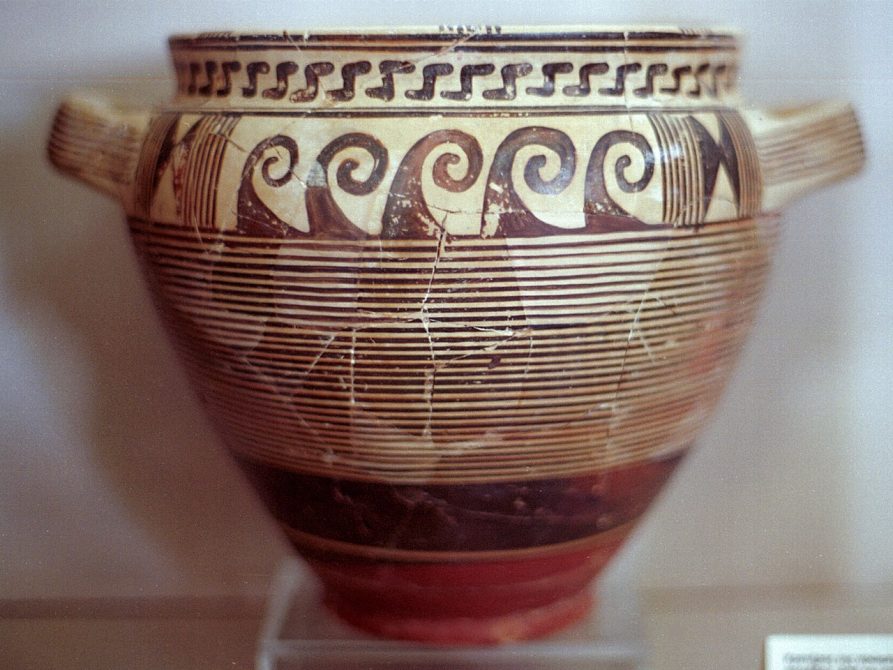
Early Protocorinthian krater, 725–700 BC, Archaeological Museum of Ancient Corinth. Photo by Zde (CC BY-SA 4.0) via Wikimedia Commons.

Orientalizing and Protoattic/Proto-Corinthian (c. 700–600 BCE)
Eastern Influences, Animal Friezes, and Corinth’s Role
The Orientalizing period reflects broad Mediterranean contact. Decorative vocabulary expands to include rosettes, composite creatures, and animal friezes, often arranged in bands that feel more animated and less purely abstract than Geometric patterning. Corinth is frequently highlighted in this phase because Corinthian workshops popularized compact, detailed decoration that traveled widely through trade.
Protoattic Narrative Painting and Myth Scenes
Protoattic work, by contrast, is often discussed for its move toward narrative ambition. Larger vessels and bolder scenes create space for mythological storytelling, and painters experiment with scale and composition in ways that feel like a rehearsal for the fully developed techniques of the Archaic period.
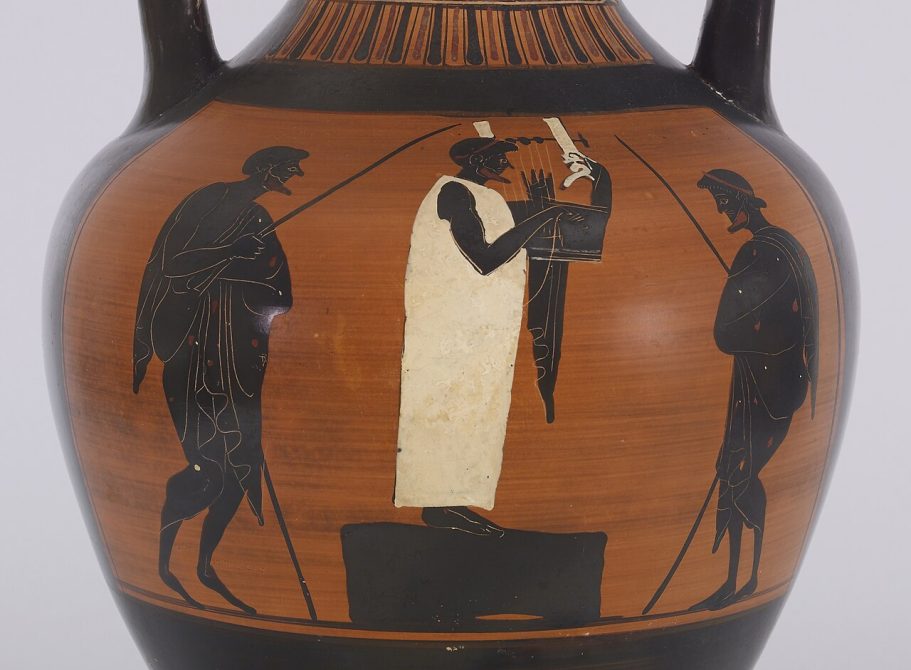
Greek black-figure Pseudo-Panathenaic Amphora (Walters Art Museum 48.2107), detail. Courtesy of Walters Art Museum, via Wikimedia Commons, CC BY-SA 3.0.

Archaic to Classical Vase Painting (c. 620–320 BCE)
Black-Figure Technique
Black-figure painting is built on silhouette power. Figures appear as black shapes against the fired clay background, with interior details created by incision and occasional added color. The technique rewards clarity and strong composition, which is why black-figure scenes often feel bold and immediately legible, even when the vessel is crowded with action.
Key Black-Figure Painters
Even though pottery was a craft industry, some painters developed distinctive hands that scholars can recognize and group. Scholars often cite Exekias for his confident compositions and psychological intensity, while they commonly discuss the Amasis Painter for his refined line and lively scenes that balance elegance with narrative detail. Their importance is not just fame; it is that their work helps map stylistic development and workshop practice over time.
Red-Figure Technique
Red-figure Phases
Red-figure does not stay the same across its long life. Early red-figure still carries some Archaic habits in pose and composition, while later Classical work often becomes more confident in perspective, movement, and narrative staging. For readers, the practical takeaway is that brushwork, proportions, and scene density can give you clues about whether a red-figure vase leans earlier or later within the broader Classical arc.
White-Ground Lekythoi and Polychrome Details
White-ground technique, often associated with lekythoi, uses a pale surface that allows for more delicate drawing and additional color. Because the white-ground finish chips more easily than standard red-figure surfaces, people often used these vessels in funerary contexts instead of everyday handling, which helps explain their tender, intimate visual tone.
Inscriptions, Signatures, and “Kalos” Names
Some vases carry inscriptions that are easy to overlook until you notice how personal they can feel. Signatures can tell you that painters and potters sometimes claimed authorship, while “kalos” inscriptions, praising a youth as beautiful, hint at social networks, fashion, and taste within elite circles. Even when an inscription is fragmentary, it can connect pottery to lived social worlds rather than treating it as anonymous decoration.
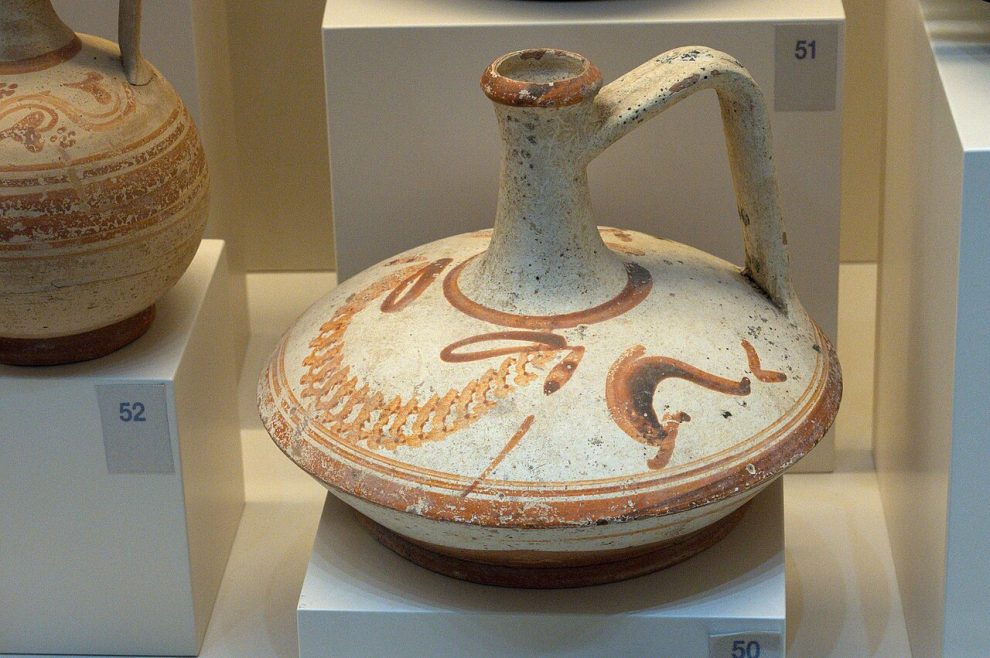
White lagynos from Epidauros (2nd–1st century BC), Archaeological Museum of Nafplion. Photo by Zde (CC BY-SA 4.0) via Wikimedia Commons.

Late Classical and Hellenistic Pottery (4th–1st century BCE)
Fourth-Century Changes and New Audiences
By the 4th century BCE, pottery markets and cultural tastes shift. Painted figure scenes become less dominant, and glossy black wares with added decoration gain prominence. This is not a decline in skill so much as a change in what buyers want: different moods, different social contexts, and sometimes more standardized production for wider distribution.
Hellenistic Wares: West Slope, Gnathia, and Megarian Bowls
West Slope ware is a major headline term for this phase, describing black-glazed pottery with added colors, incision, and decorative techniques that became widespread in the eastern Mediterranean, with the label itself linked historically to finds near the western slope of the Acropolis. Scholars often link Gnathia ware to southern Italy, and you can typically recognize it by its black glaze paired with lighter painted ornament, often floral and vine motifs, while it sits close to West Slope within the broader family of Hellenistic decorative tastes. Megarian bowls represent another popular category: mold-made relief bowls that feel almost sculptural, reflecting the period’s interest in ornate surface and repeatable production.
Why Figured Vase Painting Declines
Figured painting declines for a mix of practical and cultural reasons. Tastes move toward glossy surfaces and relief ornament, markets broaden, and other visual media, such as wall painting and later Roman decorative traditions, compete for attention and patronage. The result is not a sudden disappearance, but a gradual rebalancing where narrative painting becomes less central to “fine pottery” than it was in the Classical peak.
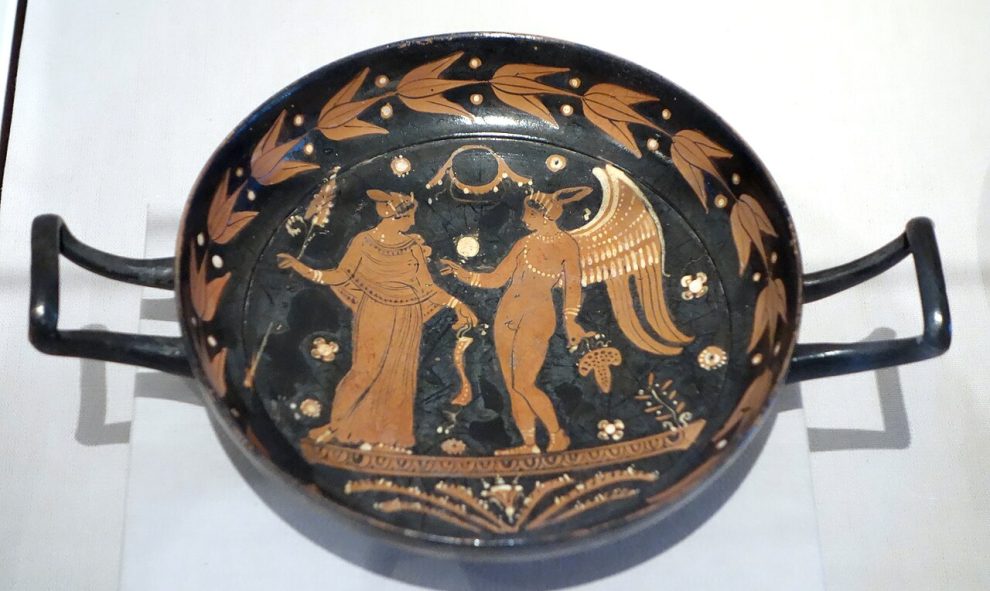
Red-figure kylix (Group of Lecce 727), South Italian (Apulia), 370–350 BC, terracotta — Legion of Honor, San Francisco. Photo by Daderot (CC0) via Wikimedia Commons.

Regional Styles, Trade Routes, and Legacy
East Greek and Island Pottery Traditions
“East Greek” and island traditions cover a wide range of workshops and tastes across the Aegean and the coastlands. The most helpful way to think about them is as parallel conversations rather than footnotes to Athens: they sometimes adopt trends early, sometimes preserve older habits longer, and often develop distinctive decorative preferences shaped by local identity and trade connections.
South Italian Red-Figure
Trade Networks and Mediterranean Demand
Greek pottery traveled because people wanted it, and that demand reveals a lot about cultural exchange. Exports didn’t move at random; merchants sent them along routes shaped by commerce, colonization, and alliances. Scholars often highlight Etruria because Etruscan buyers prized Greek painted pottery, and the finds there let researchers trace trade flows, local preferences, and how people consumed Greek imagery beyond Greece.
Afterlives: Roman Imitation and Modern Scholarship
Greek pottery did not stop mattering when its original workshops changed. Romans collected, copied, and absorbed Greek styles into broader decorative culture, and modern archaeology built much of its chronological toolkit through pottery study. The “timeline” you see in textbooks is the product of countless excavations, museum catalogues, and comparative studies that link fragments to forms, and forms to centuries, until the pattern becomes readable.
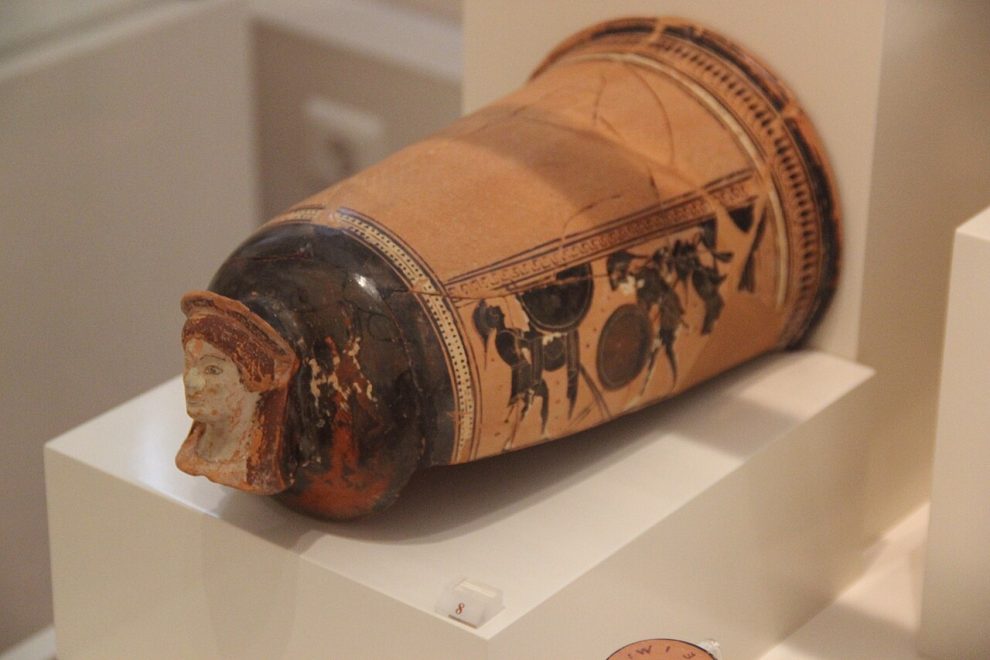
Ancient Greek pottery, Ancient Greek Vase Gallery, National Archaeological Museum of Greece (Athens). Photo by Gary Todd (CC0) via Wikimedia Commons.
.jpg)
Conclusion
The ancient Greek pottery timeline is not only a sequence of styles; it is a practical guide to how the ancient Mediterranean worked. From Protogeometric precision to Geometric funerary display, from Orientalizing experimentation to the black-figure and red-figure breakthroughs, and then into Hellenistic surfaces and mold-made relief, each phase reflects real shifts in technology, taste, trade, and social ritual.
If you want a fast way to identify a vase when you see one, start with three checks that rarely fail you. First, check the surface logic: do you see black-figure (incised details in black silhouettes) or red-figure (painted details on red bodies)? Second, look at the decorative grammar: strict patterns and registers point earlier, while naturalistic anatomy and fluid drapery usually point Classical. Third, look at the finish and ornament: glossy black with added colors and small motifs often signals later wares like West Slope and related Hellenistic tastes.
Once you train your eye on those basics, the timeline stops feeling like a list of labels and starts feeling like a readable story written in clay, one workshop decision at a time.
Feature Image: Ancient Greek Geometric pottery at the Museum of Cycladic Art (Athens). Photo: <a href=”https://commons.wikimedia.org/wiki/User:Yair-haklai”>Yair-haklai</a>, <a href=”https://creativecommons.org/licenses/by-sa/4.0/”>CC BY-SA 4.0</a>, via <a href=”https://commons.wikimedia.org/wiki/File:Ancient_Greek_Geometric_pottery_in_the_Museum_of_Cycladic_Art.jpg”>Wikimedia Commons</a>.