
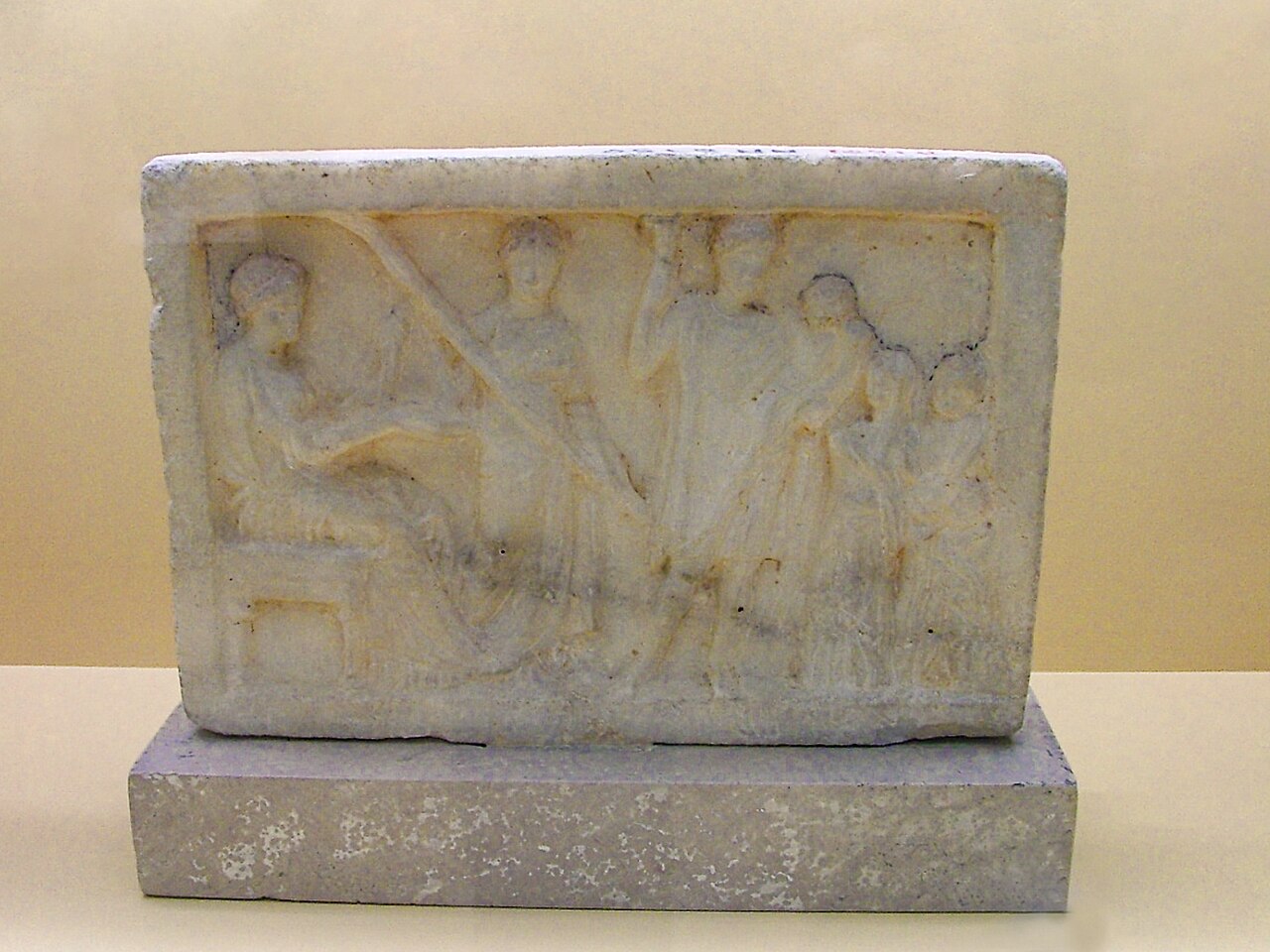
Spring in ancient Greece was not simply a change of season.
It was a deeply sacred transition, marked by religious festivals, civic ceremonies, communal rituals, and an entire mythology of renewal. For the ancient Greeks, the return of warmth and the reappearance of flowers signaled not only the revival of the natural world but the movement of divine forces, the return of the dead, the opening of new wine, and the birth of theater itself.
What Did Spring Mean to the Ancient Greeks?
Spring in ancient Greece carried layered meaning that went well beyond agriculture. It was the season in which Persephone was believed to return from the underworld, in which wine stored through the winter was finally ready to drink, in which the gods were actively present in the world, and in which the great democratic festivals of Athens brought tens of thousands of people together in shared ritual and artistic experience.
In ancient Athens, most people are believed to have worked only two-thirds of the year, with the remaining third dedicated to the worship of the gods, and the spring months were among the most festival-dense of the entire calendar. Understanding how the ancient Greeks celebrated spring means looking closely at the specific festivals that defined it, the rituals performed within them, and the gods they honored.
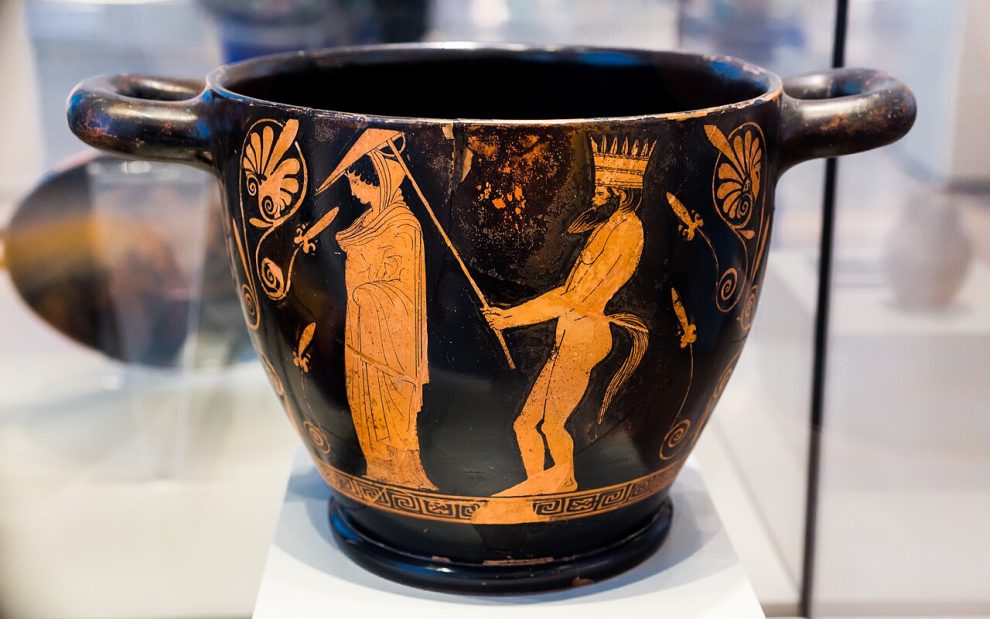
Attic red-figure skyphos by the Penelope Painter, ca. 440 BC, showing scenes possibly connected to the Anthesteria festival in Athens. Photo by ArchaiOptix, via Wikimedia Commons, licensed under CC BY-SA 4.0. No changes made.
The Anthesteria: Flowers, Wine, and the Return of the Dead
The Anthesteria was one of several Athenian festivals in honor of Dionysus, the wine god, held annually for three days in the month of Anthesterion (February to March) to celebrate the beginning of spring and the maturing of the wine stored at the previous vintage.
According to ancient Greek historian Thucydides, this was the oldest festival for the god of wine. It was also celebrated in the city-states of Ionia at the time as well as on the Aegean islands and the coast of Anatolia.
What made the Anthesteria unusual among spring festivals was its dual character. It was at once a celebration of new life and a time of quiet unease. The festival’s name comes from anthos, the Greek word for flower, gesturing toward spring’s arrival. Yet the Athenians knew that the Anthesteria was not quite like other festivals. These were days when the city held its breath, when the boundary between the living and the dead grew thin, and the streets belonged, at least in part, to those who no longer walked them.
The Three Days of the Anthesteria
Each day was named for the kind of vessel that typified the day’s activity: Pithoigia for jar-opening, Choes for jugs, and Chytroi for pots.
Pithoigia (Jar Opening)
On the first day, the jars of wine (pithoi) from the previous year were opened, libations offered to Dionysus, and the entire household, including slaves, joined in the festivities. Spring flowers were used to decorate the rooms of the house, the home’s drinking vessels, and any children over three years of age.
Choes (Wine Jugs)
The second day was a time of popular merrymaking typified by wine-drinking contests in which even slaves and children participated. The state also performed a secret ceremony in a sanctuary of Dionysus, in which the wife of the king archon went through a ceremony of marriage to Dionysus.
Chytroi (Pots)
The third day was a festival of the dead. Fruit or cooked pulse was offered to Hermes in his capacity as Hermes Chthonios, an underworld figure, and to the souls of the dead, who were then bidden to depart. None of the Olympians were included and no one tasted the pottage, which was food of the dead. Celebration continued and games were held.
The role of ceramic vessels in the Anthesteria was central and visible. The pithoi (large storage jars), the choes (wine jugs), and the chytroi (cooking pots) were not just practical objects but ritual ones. Each gave its name to a full day of the festival, embedding pottery into the very structure of springtime worship. For those interested in the ancient tradition of Attic ceramics, the Anthesteria is one of the most vivid illustrations of how vessels shaped and defined Athenian religious life.
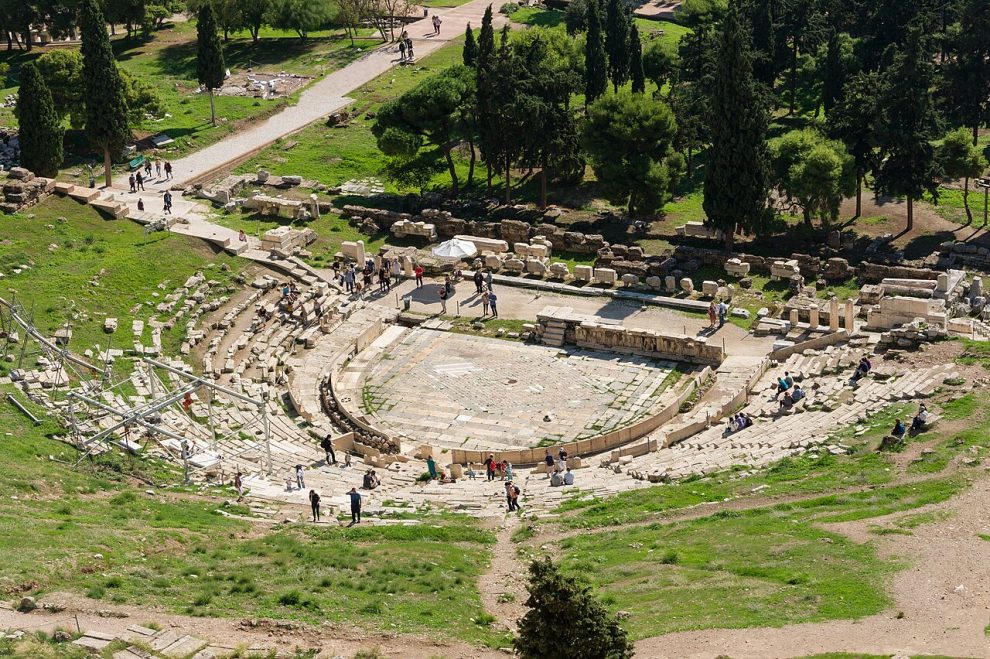
Theatre of Dionysus on the southern slope of the Acropolis in Athens, Greece. Photo by Jebulon, via Wikimedia Commons, released under CC0 1.0 Public Domain Dedication. No changes made.
The Great Dionysia: Theater, Procession, and Civic Life
If the Anthesteria was intimate and ritually complex, the Great Dionysia was Athens at its most spectacular. The Great Dionysia, also known as the City Dionysia, was a significant annual festival in ancient Greece dedicated to Dionysus, the god of wine and fertility. Originating in Athens and celebrated during March or April, the festival featured theatrical performances that included comedies, tragedies, and satyr plays.
The Greek festival honoring the god Dionysus was the most important arts festival in the ancient world. Combining theater, music, dance, and community, the six-day spring event in Athens was attended by people from all over Greece.
The Grand Procession
On the first day of the festival, the pompe, or procession, was held, in which citizens, metics, and representatives from Athenian colonies marched to the Theatre of Dionysus on the southern slope of the Acropolis, carrying the wooden statue of Dionysus Eleuthereus.
The opening of the festival featured a procession to the Theater of Dionysus bearing a wooden statue of the god. As the first day progressed, choruses of men and boys representing the ten political tribes of Athens held dithyrambic competitions. The day concluded with the sacrifice of a bull and a communal feast.
Theater as Ritual
The dramatic competitions that followed were not simply entertainment. They were acts of civic and religious participation. As many as 16,000 Athenian citizens would file into the amphitheater to view the newest plays by Aeschylus, Euripides, Sophocles, Aristophanes, and others.
The festival played a pivotal role in the evolution of Greek drama, influencing the narrative structures and thematic elements that would shape Western literature. Where possible, plays were staged in amphitheaters, and the orphaned children of men who died defending the city were honored with seats in the front row.
The Great Dionysia was also a reminder that spring in ancient Greece was a profoundly communal experience. It brought together citizens from across Attica and drew visitors from across the Greek-speaking world, all gathered in a city that understood theater, religious ritual, and democratic life as deeply connected.
The Thargelia: Purification and First Fruits for Apollo
Later in the spring season, Athens turned its attention from Dionysus to Apollo. The Thargelia was one of the chief Athenian festivals in honor of the Delian Apollo and Artemis, held on their birthdays, the 6th and 7th of the month Thargelion (about May 24 and May 25). Essentially an agricultural festival, the Thargelia included a purifying and expiatory ceremony.
The festival was named after the first fruits, or the first bread from the new wheat. In practice, this made the Thargelia a late-spring thanksgiving, a moment for Athens to offer the results of the growing season to the gods before the full heat of summer arrived.
Purification Before Gratitude
The Thargelia had a darker first day before its celebratory second. At its oldest, the festival involved ritual purification of the city through the figure of the pharmakos, a designated scapegoat who was expelled from Athens in order to cleanse it of accumulated pollution and misfortune. Those figures, known as pharmakoi, were draped with figs, fed, led in procession through the city, whipped with vegetation so as to transfer impurity to them, and then driven out.
Offerings and Olive Branches
The second day was one of gratitude and abundance. A procession carried eiresione (olive boughs wrapped in wool, decorated with figs, cakes, and first fruits) through the streets to Apollo’s temple in the Pythion, where they were hung as offerings to invoke divine blessings for fertility and health.
At the Thargelia, children would form a procession traveling throughout the city, garnering gifts. They carried an olive branch wreathed with fillets of wool and laden with numerous firstlings. On this same day, tribes competed in cyclic choruses singing hymns to Apollo, with victors awarded bronze tripods dedicated at the temple, fostering civic unity and honoring the god’s musical and prophetic aspects. Adoption ceremonies and communal feasts also occurred, reinforcing social bonds amid the seasonal transition.
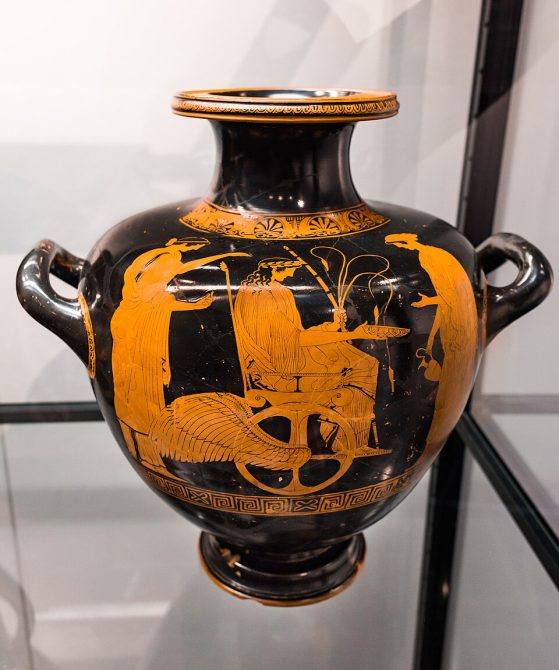
Attic red-figure hydria attributed to the Chicago Painter, ca. 450–440 BC, showing Triptolemos with Persephone and Demeter. Photo by ArchaiOptix, via Wikimedia Commons, licensed under CC BY-SA 4.0. No changes made.
The Myth Beneath the Rituals: Demeter, Persephone, and the Season of Return
No account of spring in ancient Greece would be complete without the myth that gave it its deepest resonance: the return of Persephone from the underworld. According to the myth, Persephone had been taken by Hades, God of the underworld, and her mother Demeter, goddess of grain and the harvest, had caused the earth to grow barren in her grief. When Persephone was permitted to return to the surface each year, spring arrived with her. The world flowered again because the goddess had come home.
This myth was not only told. It was enacted through the Eleusinian Mysteries, one of the most significant religious rites of the ancient world. These ceremonies were held annually in honor of the goddesses Demeter and Persephone and took place in the town of Eleusis. The Eleusinian Mysteries have origins dating back to the Mycenaean period. The rites celebrated the myth of death, descent, and return that spring itself embodied.
The persistence of this story across centuries, and across cultures that adopted it and transformed it, points to something fundamental in how the ancient Greeks understood the natural world. Spring was not simply climate. It was narrative, divine, and participatory.
Martis: An Ancient Springtime Custom That Survives Today
Some springtime customs from ancient Greece have persisted far longer than the festivals themselves. The tradition of Martis dates back to the cults of Demeter and Persephone, which began thousands of years ago in ancient Greece. As a form of initiation into the cult, which was one of the Eleusinian Mysteries, the faithful wore a bracelet called a kroki around both their right hand and left ankle.
The ancient tradition still lives on today in modern Greece. The bracelet must be woven on the last day of February and made of white and red thread. The white thread of the bracelet symbolizes purity while the red represents life and passion.
This continuity between ancient ritual and living custom is one of the things that makes Greece distinctive as a cultural landscape. The same soil that was plowed and offered to the gods in spring still carries that layered memory.
Ceramics and Spring Rituals: The Vessel as Sacred Object
Spring festivals in ancient Athens were inseparable from pottery. The Anthesteria drew its entire three-day structure from the names of ceramic vessels: the pithos, the chous, and the chytros. Wine was stored in large clay jars through the winter, brought out at the festival’s opening, and poured as libations to the gods. The chytros, a simple cooking pot, became a ritual object on the festival’s final day, filled with grain and pulse as an offering for the dead.
This connection between ceramics and ritual runs throughout ancient Greek culture. Attic pottery, produced in the workshops of ancient Athens, often depicted festival scenes: processions, symposia, sacrifices, and figures with wine vessels. These images were not decorative alone. They recorded and participated in the religious life they showed.
The tradition of working with clay in Athens, shaping vessels by hand with attention to both form and meaning, connects directly to that ancient practice. Today, the workshops at Attic Black in Athens offer a way to engage with that tradition in a hands-on, historically grounded way, learning the techniques that gave rise to some of the most significant ceramic art in Western history.
Conclusion
Spring in ancient Greece was a season of profound ritual richness. From the three-day cycle of the Anthesteria, with its wine jars, sacred marriage, and offerings for the dead, to the vast theatrical spectacle of the Great Dionysia attended by thousands, to the purifying processions of the Thargelia with their first-fruit offerings, the ancient Greeks understood spring as a time when the world required active participation. The gods needed to be honored. The dead needed to be acknowledged. The new wine needed to be opened and poured.
At the center of many of these rituals were ceramic vessels, the same forms that Athenian potters shaped by hand in the workshops of Attica. Understanding spring in ancient Greece means understanding the culture, the mythology, and the material life that gave those rituals their form. For those visiting Athens today, exploring that heritage, whether through its museums, its archaeology, or through a hands-on pottery workshop in the city, offers a direct and meaningful point of connection to one of the world’s great ancient traditions.
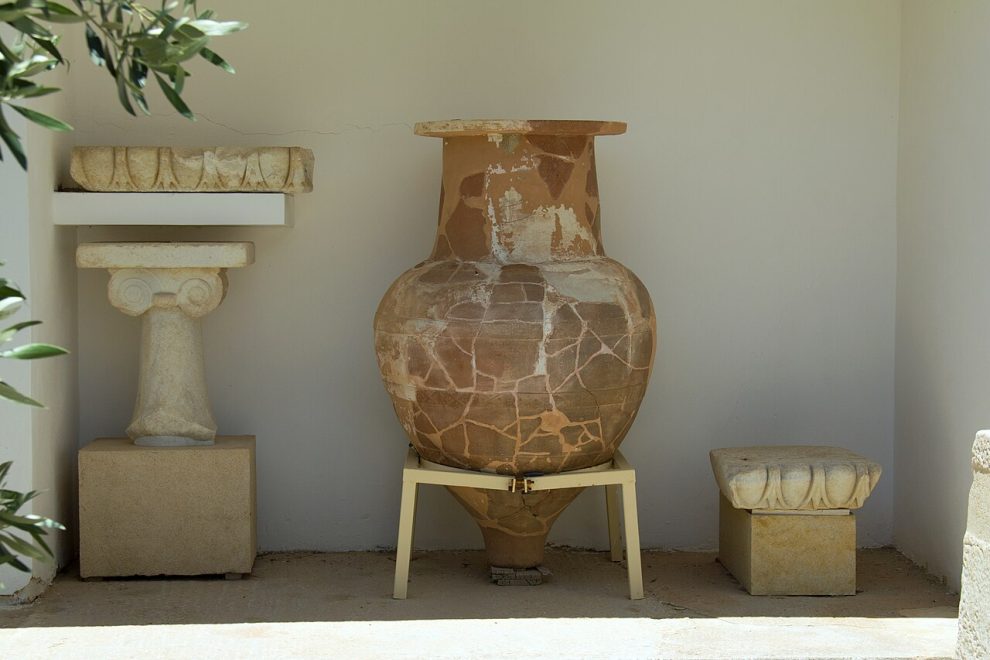
Large ancient Greek pithos and architectural fragments in the courtyard of the Archaeological Museum of Paros. Photo by Zde, via Wikimedia Commons, licensed under CC BY-SA 4.0. No changes made.
Frequently Asked Questions About Spring in Ancient Greece
What festivals did ancient Greeks celebrate in spring?
The main spring festivals in ancient Greece included the Anthesteria (dedicated to Dionysus and the new wine), the Great Dionysia (a theatrical and civic festival in Athens), and the Thargelia (an agricultural festival honoring Apollo and Artemis with first-fruit offerings). Each marked a different dimension of the season, from the opening of wine jars to dramatic competition to ritual purification.
What was the role of Dionysus in ancient Greek spring festivals?
Dionysus was central to the Athenian spring calendar. Both the Anthesteria and the Great Dionysia were held in his honor. As a god associated with wine, fertility, death, and rebirth, Dionysus embodied the cyclical nature of spring itself. His festivals involved wine-drinking, theatrical performance, sacred marriage ceremonies, and the ritual acknowledgment of both new life and the dead.
How did ancient Greeks mark the arrival of spring?
Spring was marked through a combination of religious ceremony, communal celebration, and agricultural ritual. Flower decorations were placed in homes and on children. Wine jars sealed the previous autumn were opened and offered to the gods. Processions moved through Athens carrying statues of the gods. Theaters filled with tens of thousands of citizens for dramatic competitions. Olive branches laden with first fruits were carried through city streets.
What is the connection between ancient Greek spring rituals and pottery?
Pottery was central to spring festivals in ancient Athens. The Anthesteria took its three-day structure directly from ceramic vessel types: the pithos (storage jar), the chous (wine jug), and the chytros (pot). Wine was aged in clay jars, poured as libations, and distributed to participants. The chytros was filled with grain offerings for the dead on the festival’s final day. Attic pottery also frequently depicted spring festival scenes in both black-figure and red-figure styles.
How did the myth of Persephone relate to spring in ancient Greece?
The myth of Persephone’s return from the underworld was the foundational story behind Greek spring. Her annual return from the realm of Hades caused Demeter to restore fertility to the earth, bringing flowers, grain, and warmth. This myth was at the heart of the Eleusinian Mysteries, one of the most important and secretive religious rites of ancient Greece, held each year to mark the cycle of death and renewal.
Featured image: Marble votive relief with an Eleusinian theme, late 4th century BC, Ancient Agora Museum in Athens. Photo by Dorieo, via Wikimedia Commons, licensed under CC BY-SA 4.0. No changes made.