
What Is a Pithos?
A pithos is one of the most important and architecturally imposing objects in ancient Greek pottery. This large ceramic storage jar, produced from at least the Late Neolithic period through the Iron Age and beyond, served as the primary container for bulk goods across palace economies, farming households, and maritime trade routes throughout the ancient Mediterranean.
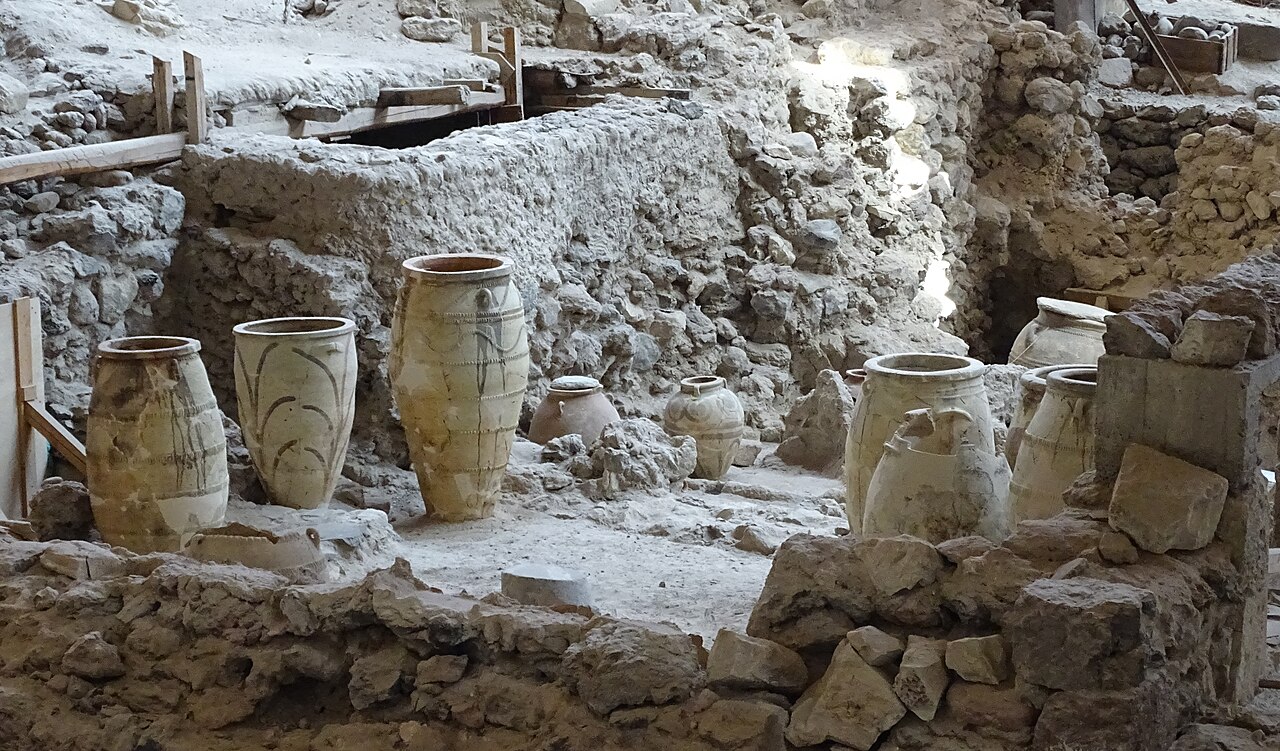
Unlike the refined painted vessels that fill museum cases, the pithos was a workhorse of clay. Some examples stood taller than a human being and held close to a thousand liters of liquid. Others were sunk into the earth up to their shoulders in palace storerooms, where they functioned less as movable containers and more as permanent fixtures of an organized economy.
For anyone studying ancient Greek pottery, archaeology, or the Bronze Age in general, the pithos is impossible to ignore. It appears at Minoan palaces in Crete, in Mycenaean administrative records, on ancient shipwrecks, in the works of Homer and Hesiod, and at the heart of one of the most familiar myths in Western culture.
The Definition and Shape of a Pithos
The word pithos comes from ancient Greek (written as the single noun: “pithos”), and its plural form is pithoi. Its etymology has been debated by scholars for generations. One influential proposal traces it to the Proto-Indo-European root related to the concept of a “container,” and links it to the Latin word fiscus, meaning purse, which eventually gave English the word “fiscal.” A competing theory, supported by the linguistic evidence of Linear B tablets, suggests that pithos may have been borrowed into Greek from a pre-Greek Mediterranean substrate language, given certain phonetic irregularities that do not align with standard Indo-European sound changes.
Regardless of its origins, the word was in common use in Greek by the time of Homer, and it describes a consistent physical type. A pithos was a large ceramic jar with a roughly ovoid or cylindrical body, a wide mouth for filling, a flat or rounded base for stability, and multiple handles or lugs positioned around the body for attaching ropes or a lifting harness. Most examples were produced from coarse, gritty clay fired at relatively low temperatures, giving them a robust, terracotta-red or buff appearance.
The defining physical feature of a pithos is its size. Examples from the Minoan palace at Knossos measure approximately 1.14 meters in height and 0.7 meters in diameter, but some of the largest documented specimens reached 1.7 meters in height with calculated volumes approaching 1,000 liters, roughly the equivalent of 1,000 standard water bottles.
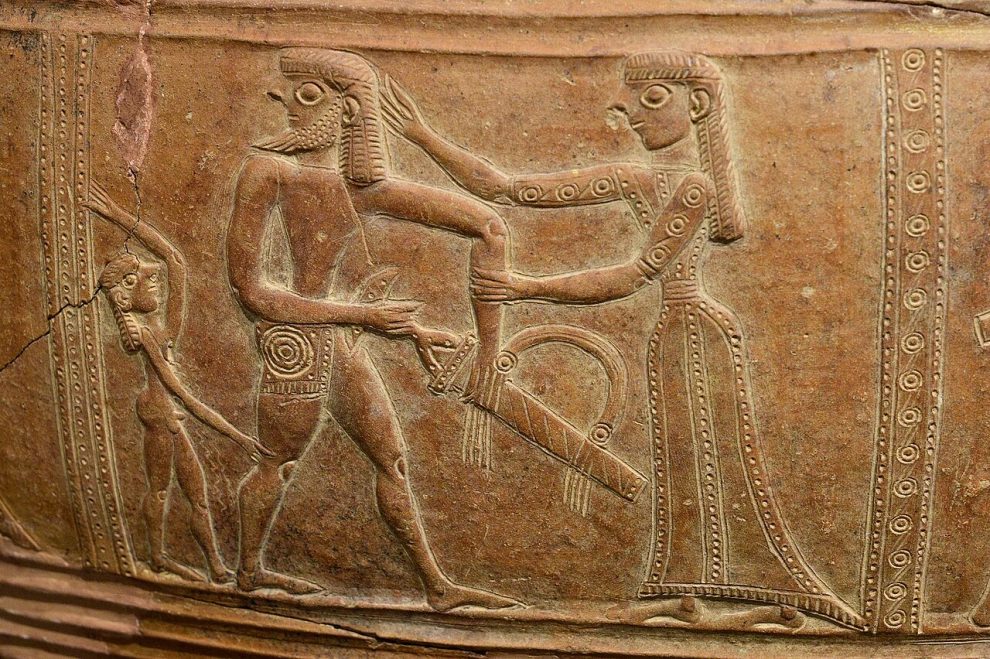
Mykonos relief pithos depicting the capture of Troy and the Trojan Horse, dated to around 670 BC. Photo by Zde, via Wikimedia Commons, licensed under CC BY-SA 4.0. No changes were made.
How Pithoi Were Made
Building a pithos required a different approach than throwing a smaller vessel on a wheel. Because of their extreme size, large pithoi were constructed in sections, with individual coiled or slab-built portions assembled while still workable and then fused together with clay slip. The joins were reinforced with raised horizontal bands of clay applied around the exterior, which both strengthened the vessel structurally and, over time, developed into a decorative convention.
These relief bands became a signature visual element of pithoi. Early examples were left plain or given simple incised marks. Over time, potters applied more elaborate surface treatments: incised geometric patterns, stamped or rolled designs of spirals, meanders, and wave motifs, and in some cases figurative painted scenes in polychrome. The decoration was generally concentrated on the neck and upper body of the vessel, the parts that remained visible when the jar was partially buried or set into a floor.
Some pithoi, particularly those intended for ritual use or prominent household display, received high-quality figurative painting comparable to other fine ancient Greek pottery. The spacious surfaces of a large pithos offered a canvas for narrative scenes that a smaller amphora or krater could not accommodate as generously.
The Role of Pithoi in the Ancient Economy
The pithos was not primarily an object of display. It was an instrument of economic organization, and understanding how pithoi functioned in the ancient world reveals a great deal about how early Mediterranean societies managed agricultural surplus, administered resources, and sustained large populations.
Palace Storage at Knossos and Mycenae
The most famous pithoi in the archaeological record come from the Minoan palace complex at Knossos on Crete. The palace included dedicated storage magazines, long narrow rooms lined with pithoi set into pits in the floor. These vessels held olive oil, wine, grain, dried legumes, and other agricultural goods collected as tribute from the surrounding region and redistributed to palace workers, craftspeople, and the broader population.
The scale of Minoan pottery storage at Knossos was extraordinary. The combined capacity of the pithoi in a single storage corridor ran into tens of thousands of liters. This was not casual household provisioning. It was state-level resource management embedded in ceramic form, and the administrative records found alongside these jars, written in the undeciphered Linear A and later in Mycenaean Linear B, confirm that every vessel was tracked, measured, and accounted for.
Similar patterns appear at Mycenaean palace sites on the Greek mainland, where Linear B tablets record inventories of pithoi and their contents using a standardized wet unit of approximately 36 liters and a dry unit of approximately 96 liters. The Mycenaean bureaucracy built its accounting system around the known capacities of these jars.
Household and Farmstead Use
Beyond the palace, pithoi were a fundamental part of everyday domestic life across ancient Greece and the broader Mediterranean. Farmsteads and villas kept clusters of pithoi in dedicated storage rooms, partially buried in the ground to take advantage of the earth’s natural insulation and maintain the cool, stable temperatures that preserved oil and wine through long Mediterranean summers.
The partial burial of a pithos served practical purposes on multiple levels. The earth stabilized the vessel against tipping, reduced the risk of temperature fluctuations that could spoil contents, and kept the jar from shifting when the liquid inside moved. This integration with the landscape meant that a pithos, once placed and filled, was essentially immovable furniture. The largest examples, weighing hundreds of kilograms when full, could not have been moved by hand.
Trade and Maritime Transport
Smaller pithoi, those with capacities between roughly 100 and 300 liters, were used in maritime trade. Evidence from Bronze Age shipwrecks confirms that pithoi were loaded onto merchant vessels and transported across the eastern Mediterranean. A Late Bronze Age wreck discovered at Uluburun off the coast of Turkey carried several pithoi as part of a mixed cargo that included copper ingots, fine ceramics, and other goods. Some of the Uluburun pithoi served as packing crates for smaller pottery, making them among the earliest known examples of shipping containers used within shipping containers.
The weight and volume of even moderately sized transport pithoi required mechanical assistance for loading and unloading. Rope handles and lugs provided the purchase points for a harness system, and the organized bands of raised decoration around the body of many pithoi may have served a structural as much as a decorative function, reinforcing the joints between sections of the vessel against the stresses of handling.
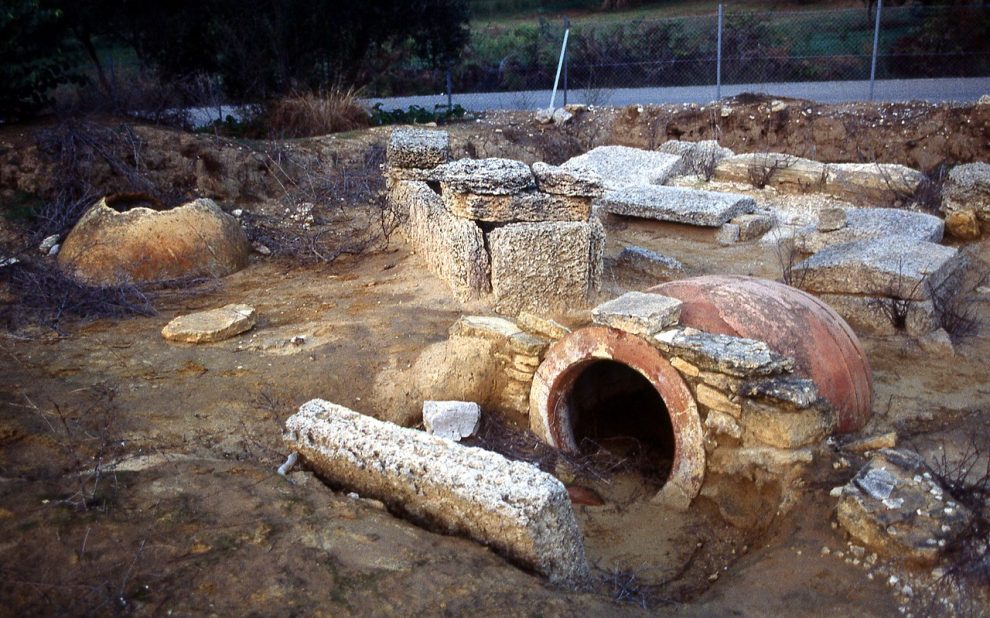
Ancient cemetery with pithos burials at Mazi in Skillountia, Elis, Greece. Photo by Mark Landon, via Wikimedia Commons, licensed under CC BY-SA 4.0. No changes were made.
Pithoi as Burial Vessels
Not all pithoi held agricultural goods. A secondary but archaeologically significant use was as containers for human remains. In Middle Bronze Age burials at Mycenae and on Crete, pithoi served as coffins, with the contracted bodies of the deceased placed inside and the vessel sealed and buried. The symbolic logic of this practice was not lost on the ancient Greeks: the same vessel that contained the wealth of the living, the grain and oil that sustained life, could also contain the dead in their transition to the underworld.
Later Greek religious thought built on this association. Certain temples and sanctuaries used large jars to store ritual offerings. Because the pithos could hold abundance or conceal what remained hidden from view, it became a powerful symbol in Greek religious and mythological imagination.
The Pithos in Greek Mythology: Pandora’s Jar
The most widely known appearance of the pithos in Greek mythology is in the story of Pandora as told by the poet Hesiod in his Works and Days, composed in approximately the 8th century BCE. According to Hesiod, Pandora was given a large jar by the gods, inside which were sealed all the evils, diseases, and misfortunes of the world. When she opened it out of curiosity, everything escaped into the world, leaving only hope (elpis in Greek) remaining inside.
The vessel Hesiod describes is explicitly a pithos, a large storage jar of the type familiar to any Greek household. The image draws its mythological weight directly from the pithos’s role in daily life. The vessel held everything a family needed to survive the year, so ancient audiences immediately understood the power of sealing disaster inside it or opening it and releasing disaster into the world.
The shift from “Pandora’s jar” to “Pandora’s box” in popular language is the result of a mistranslation. In the 16th century, the scholar Erasmus of Rotterdam, working from Hesiod’s text, translated the Greek word pithos into the Latin pyxis, meaning a small lidded box or container. This rendering entered the Western tradition and has persisted ever since, obscuring the original ceramic and domestic context of the myth. The object Pandora opened was not a box. It was a large, heavy, partially buried storage jar of the kind that formed the material backbone of the ancient Greek economy.
Diogenes and the Pithos as Home
One additional appearance of the pithos in ancient Greek culture deserves mention. The philosopher Diogenes of Sinope founded the Cynic school. Many consider him one of the ancient world’s most provocatively unconventional thinkers. Ancient accounts say that he lived in a pithos in Athens. Some translations describe the object as a barrel or tub. However, the accounts almost certainly refer to the same large ceramic storage jar used for grain and oil. Diogenes deliberately chose the vessel as his home. Through that choice, he rejected conventional housing, wealth, and social expectations and reduced shelter to its most basic form in the Athenian marketplace.
The anecdote illustrates once again the sheer scale of the pithos. A vessel large enough for a man to sleep inside was not unusual. At full size, a pithos was not merely a jar. It was an architectural element of ancient life.
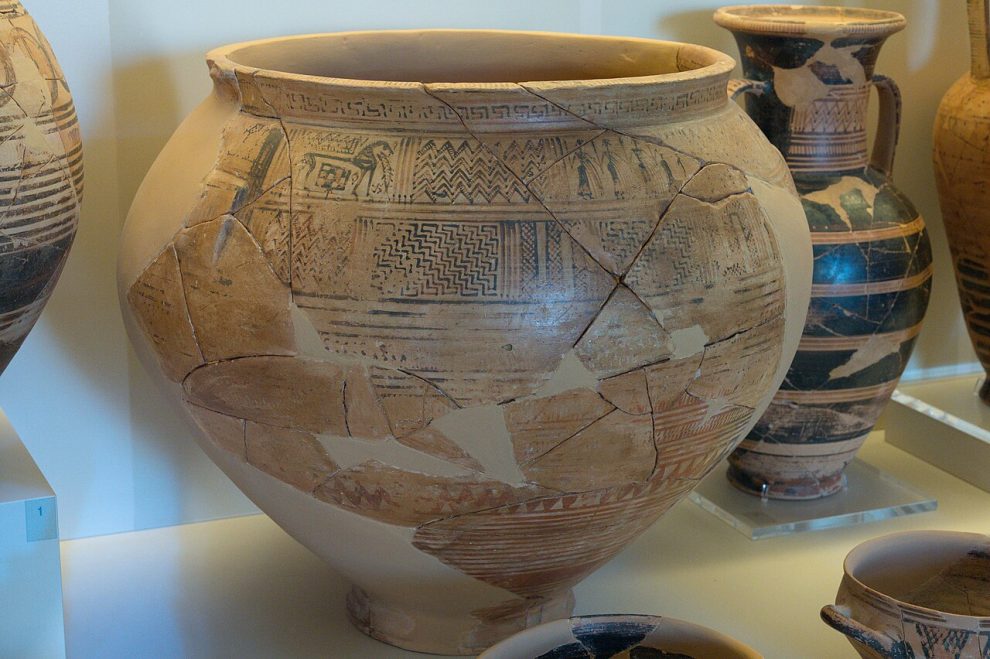
Geometric-period krater decorated with horses and women, from Asine and dated to around 700 BC. Photo by Zde, via Wikimedia Commons, licensed under CC BY-SA 4.0. No changes were made.
How the Pithos Compares to Other Ancient Greek Storage Vessels
The pithos occupies the largest end of the spectrum of ancient Greek storage and transport pottery. Understanding how it relates to other vessel types helps clarify its unique role.
Pithos vs. Amphora
Pithos vs. Krater
The krater was a mixing vessel used at symposia for diluting wine with water. It was made for use in social settings and was typically decorated with high-quality figurative painting. The pithos and the krater represent opposite poles of ancient Greek ceramic culture: one is an anonymous industrial vessel serving an economic function, the other is a prestige object serving a social and ritual one.
Pithos vs. Hydria
The hydria was a water-carrying vessel with three handles, designed for women to carry water from public fountains. It was portable and used in everyday domestic activity. Where the hydria moved water around the household, the pithos stayed in one place and held much larger quantities of commodities for the long term.
Pithoi in Museum Collections
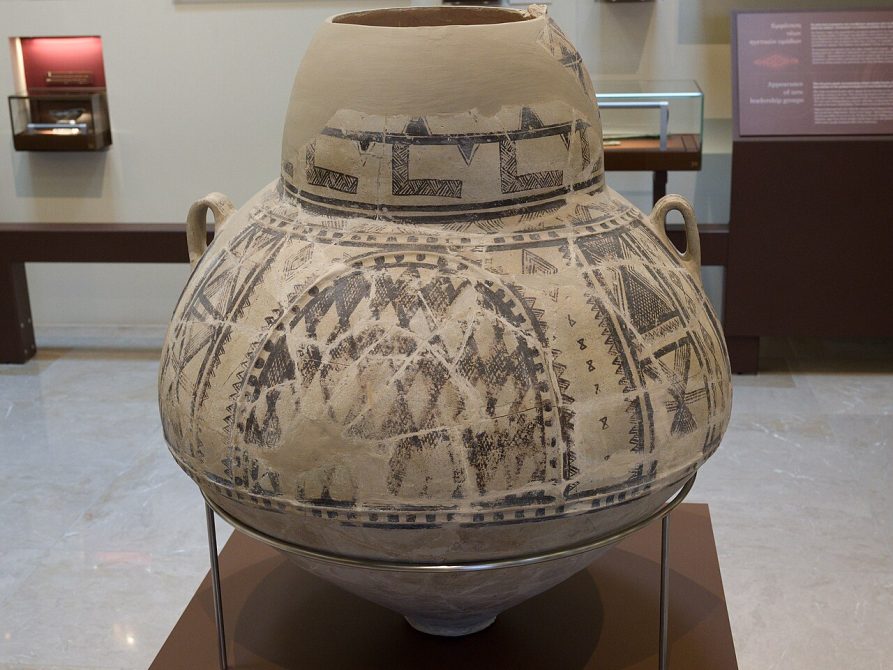
These museum pithoi vary considerably in their level of decoration. The plainest are entirely unadorned, their surfaces marked only by the horizontal relief bands that reinforced their construction. The most elaborate examples carry figurative painted panels, geometric polychrome decoration, and in some cases Linear A inscriptions or ownership marks incised into the clay before firing.
Seeing a pithos in a museum collection changes one’s sense of scale in ancient pottery. People handled most ancient Greek vessels, including cups, jugs, plates, and small amphoras.
A pithos is something else entirely, closer in presence to a large piece of architectural stonework than to a dinner table object. It is pottery at the edge of architecture.
The Pithos and the Living Tradition of Greek Ceramics
The pithos still belongs to the present. In parts of Greece, particularly Crete, artisans continue to produce large terracotta storage jars called pitharia. People still use these vessels today. This practice preserves an unbroken ceramic tradition that reaches back to the Neolithic period. Modern pitharia retain the same coarse fired clay and general form as their ancient counterparts. They also maintain the same practical connection with the earth and the storage of agricultural goods.
This continuity is part of what makes ancient Greek pottery so compelling as a cultural subject. Artisans did not create these forms for art. They created them for life. The pithos evolved to solve a specific problem. It allowed people to store large quantities of food and liquid safely in a warm climate. Its basic design solved that problem so effectively that people have used it for more than five thousand years.
At Attic Black, the ancient ceramic tradition is something studied, revived, and taught through hands-on workshops in Athens. The workshops do not produce vessels on the scale of pithoi. However, their techniques, clay, and the fundamental relationship between the potter’s hands and the material continue the same deep tradition. That tradition produced every storage jar found at Knossos.
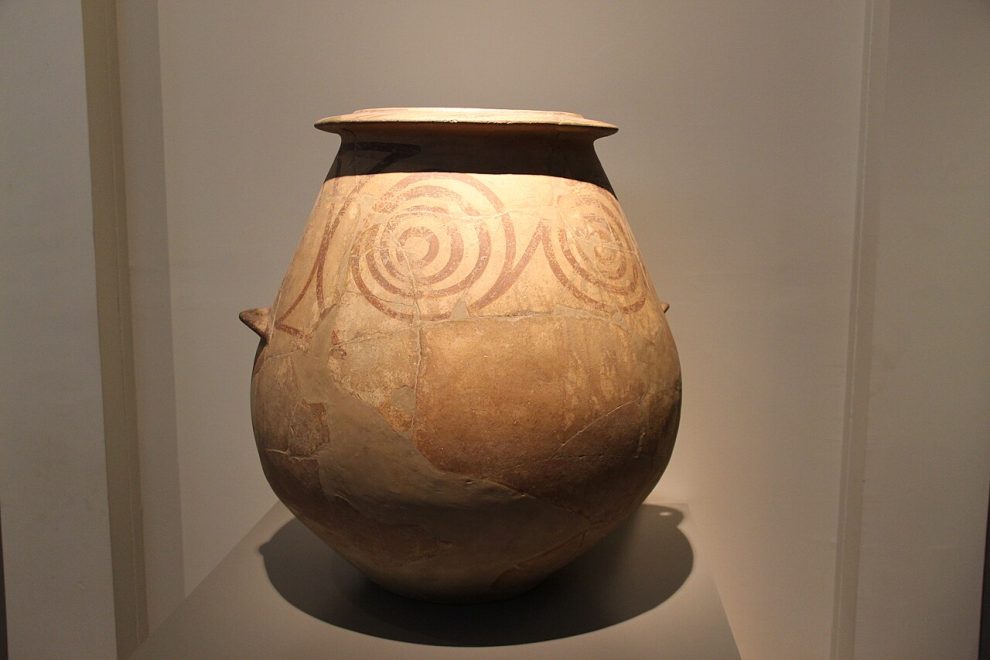
Middle Cycladic pithos from Milos, dating to the beginning of the second millennium BC. Photo by Gary Todd, via Wikimedia Commons, released under CC0 1.0. No changes were made.
Frequently Asked Questions About the Pithos
What is the difference between a pithos and an amphora?
What does “pithos” mean in Greek?
What is Pandora’s pithos?
The poet Hesiod tells how Pandora opened a pithos that the gods had given her. She released all the evils and misfortunes of the world. The vessel was a large ceramic storage jar. In the 16th century, the scholar Erasmus mistranslated the Greek word pithos as “box.” He used the Latin word pyxis instead. This mistranslation created the modern phrase “Pandora’s box.”
Where are ancient pithoi found today?
The Heraklion Archaeological Museum in Crete holds a major collection of ancient pithoi. The collection includes examples from the Minoan palace at Knossos. The National Archaeological Museum in Athens also houses an important collection. Archaeological sites such as Knossos, Mycenae, and various Cycladic island settlements have produced significant numbers of pithoi in situ.
How big was a pithos?
Pithoi varied considerably in size. Smaller household examples stood roughly 0.5 meters high. The largest palatial specimens exceeded 1.7 meters in height. Some of the largest pithoi at Knossos held nearly 1,000 liters. Maritime traders generally used smaller transport pithoi with capacities of about 100 to 300 liters.
Were pithoi decorated?
Yes, particularly on the neck and upper body. Artisans commonly decorated pithoi with raised relief bands that reinforced the vessel’s structure. They also added incised or stamped geometric patterns and painted figurative scenes.
Plain pithoi were also common, especially for industrial storage contexts where appearance was not a consideration.
Feature image by: Ad Meskens, via Wikimedia Commons, licensed under CC BY-SA 4.0. No changes were made.
