
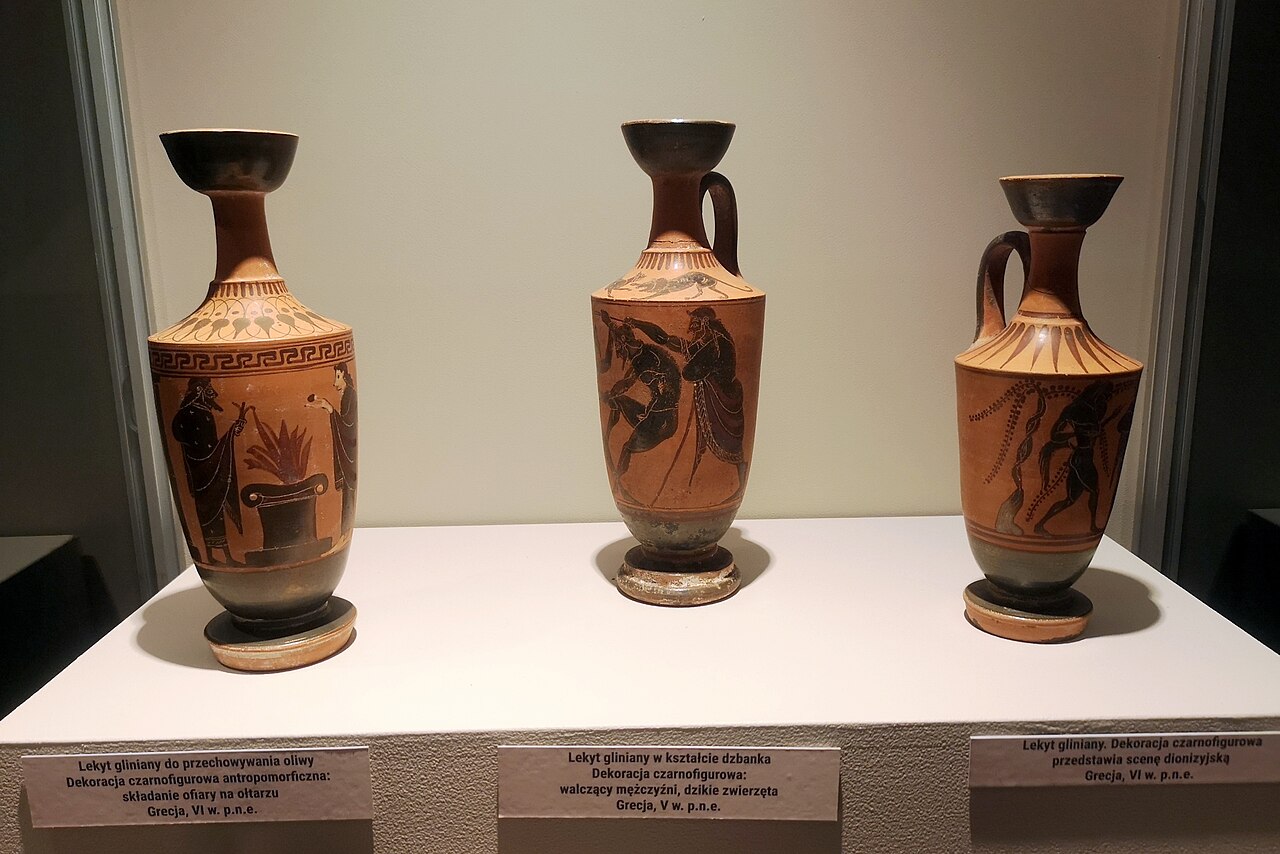
A lekythos is a narrow-necked ceramic vessel that ancient Greeks used to store and pour olive oil.
Its slender neck limited the flow of a valuable liquid, which made the shape practical for the bath and the gymnasium, where athletes applied scented oil after exercise. By the fifth century BCE, the lekythos had also become the principal vessel of Athenian funerary ritual, painted in the delicate white-ground technique and left at graves as an offering to the dead.
Among the many vessel shapes that ancient Greek potters refined over the centuries, the ancient Greek lekythos ranks among the most quietly versatile. Slender, single-handled, and easy to recognize by its narrow neck, this vessel followed an Athenian from the gymnasium to the wedding chamber to the grave, holding the same substance, olive oil, at every stage. Few pottery shapes carry as much of daily and ritual life inside a single form.
This article looks at what a lekythos is, how its design served the practical demands of storing costly oil, and how a household object became, by the Classical period, ancient Athens’s central expression of mourning through the white-ground lekythos. It completes Attic Black’s survey of major Greek vessel shapes and closes with where visitors can see the same white-ground tradition reflected in the studio’s own decorated pottery.
Where the Lekythos Comes From
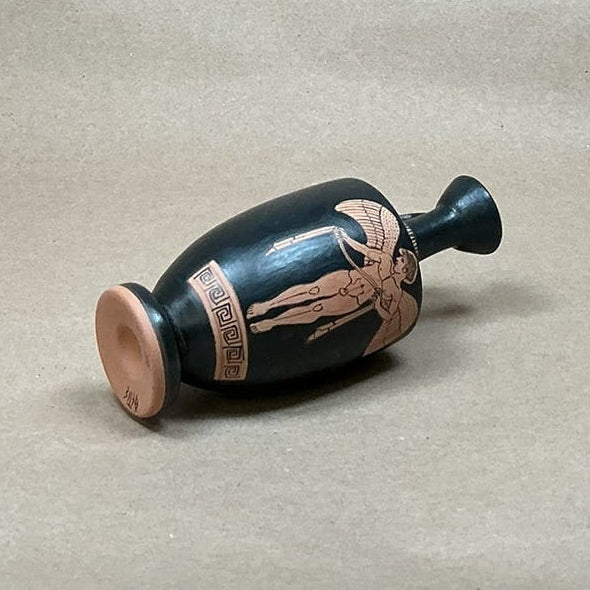
The word lekythos (plural lekythoi) was the term ancient Greeks themselves used for this oil flask. It appears in Greek comedy and everyday vocabulary of the period, not only in modern archaeological classification. The shape has its roots in Corinthian pottery of the seventh century BCE, where potters were already producing small, closed vessels for perfumed oil. Athenian workshops adopted and refined the form during the sixth century BCE, and by the fifth century BCE the lekythos had become one of the most commonly produced shapes in Attic pottery, made in black-figure, red-figure, and white-ground versions.
The vessel’s popularity tracked closely with the value of its contents. Olive oil was a household staple, an export commodity, and a ritual offering all at once, so a shape built to store, ration, and pour it carefully had a use in nearly every part of Greek life.
How to Recognize a Lekythos: Shape and Design
A lekythos has a tall, cylindrical or ovoid body that narrows sharply at the shoulder into a thin neck, topped with a small mouth and flared lip. A single strap handle runs from the neck to the shoulder, leaving the body free for painted decoration. Unlike wider vessels such as the amphora, used for storing wine and oil in bulk, the lekythos was sized for one person’s supply, and most examples stand under fifty centimeters tall.
Potters produced the shape in several recognizable variations, each suited to a different use.
Standard (Cylindrical) Lekythos
The most common form, with straight sides and a flat or slightly rounded shoulder, used for oil storage in the bath, gymnasium, and home.
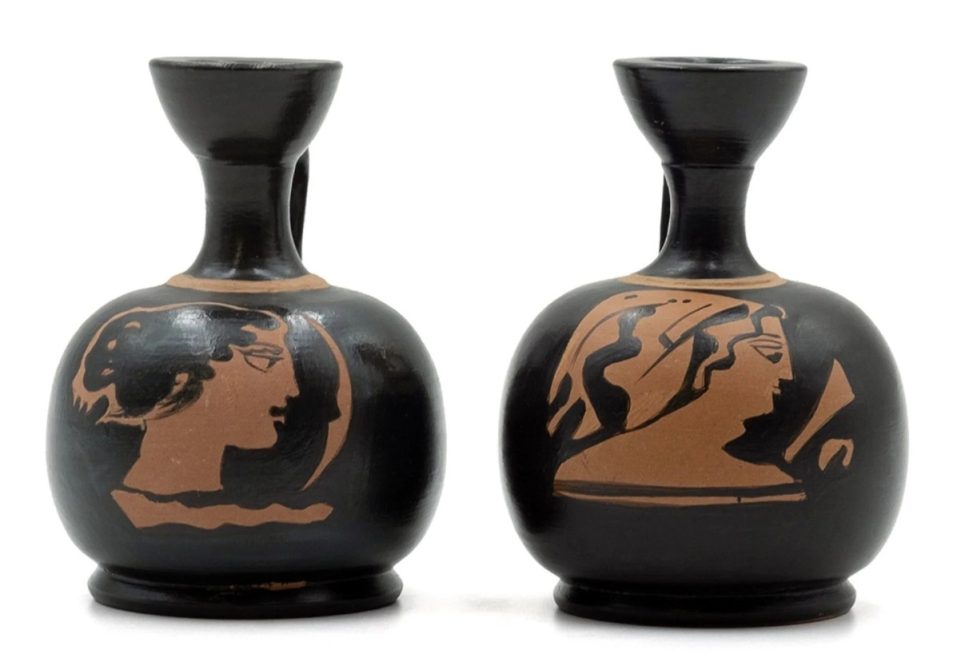
Squat Lekythos
A shorter, rounder body under twenty centimeters tall, popular in the fifth century BCE as a smaller, more affordable option for everyday oil storage.
Shoulder Lekythos
Distinguished by a sharply angled shoulder, this type became the standard shape for white-ground funerary decoration from the mid-fifth century BCE onward.
An Oil Vessel for the Bath, the Gymnasium, and Daily Life
Olive oil was central to Greek hygiene and athletics well before soap existed. Bathers and athletes rubbed oil onto their skin before exercise and scraped it off afterward, along with dirt and sweat, using a curved tool called a strigil. The lekythos, carried to the gymnasium or the public bath, held that oil, and its narrow neck served a practical function: it slowed the pour, which limited waste of an expensive commodity.
Some lekythoi went further, built with a false inner wall that created the appearance of a full vessel while actually holding a fraction of the volume, a detail that speaks to how carefully oil was measured and sold. The same shape, filled with perfumed oil rather than plain olive oil, also served as a wedding gift and formed part of a bride’s preparation.
Lekythos or Aryballos?
The lekythos is often discussed alongside the aryballos, a smaller, round-bodied oil flask that athletes tied to the wrist with a cord and carried directly into the gymnasium or wrestling ground. Where the aryballos was built for portability during exercise, the lekythos was the household and graveside vessel: larger, standing upright, and painted with more elaborate decorative programs.
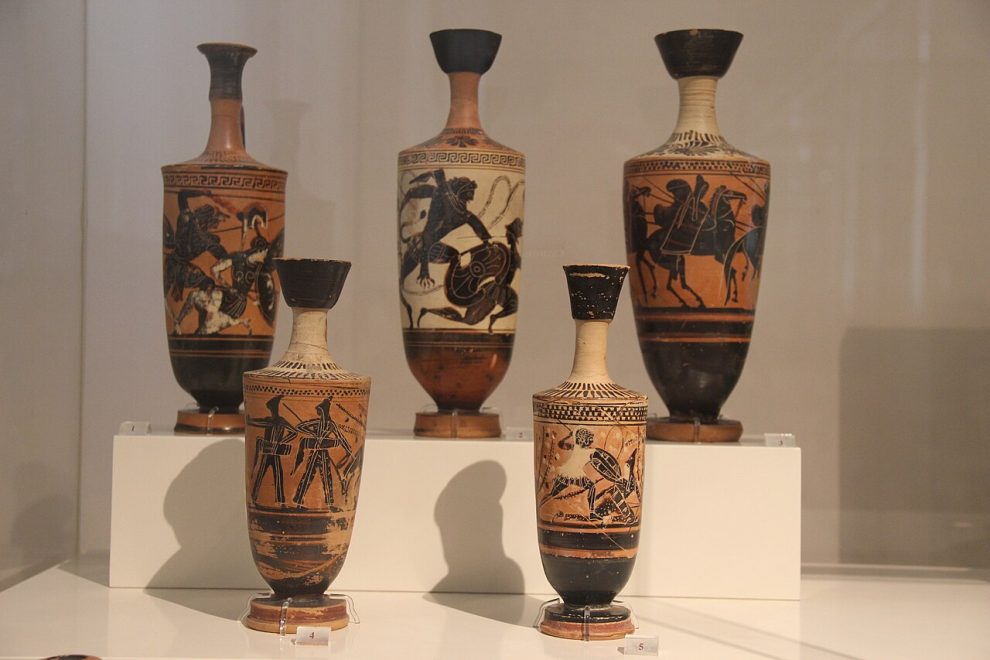
Photo by Gary Todd, via Wikimedia Commons (CC0 1.0).
From Black-Figure to White-Ground: How the Lekythos Was Decorated
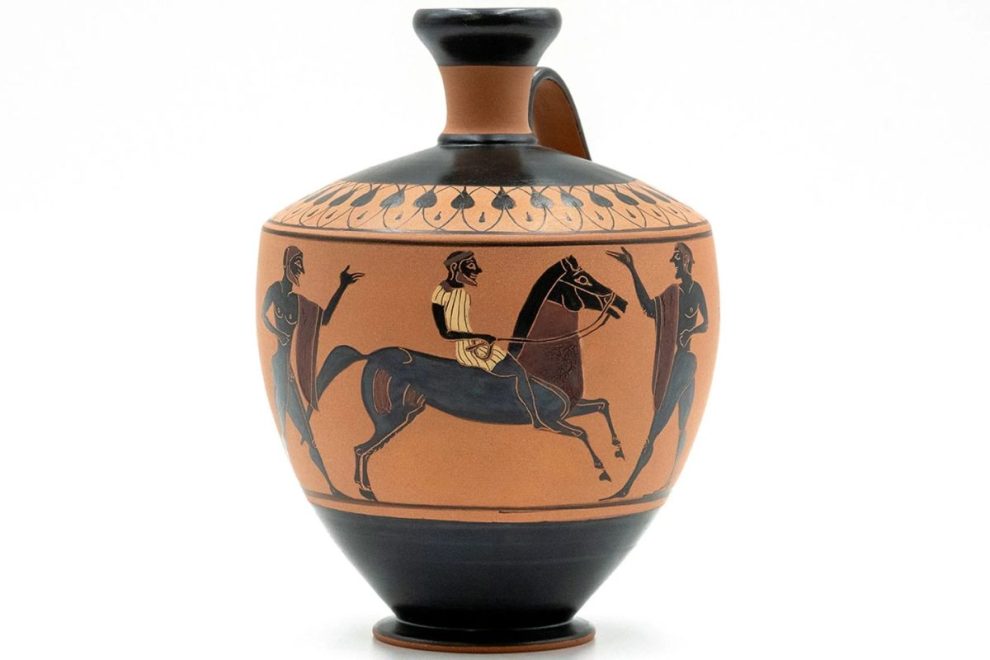
Like most Attic pottery, the lekythos followed the broader development of Athenian vase painting. Sixth-century BCE examples favored the black-figure technique, with dark silhouetted figures incised for detail against the reddish clay ground. As red-figure painting gained favor after roughly 530 BCE, some lekythoi adopted the new technique’s greater freedom for anatomical and drapery detail, though black-figure and plain black-glazed lekythoi remained common for everyday oil storage because they held up better to regular handling.
The White-Ground Technique and Its Fragile Beauty
The white-ground lekythos takes its name from the technique most closely associated with the shape today, developed in Athens around the start of the fifth century BCE. Painters coated the vessel in a fine white clay slip, then outlined figures in black or dark brown and filled in details with a wider palette of colors, including pink, blue, and gold, applied in a matte finish rather than a fired glaze. Many of these pigments were unstable and have faded or flaked away over the centuries, so surviving examples often show only faint traces of what was once a colorful surface. Attic Black’s guide to the beauty of white-ground Greek pottery examines this technique in more depth, including the painters who developed it and how its coloring differed from black-figure and red-figure work.
Because the white slip and unfired pigments wore away quickly with use, white-ground lekythoi were largely unsuitable for daily handling. Rather than a shortcoming, that fragility shaped their purpose: the technique suited objects intended for a single ceremonial use rather than years of service, which is exactly the role the lekythos took on in Athenian funerary custom.
The Funerary Lekythos: Athens’s Vessel for the Dead
By the middle of the fifth century BCE, the funerary lekythos had become the standard offering left at Athenian graves. Family members brought oil to pour as a libation for the deceased, and the vessel itself, along with its contents, was left at the tomb rather than carried home, which explains why so many surviving examples come from grave excavations rather than domestic contexts.
The painted scenes on funerary lekythoi center on the rituals of mourning itself rather than on mythological narrative: women and family members visiting the grave, carrying baskets of offerings, tying ribbons to the grave stele, or exchanging a farewell glance with the deceased, shown as if still present. This is a notably different repertoire from the mythological scenes that decorate many drinking and mixing vessels; readers curious about how gods and heroes appear on Greek pottery more broadly can find that subject in Attic Black’s article exploring Greek myths on vases.
Marble Lekythoi as Grave Monuments
The lekythos shape carried enough funerary weight that it moved beyond pottery entirely. During the fifth and fourth centuries BCE, wealthy Athenian families sometimes commissioned monumental marble lekythoi as grave markers, carved in low relief with farewell scenes and standing well over a meter tall. The Metropolitan Museum of Art’s marble lekythos of Kallisthenes, carved from Pentelic marble around 400 to 390 BCE, is a well-documented example of the type. Reproducing the household oil flask at monumental scale and in stone shows how firmly the shape had become tied to death and remembrance by the Classical period.
The Lekythos in Attic Black’s Collection
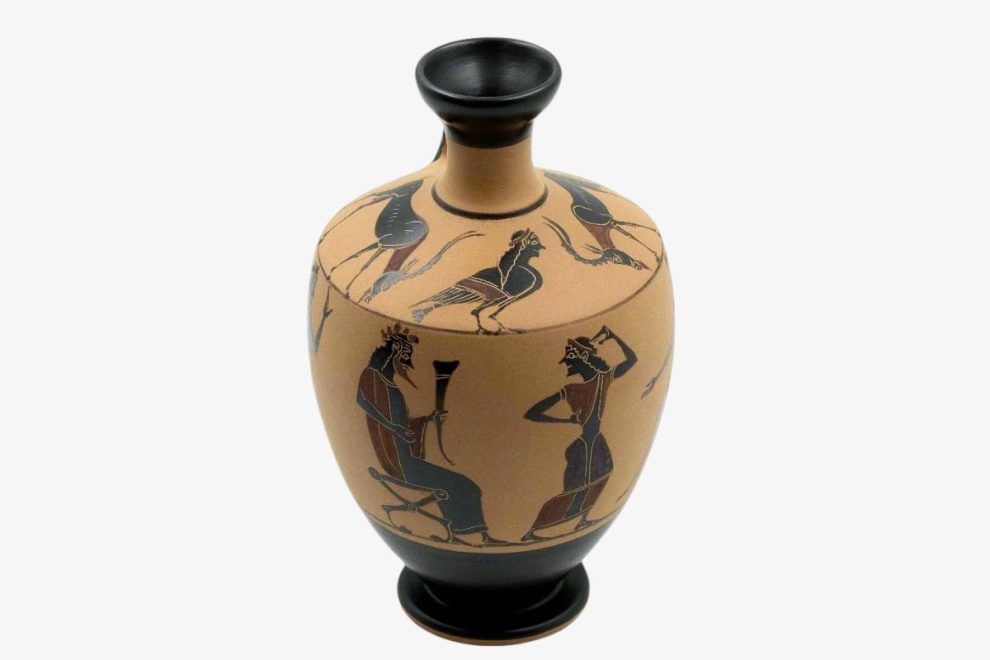
The lekythos completes a shape that Attic Black’s ongoing guide to Greek pottery had not yet addressed directly, alongside the amphora, the psykter, and the other forms covered in the studio’s ancient Greek vase types and styles guide. Where those vessels served wine and storage, the lekythos offers a more intimate counterpart: a shape built around a single person’s ration of oil, carried from the gymnasium to the wedding to the grave.
Attic Black’s own decorated pieces draw directly on this tradition, including hand-painted work that revives the white-ground palette described above. Visitors to the studio’s decorated classical pottery collection can see how that same technique, slip, fine outline work, and restrained color, moves from a funerary offering into a piece made for display today. For those who want to work with the technique directly, Attic Black’s Athens workshops teach the painting methods that produced vessels like the lekythos more than two thousand years ago.
Conclusion
A lekythos is best understood not as a single-purpose container but as a shape that tracked an ancient Athenian’s life at its most significant moments: the gymnasium, the wedding, and finally the grave. Its narrow neck answered a practical need to manage costly oil, while its later white-ground decoration turned that same everyday object into one of the most affecting forms of Greek funerary art. Together with the amphora, psykter, and the rest of Attic Black’s vessel guide, the lekythos rounds out a fuller picture of how form followed function in ancient Greek pottery. Those drawn to the white-ground palette described here can find it reflected in Attic Black’s decorated pottery collection, or learn to paint it firsthand in one of the studio’s Athens workshops.
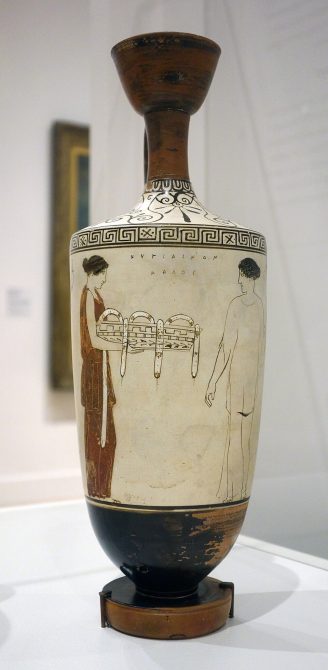
Attic white-ground lekythos (mid-5th century BCE), attributed to the Achilles Painter, Worcester Art Museum (acc. 1900.65). Photo: Mark Landon, CC BY 4.0 (Wikimedia Commons)
FAQ
What does lekythos mean?
Lekythos is the ancient Greek term for a narrow-necked oil flask. It is the same word used by Greek writers of the period, not a modern archaeological label.
What was a lekythos used for?
It stored and poured olive oil for bathing and athletics, served as a wedding gift when filled with perfumed oil, and by the fifth century BCE was the standard vessel left as an offering at Athenian graves.
What is a white-ground lekythos?
A white-ground lekythos is a lekythos coated in a fine white clay slip and painted with matte, unfired colors rather than the glossy black-figure or red-figure technique. Its fragility meant it was made mainly for funerary use rather than daily handling.
Why does a lekythos have such a narrow neck?
The narrow neck controlled the flow of oil, a costly commodity, and reduced waste when pouring small amounts for bathing, anointing, or a graveside libation.
Feature Image: Silar, “Lekythoi in Poland,” via Wikimedia Commons, licensed under CC BY-SA 4.0. No changes made.