
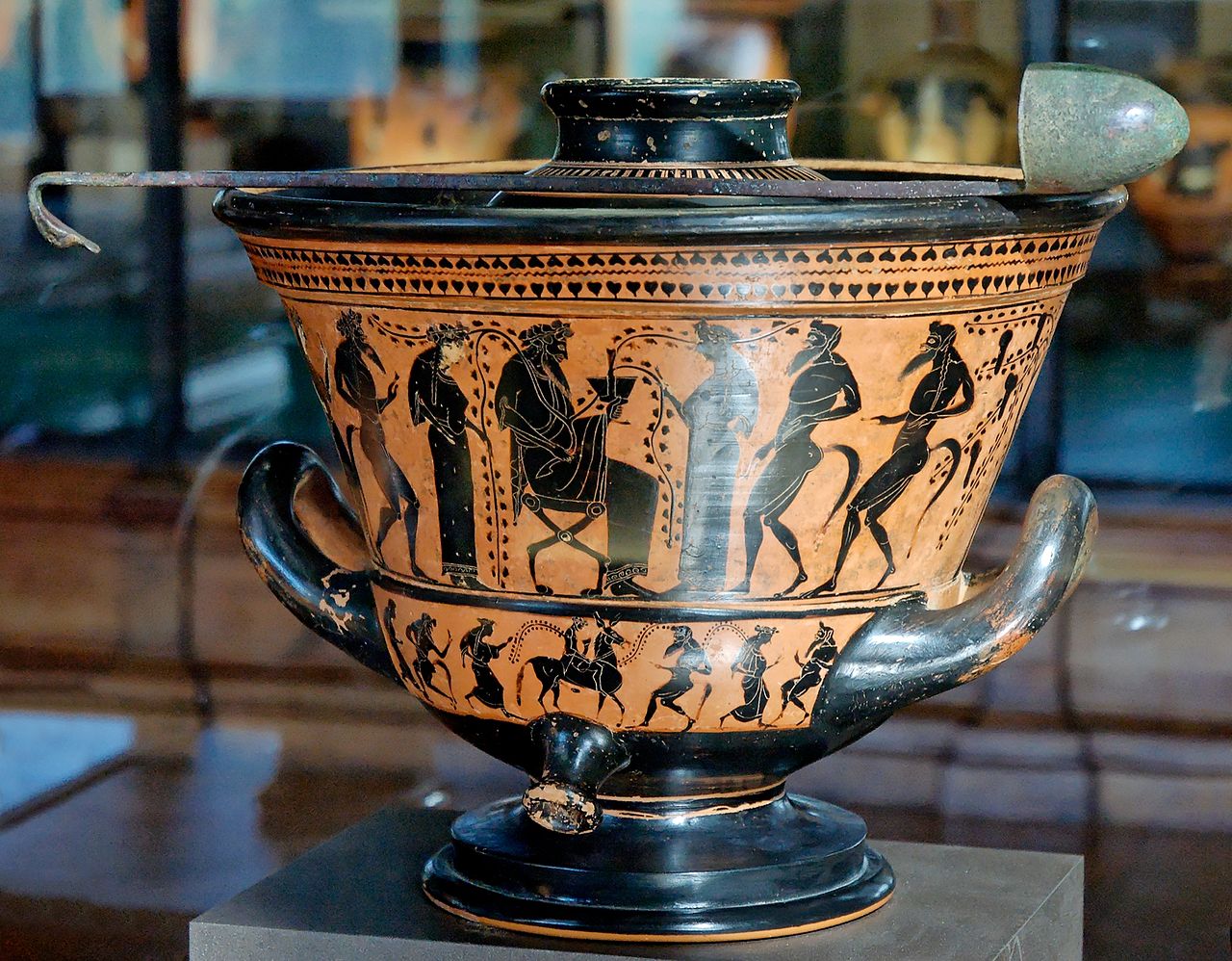
The psykter was an ancient Greek wine chiller that kept symposium wine cold through smart design and artistry.
Key Highlights
- The psykter was a unique mushroom-shaped vessel used in ancient Greece to cool wine for social events.
- Its name comes from the Greek verb “psycho,” which means to cool or chill.
- This clever pot worked by floating in a larger bowl, a krater, to chill the wine inside it.
- Psykters were a short-lived fad, popular mainly between 520 and 480 BCE.
- Many were painted with scenes of parties and myths in black-figure or red-figure styles.
- It was a sign of a host’s good taste at a symposium, but simpler cooling methods eventually made it obsolete.
In the vibrant world of the Athenian symposion, the elite drinking parties of ancient Greece, the quality of the wine was a direct reflection of the host’s status. However, in the Mediterranean climate, hosts who served lukewarm wine committed a social failure.
To solve this, Greek potters engineered one of the most curious and aesthetically striking vessels in history: the psykter.
Far from being a simple jug, the psykter was an ingenious “wine chiller” that utilized the principles of buoyancy and thermal exchange to ensure that the guests’ cups remained cold and refreshing throughout the night.
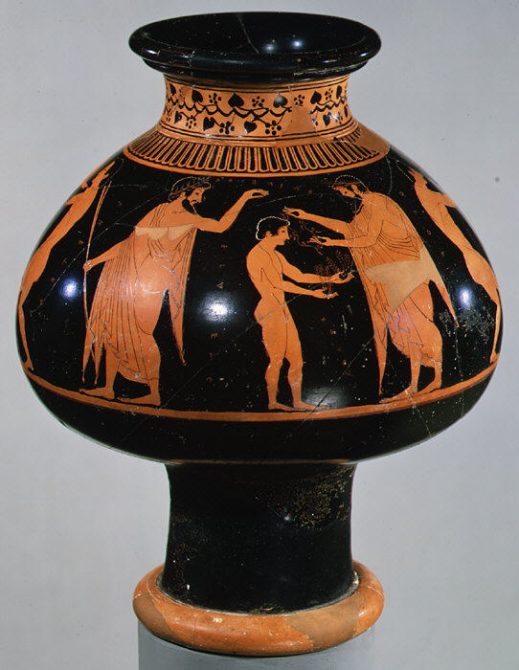
Terracotta psykter (vase for cooling wine), Greek, Attic, attributed to Oltos (ca. 520–510 BCE), The Metropolitan Museum of Art (acc. 10.210.18). Image via Wikimedia Commons, licensed CC0.
Psykter Info: Defining the Ancient Wine Cooler
To understand the basics of psykter info, one must first look at its bizarre, almost mushroom-like silhouette. Unlike most Greek vases which feature a wide base for stability, the psykter has a large, bulbous body that tapers down into a very tall, slender, and hollow cylindrical stem.
This design was entirely intentional. The vessel was crafted to float inside a much larger krater (a wide-mouthed mixing bowl). The stem acted as a weighted keel, allowing the bulbous body containing the wine to bob upright while surrounded by cold water or snow. This was the ancient world’s version of an ice bucket, though far more elegant in its execution.
What was Psykter Used For in Ancient Greece?
Essential Psykter Pottery Facts and Design
A deep dive into psykter pottery facts reveals that this was a highly specialized and short-lived vessel. The psykter appeared suddenly in Athenian workshops around 525 BC and remained popular for only about fifty years, disappearing by roughly 470 BC.
The ceramic engineering required for these vessels was substantial. Because they had to float, the walls of the vessel needed to be thick enough to be durable but balanced enough to remain upright. If the potter miscalculated the weight of the hollow stem compared to the wine-filled body, the vessel would capsize, spilling the precious wine into the cooling water, a disaster at any high-stakes social gathering.
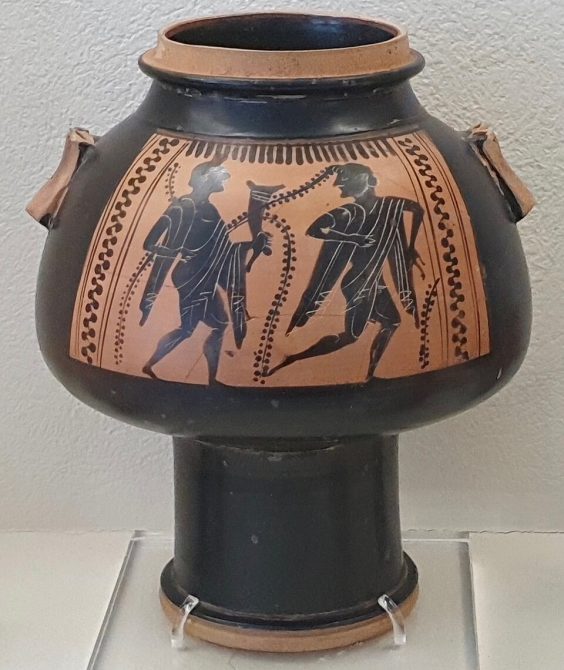
Psykter (vase for chilling wine) with depiction of revellers, 500–475 BC. Photo by Yair-haklai, CC BY-SA 4.0, via Wikimedia Commons.
Masterpieces of Psykter Art and Decoration
The psykter art we find today in museums like the Met or the British Museum provides a window into the Greek sense of humor and movement. Because the vessel floated and bobbed inside a krater, it naturally rotated. Greek artists took advantage of this “moving” canvas by painting continuous narrative friezes. As the psykter spun in the cooling water, the figures on the vase would appear to be chasing one another around the bowl. Common themes included satyrs, the wild, half-man followers of Dionysus, engaged in drunken revelry, or warriors locked in the chaos of the Gigantomachy.
Black-Figure vs. Red-Figure Psykters
The stylistic evolution of these vessels spanned the transition from Black-Figure to Red-Figure techniques. In Black-Figure psykters, artists etched silhouettes into the clay and often created sharp, iconic images. However, it was the Red-Figure style that truly brought psykter art to life, allowing for more fluid muscles and facial expressions on the dancing satyrs, making the vessel’s rotation even more lifelike.
The Social Status of the Psykter in the Symposion
Owning a psykter was a significant “flex” in ancient Athens. Because they were technically difficult to produce and served a very specific, luxury purpose, they were expensive. Including a psykter in your symposion signaled to your guests that you not only had the wealth to afford fine pottery but also the logistical means to acquire ice or snow, often brought down from the mountains at great expense. It turned the act of chilling wine into a performative art form, a centerpiece that sparked conversation as much as the wine itself.
Why the Psykter Disappeared from Pottery Workshops
Despite its ingenuity, the psykter eventually fell out of fashion. By the mid-5th century BC, historical records suggest that Greeks replaced the psykter with the “double-walled krater.” Potters built these kraters with a permanent internal chamber for the cooling agent, making them more stable and less likely to tip than a floating psykter. While more practical, these replacements lacked the whimsical, bobbing motion that had made the psykter the star of the party for two generations.
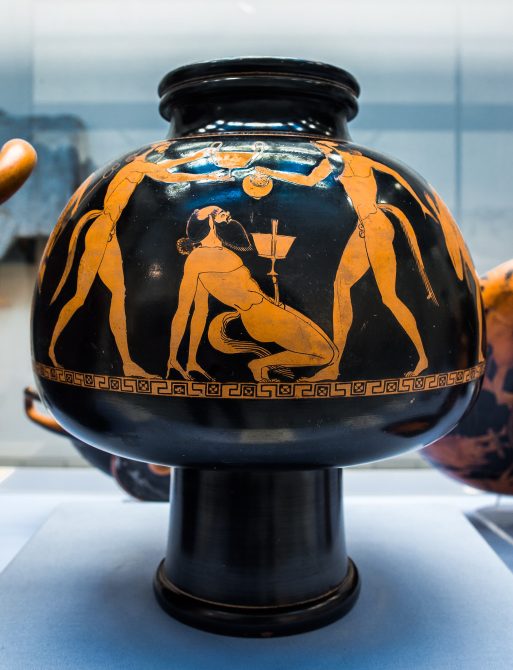
Attic red-figure psykter painted by Douris (ca. 490–480 BC), British Museum (1868,0606.7 / E 768). Photo by ArchaiOptix, CC BY-SA 4.0, via Wikimedia Commons.
Conclusion
The psykter remains one of the most fascinating artifacts of antiquity, a perfect intersection of ancient Greek technological ingenuity, social necessity, and artistic mastery. It proves that even thousands of years ago, the pursuit of the “perfectly chilled drink” was an endeavor that inspired great art and brilliant engineering. Today, these vessels stand in museums not just as jars, but as reminders of a culture that valued both the science of the cool and the art of the pour.
Feature Image by: “Crater psykter” (Louvre MNE 938), photo by Jastrow, Public Domain, via Wikimedia Commons.